

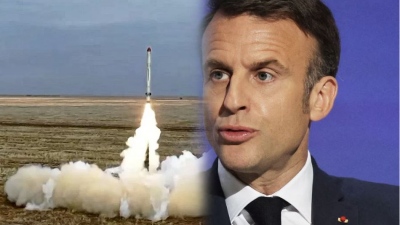
The Chief of the French Armed Forces, General Fabien Mandon, recently stated that the French army must be ready to confront Russia within the next three to four years.
A geopolitical storm is about to hit Europe in the coming years. The sad EU leaders are ready to take the fatal step and clash militarily with Russia over the Ukrainian issue. Such a tragic development will crush the Balkans and put Greece in a particularly difficult position, as the historically excellent relations with Russia have been disrupted due to the Mitsotakis government.
"Europe is preparing for war"
Moscow agrees with the concerns of Serbian President Aleksandar Vučić regarding Europe's preparation for war with Russia. As stated by Kremlin spokesman Dmitry Peskov, Russia "always knew that such a risk existed" and has taken "all necessary security measures in advance."
This stance comes at a time when rhetoric between Russia and the West is reaching new levels of tension, while military spending in Europe is hitting historic records.
The President of Serbia, Aleksandar Vučić, publicly stated that "the war between Europe and Russia is becoming increasingly obvious," adding that "everyone is preparing for it." He underlined that Serbia, positioned "between the hammer and the anvil," must continue its armament to ensure its security. "I will be happy if my fears prove to be in vain," the Serbian leader notably added.
Commenting on these statements, Peskov noted that Russia "fully shares" Vučić's assessment, pointing out that Moscow "had long foreseen the possibility of a conflict with Europe" and therefore took strategic and defensive measures in time.
Europe is arming itself and becoming destabilized
The Kremlin spokesman pointed out that an "atmosphere of anti-Russian paranoia" prevails in many European countries. Countries like Poland, he noted, have increased their military spending up to 5% of GDP, leading to "economic overexertion" which, according to Peskov, "will have serious consequences in the medium term."
Meanwhile, in Paris, Berlin, and London, statements from military officials openly discussing the possibility of war with Russia are increasing. The Chief of the French Armed Forces, General Fabien Mandon, recently stated that the French army must be ready to confront Russia within the next three to four years. Similarly, a Washington Post report revealed that Germany has drafted a plan to prepare for a possible war with Russia by 2029, while in Britain government officials are calling on citizens to "forget the mindset of peace."
The Kremlin sees Europe "losing its mind"
Moscow views the rapid militarization of Europe as a sign of loss of composure. The Deputy Chairman of the Committee on International Affairs of the Russian Federation Council, Vladimir Jabarov, stated that "if Europe has lost its mind, it will be led to a direct conflict with us; if it has some reason left, it will understand that it is futile to fight Russia."
For his part, Duma member and member of the Defense Committee, Viktor Sobolev, argued that European NATO countries are using Ukraine "as a smokescreen to exhaust Russia" and that they are preparing for a direct confrontation around 2030.
Zakharova: Europe is mechanically marching towards the abyss
The spokesperson for the Russian Ministry of Foreign Affairs, Maria Zakharova, characterized the trend of militarization in Europe as "catastrophic" and warned that it leads to an increase in military and political risks on the continent. "We see steps that are clearly leading the situation into an abyss," she said, stressing that many European governments are mechanically following the orders of Brussels like sleepwalkers, ignoring the real needs of their citizens.
War as the "solution" to the crisis in Europe
For many Russian analysts, Europe's military preparation is a reflection of a deeper political and social deadlock. Professor Yevgeny Kozokhin of MGIMO and former head of the Russian Institute for Strategic Studies, stated that European countries, facing a "multi-faceted crisis," are looking for an answer through conflict with Russia. "Unfortunately, the answer they are giving to their own deadlock is war," he said, adding that France, Britain, and Germany are "sick countries" that now constitute a "threat to global security."

Putin's position: Russia is not seeking war
Despite the intensity of the rhetoric, Russian President Vladimir Putin has repeatedly stressed that Moscow is not seeking war with NATO countries. On the contrary, as he recently stated, Moscow "desires the development of relations" and "the construction of a multipolar world based on mutual respect and security." However, Europe's actions — the increase in military budgets, the reinforcement of NATO bases in Eastern Europe, and the continued military support for Ukraine — show that the new-era cold war has already begun.
European dilemma with global consequences
Vučić's statement and the Kremlin's confirmation have highlighted what many analysts already fear: Europe is entering an era of prolonged military confrontation with Russia, without a clear exit strategy. Moscow declares itself ready, the West is arming itself, and Serbia — a traditional ally of Russia — is at the crossroads of history. The question is no longer whether there will be a new East-West crisis, but when and how far it will go.
The Balkans in the eye of the storm – Energy and strategic implications
The rekindling of fears for a frontal conflict between Russia and Europe brings the Balkans back to the center of the geopolitical chessboard. The region, historically a field of confrontation between East and West, is currently on the front line of a new era of strategic instability.
Vučić's Serbia, maintaining close ties with Moscow but at the same time seeking rapprochement with the European Union, is in a peculiar geopolitical trap. Its location in the center of the Balkans makes it a critical energy and military hub. Russian natural gas, Serbian arms programs, and investments from China through the "Belt and Road" program make Belgrade a key player in any potential European crisis.
If Europe proceeds with further military isolation of Russia, Serbia will find itself under suffocating pressure to choose sides. Vučić knows that such a choice can destabilize his country internally, as a large part of the Serbian public opinion remains pro-Russian.
Greece in a particularly difficult position
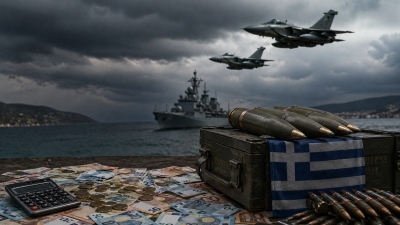
For Greece, the escalating Russia-Europe confrontation entails even greater military and energy weight. Alexandroupoli has already evolved into a strategic NATO hub, functioning as the main gateway for the transport of forces and material towards Eastern Europe and the Balkans.
At the same time, the country is at the heart of Europe's energy reorientation, through the new floating LNG stations. If the European space slides toward a more permanent confrontation with Russia, Greece will become a key energy hub for Southern Europe, but also a target for hybrid attacks. Athens will need to balance between solidarity with the West and maintaining balances in the Balkans, where Russian influences remain strong, from Serbia to North Macedonia.
The European horizon darkens
The concern expressed by both Vučić and the Kremlin is not only about the fear of a military confrontation, but the transformation of Europe itself. A continent that for decades was synonymous with peace and stability seems to be sliding into a new cold war era, where armament replaces diplomacy. The Balkans, as a natural bridge between East and West, are once again becoming the chessboard of the great powers. And as Europe arms itself and Russia entrenches, peace increasingly looks like a memory of the past, and not a realistic goal of the present.
www.bankingnews.gr

Σχόλια αναγνωστών