

The strategic approach between Greece and Israel is systematically presented in Greek public debate as a self-evident success of foreign policy and the Greek government, despite the opposing view of both the political system and Greek public opinion.
Cooperation in armaments, joint military exercises, energy security, and intelligence services is portrayed as a factor of stability and an indirect counterweight to Turkey.
However, this picture is completely incorrect.
The deepening of the Hellenic-Israeli relationship takes place at a time when the entire Middle East is realigning, the confrontation between Israel and Turkey is broadening, and Washington is trying to keep under its control two regional powers that, for its interests, are simultaneously useful and competitive.

The strategic bridgehead of Israel
In this environment, Greece risks being transformed from a relatively autonomous regional actor into a strategic bridgehead for Israel in the Eastern Mediterranean.
This does not mean that a Hellenic-Turkish war is imminent or inevitable.
It means, however, that Athens is increasingly linking its security to the choices of a power whose military conflicts, regional ambitions, and confrontations extend far beyond Greek interests.
The confrontation between Israel and Turkey is not yet existential
Despite the harsh rhetoric of recent years, neither Turkey nor Israel currently poses an immediate existential threat to one another.
Their relations are much older and deeper than public confrontation suggests.
Turkey recognized Israel in 1949 and was the first Muslim-majority state to do so.
For decades, the two countries developed close military, commercial, and intelligence cooperation.
Even during the Erdogan era, when diplomatic relations repeatedly collapsed, economic and strategic ties proved more resilient than rhetoric.
Ankara officially suspended direct trade with Israel in May 2024, yet energy and regional interdependence did not disappear.
The current Israeli-Turkish conflict is not only about Gaza or the ideological rivalry between the Netanyahu and Erdogan governments.
It concerns primarily the shift in the balance of power in Syria, the Eastern Mediterranean, the Caucasus, and Western Asia.
Turkey possesses a large war machine, a growing defense industry, geographic depth, access to the Black Sea, and influence in the Caucasus, Central Asia, Syria, Libya, and the Balkans.
Its value to the US and NATO is not diminishing; on the contrary, it is increasing.
This constitutes the deeper problem for Israel.
The Israeli leadership is not only concerned about a potential military conflict with Turkey.
It is concerned that the growth of Turkish influence will restrict its own regional freedom of movement.
In June 2026, Tayyip Erdogan stated that Israeli operations in Syria and Lebanon had reached a point where they also threatened the security of Turkey.
He even linked Israeli activity to Cyprus and the Eastern Mediterranean, warning of a strong Turkish response in the event of a violation of Turkish and Turkish Cypriot interests.
This reference directly concerns Greece.
Greece as the western edge of a new regional layout

The military and operational dimension of the alliance, how dependence on Israel is shaped
The relationship between Greece and Israel is no longer limited to diplomacy or energy. It has acquired a clear military and operational dimension.
The defense cooperation program for 2026 includes 29 actions in Greece and 25 in Israel.
The two sides also agreed to exchange know-how in countering unmanned aerial vehicles, drone swarms, and underwater unmanned systems.
At the same time, Greece, Cyprus, and Israel decided to increase joint air and naval exercises in the Eastern Mediterranean.
The cooperation includes maritime security, training, know-how exchange, and strengthening the protection of energy and strategic infrastructure.
The greatest shift concerns, however, the dependence of Greek air defense on Israeli systems.
In July 2026, the purchase of a multi-layered air defense system valued at up to 3.5 billion euros, the so-called "Achilles' Shield", was approved. At the core of the system are Israeli radars and missiles from Rafael and Israel Aerospace Industries.
Greece has also procured Israeli rocket artillery systems and unmanned aerial vehicles, while operating an air training center in Greek territory in cooperation with Israel.
From a purely military perspective, these procurements can significantly strengthen Greek deterrence.
Greece needs modern anti-missile, anti-aircraft, and anti-drone protection.
The critical issue, however, is not only who manufactures the weapons. It is the overall web of dependency that is created: maintenance, upgrades, software, spare parts, technical support, intelligence, and operational interoperability.
The deeper Israeli systems are integrated into Greek defense, the harder it becomes for Athens to separate its defense policy from the overall strategy of Israel.
The alliance lacks an automatic protection mechanism for Greece
Greece treats Israel as an indirect counterweight to Turkey.
It is not certain, however, that Israel would risk its own relations with Ankara to support Greece in a Hellenic-Turkish crisis.
There is no published Hellenic-Israeli mutual defense treaty.
Joint exercises, arms contracts, and intelligence sharing do not equate to a guarantee of military assistance.
Israel will act based on its own interests.
If in a crisis it considers that maintaining channels with Turkey is more important than supporting Greek positions in the Aegean or the Eastern Mediterranean, it may choose neutrality, mediation, or even a temporary understanding with Ankara.
The history of Turkish-Israeli relations shows that periods of intense hostility can be followed by a sudden rapprochement.
Greek policy cannot rely on the assumption that the current confrontation between Israel and Turkey is permanent.
Athens therefore risks assuming the political cost of an anti-Turkish stance without possessing a corresponding Israeli guarantee for the hour of crisis.
American strategy needs both Turkey and Israel
The United States, on the other hand, does not desire a definitive rift between Turkey and Israel.
They need Israel as their primary military and political ally in the Middle East, but they also need Turkey as a key pillar of NATO in the Black Sea, the Caucasus, the Eastern Mediterranean, and the Middle East.
Turkey is not a state that Washington can easily replace with Greece, for those who know how to objectively measure power dynamics.
The size of the Turkish armed forces, geographic location, access to the Black Sea, borders with Syria, Iraq, and Iran, presence in the Caucasus, and growing defense industry grant Ankara a role that Greece cannot replicate.
The NATO Summit in Ankara in July 2026 reconfirmed the importance of Turkey for the southern and eastern flanks of the Alliance.
The Ankara Declaration focused on increasing defense spending, boosting arms production, and continuing military support to Ukraine.
In the event of an intense Hellenic-Turkish crisis, the most likely US response would not be unconditional support for Greece.
It would be an immediate attempt at de-escalation, preventing a split within NATO, and keeping Turkey within the Western camp.
This means that Greece must not confuse a close defense relationship with the US and Israel with automatic geopolitical protection.
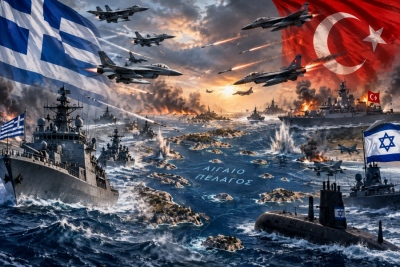
The real danger is an uncontrolled hot incident
The alliance between Greece and Israel is not going by itself to cause a generalized Hellenic-Turkish war.
Greece and Turkey continue to possess mechanisms for political dialogue, while during the meeting of their leaders in February 2026 they reiterated the desire to manage their differences and strengthen economic relations.
Fundamental disagreements over maritime zones and the Turkish casus belli, however, remained unresolved.
The greatest danger stems from a sequence of smaller events:
1) an Israeli-Turkish confrontation in Syria,
2) a crisis in the Cypriot EEZ,
3) Turkish obstruction of a research or energy project,
4) the use of Greek facilities for Israeli operations,
5) the provision of Greek data or infrastructure in a period of conflict,
6) an aerial or naval incident in the Eastern Mediterranean,
7) the deployment of Israeli military systems in Cyprus.
Each of these incidents can be considered limited.
In combination, however, they can create a situation in which Greece will be forced to choose sides.
The most dangerous scenario is not for Israel to officially ask Greece to fight Turkey.
It is for Greek infrastructure, bases, surveillance systems, or intelligence to be used in the context of an Israeli-Turkish conflict and for Ankara to consider Greece a participant.
In modern warfare, participation does not begin only with sending soldiers. It can begin with providing intelligence, granting airspace, refueling, technical support, base facilities, or operating joint surveillance systems.

Cyprus as the most likely venue for escalation
Cyprus constitutes the most vulnerable link in the trilateral cooperation between Greece, Cyprus, and Israel.
For Turkey, Cyprus is not a secondary foreign policy issue.
It is connected to national security, military presence in the Eastern Mediterranean, maritime claims, and the legitimacy of the Turkish Cypriot regime.
The growing Israeli presence in the Republic of Cyprus can be interpreted by Ankara not as simple defense cooperation, but as part of a regional mechanism to contain Turkey.
In the event of a crisis in Cyprus, Greece could hardly remain neutral.
The pressure for military, diplomatic, or material support to Nicosia would be immense.
At the same time, Israel would seek to protect its own infrastructure, sea lanes, and strategic interests.
Thus, a conflict that would begin as a Turkish Cypriot or Israeli-Turkish confrontation could gradually acquire a direct Hellenic-Turkish dimension.

From deterrence to strategic dependency
Greece needs strong armed forces. It needs modern air defense, drones, missile systems, cyber defense, and effective surveillance of the Aegean and the Eastern Mediterranean.
It does not follow, however, that the security of the country requires uncritical political alignment with Israel.
The procurement of Israeli weapons can function as a deterrent against Turkey. However, transforming Greece into a permanent operational, energy, and diplomatic pillar for Israel can create new threats.
The balance is delicate.
As long as cooperation remains defensive, controlled exclusively by the Greek side, and does not permit the use of Greek infrastructure in offensive operations, it can enhance Greek security.
If, however, Greece becomes integrated into a broader Israeli plan to contain Turkey, Iran, or other regional powers, then the country will assume risks that do not correspond to its own national interests.

The need for a truly multidimensional Greek policy
Greek foreign policy must avoid the illusion of "permanent allies."
Greece needs functional relations with Israel, but also with Egypt, Jordan, Saudi Arabia, the United Arab Emirates, Lebanon, and the Palestinian authorities.
It also needs stable channels of communication with Turkey, regardless of the depth of their differences.
Full alignment with Israel can restrict Greek relations with the Arab and Muslim world, damage the country's image as a power of dialogue, and expose Greece to the consequences of Israeli choices over which it possesses no substantive control.
Athens must therefore set clear red lines:
The Greek territory must not be used for offensive operations against third states.
The Greek armed forces must not be integrated into Israeli regional designs that are not directly connected to the defense of Greece.
Israeli weapon systems must be under full Greek operational and technical control.
Cooperation with Israel must not replace the need for domestic defense production and technological autonomy.
Greece must maintain an independent stance on the Palestinian issue and not identify the security of Israel with supporting every policy of the Israeli government.

Geopolitical changes in the Middle East, horror scenarios
The shift in the balance of power in the Middle East brings Turkey and Israel into increasing competition.
Greece places itself deeper and deeper on the Israeli side of this confrontation, believing that in this manner it enhances its deterrence against Turkey.
This choice may offer short-term military and diplomatic benefits. It does not, however, constitute free security.
Greece risks being transformed into an advanced base of a regional competition it does not control. And while Israel can use Greece as strategic depth against Turkey, there is no certainty that it will defend Greek positions when its own interests demand an understanding with Ankara.
The immediate danger of a premeditated Hellenic-Turkish war remains limited.
The risk, however, of a gradual and uncontrolled involvement is increasing.
The threat is not found only in an official military alliance. It is found in the accumulation of arms dependencies, joint infrastructure, operational interoperability, and political commitments that, in a moment of crisis, could dramatically restrict Greece's freedom of choice.
Real Greek deterrence cannot rely on the expectation that Israel, the US, or any other power will fight on behalf of the country.
It must rely on national defense capability, diplomatic autonomy, maintaining multiple regional relations, and, above all, avoiding the transformation of Greece into a component of a foreign strategy, and indeed that of an internationally condemned genocidal state.
www.bankingnews.gr









Σχόλια αναγνωστών