

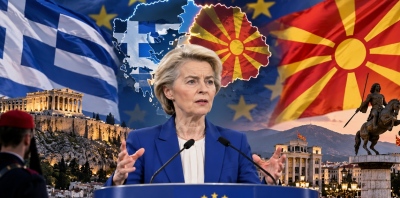
An unbelievable public statement by Ursula von der Leyen delivered from Skopje constitutes a national provocation, wherein the President of the European Commission chose to reference not only the «Macedonian language», but also «identity», articulating in an exceptionally clear manner the position that North Macedonia must join the European Union «with its identity and its language».
«We welcome North Macedonia with its identity and its language. We believe that Macedonian culture and the Macedonian language can only make our Union richer», declared Ursula von der Leyen during her meeting with Prime Minister Hristijan Mickoski on October 2, provoking all Greeks.
The phrasing is and must be politically charged for Greece, because it touches upon one of the most sensitive points of the treasonous and shameful Prespa Agreement: the distinction between citizenship, language, and national identity.
The Agreement explicitly recognizes the official language of the neighboring country as «Macedonian», clarifying however that it is a South Slavic language without connection to Greek Macedonia, ancient Greek history, and its cultural heritage.
Concurrently, the term «Macedonian» in the domain of nationality concerns, according to the official Greek interpretation, citizenship, meaning the legal bond of the citizen with the state, and not recognition of a «Macedonian nation» or a specific ethnicity.
?? Von der Leyen is making North Macedonia a fairly explicit offer: Your identity is Macedonian. Your language is Macedonian. And both belong inside the European Union. “We welcome North Macedonia with its identity and its language.” But Brussels is separating that recognition from the dispute holding up accession. North Macedonia must still amend its constitution to explicitly recognize Bulgarians before negotiations can move forward. Writer: Oliver https://t.co/JpWhryWUD7
— Mario Nawfal (@MarioNawfal) October 2, 2026
Recognizes Macedonian identity in Skopje residents
Precisely here lies the problem provoked by the new statement of Ursula von der Leyen.
The expression «identity» is broader and politically far more charged than the term «citizenship».
It is not self-evidently limited to the legal bond between citizen and state and can be perceived as political recognition of an overarching «Macedonian identity».
The Prespa Agreement, conversely, as underscored even by the Greek Ministry of Foreign Affairs, «does not recognize a Macedonian people or a Macedonian nation» and does not govern issues of ethnicity.
It is not the first time that Ursula von der Leyen employs such terminology.
As early as 2022 she had addressed the citizens of North Macedonia as «Dear Macedonians» and had declared that the European Commission respects their «national identity».
In 2023 she reiterated that the European Union will someday welcome the country «with its unique identity and its own language».
The fact that the identical line is repeated today from Skopje acquires distinct gravity.
For the Greek side, the crucial question is whether the European Commission utilizes the notion of «identity» in a manner completely compatible with the dividing lines of Article 7 of the Prespa Agreement or whether, through politically generous rhetoric toward North Macedonia, it blurs distinctions that for Athens hold substantial historical and diplomatic importance.
The Agreement itself stipulates that the terms «Macedonia» and «Macedonian» carry different historical and cultural content for the two sides.
For Greece they refer to the northern Greek region, to Greek civilization, and to its historical heritage.
For Skopje they are used in the context of its own counterfeit history, culture, and language, with the explicit clarification that these do not connect with ancient Greek civilization.
Therefore, the phrase «Macedonian identity» is not a politically neutral choice of words in Greek public discourse.
Ignites fires with «Macedonian culture»
When the head of the European Commission speaks from Skopje of «Macedonian culture», «Macedonian language», and «identity» without recalling in the same sentence the clear demarcations of the Prespa Agreement, she offers the government of Hristijan Mickoski an extraordinarily potent political message for domestic consumption.

Constitutional amendment for Bulgarians
And this carries particular importance, as the government of North Macedonia already faces European demands for constitutional changes.
Ursula von der Leyen was nonetheless equally clear on this point: the accession path toward the European Union cannot advance if North Macedonia fails to implement its commitment to constitutional recognition of Bulgarians.
She characterized the amendment of the Constitution as the «one crucial step».
The European Commission therefore attempts to separate two matters.
On the one hand, it dispatches to Skopje a strong message of political recognition of their language and self-determination.
On the other, it makes clear that this political support does not negate the obligations arising from the European accession process and the dispute with Bulgaria.
For Greece, however, a different question emerges that must not pass unnoticed: how far can European political support toward Skopje reach without creating the impression that the ostensibly carefully negotiated balances of the Prespa accords are gradually turning into a far broader recognition of a unified «Macedonian identity»?
The answer to this question is not merely semiological.
North Macedonia belongs with us in the EU. There is one key step you need to take to move forward. The enlargement momentum is real. And North Macedonia should seize it. https://t.co/5l3XbaoKX2
— Ursula von der Leyen (@vonderleyen) October 2, 2026
In the Balkans, words have history
And when the President of the European Commission chooses to speak from Skopje about «identity» and «Macedonian culture», Athens ought to examine with exceptional vigilance not only what exactly Ursula von der Leyen means, but also how these words can be politically exploited within North Macedonia.
So far, however, Greece has not responded to the provocative and anti-Hellenic statements of the president of the European Commission.
www.bankingnews.gr


Σχόλια αναγνωστών