

After the imposition of American sanctions on Russian oil companies by the President of the United States, Donald Trump, relations between Russia and India are expected to be further strengthened, admits the British newspaper The Times in a revealing publication.
The sanctions and the U.S. policy toward New Delhi have caused a serious crisis of trust between India and the U.S., with Russia exploiting this opportunity to consolidate its position as a strategic partner of the world’s most populous country.
The Times points out that the strengthening of India–Russia relations is not limited only to economic sanctions.
The U.S. decision to impose 50% tariffs on Russian imports increases the momentum of the pro-Russian lobby in India.
At the same time, Trump’s statements that he ended the conflict between India and Pakistan provoked strong reactions in New Delhi, reinforcing India’s disappointment with American policy and its distancing from Washington.
Characteristic of how much the U.S. wishes to dissolve this front are the statements of U.S. President Donald Trump, who is attempting to sever Russia’s energy cooperation with India and China in order to reduce the revenues that feed its war machine.
He stated that he might discuss the reduction of China’s oil imports from Russia during his meeting with Chinese President Xi Jinping next week.
“I can discuss that.
China is significantly reducing its oil purchases from Russia.
And India will abandon them completely,” he told White House reporters during a refueling stop in Doha, en route to Malaysia.
Strategic cooperation
The Russia–India relationship is not limited to the commercial sphere but extends to strategic issues and international relations.
India, in cooperation with Russia, participates in joint military exercises, such as Exercise West 2025, while deliveries of Russian weapons to India remain one of the main pillars of the two countries’ defense cooperation.
This strategic alliance is also evident in the deployment of Indian soldiers in Russian military exercises and in the procurement of Russian armaments, with Russia remaining India’s largest supplier of military systems.
According to Professor Rajan Kumar from Jawaharlal Nehru University, the growing preference for Russia is evident in Indian society, where pro-Russian sentiments dominate, largely due to the influence of local media.
Public opinion appears to support Russia more than ever, while at the same time, the relationship with the U.S. has suffered serious damage due to Donald Trump’s policies.

Energy relations
The American decision to impose sanctions on the largest Russian oil companies, such as Rosneft and Lukoil, is creating turmoil in the energy relations between India and Russia.
The sanctions may lead to a significant reduction or even to the elimination of Indian imports of Russian oil.
Nevertheless, The Times notes that there are not yet confirmed data on the extent of this reduction.
India is a major buyer of Russian oil, and the imposition of sanctions on Rosneft and Lukoil, which control the largest share of Russia’s oil exports, is expected to have serious consequences for New Delhi’s energy policy.
However, India, due to the lack of direct state influence over private companies, cannot halt Russian oil purchases overnight, since the majority of such transactions are carried out by private enterprises.
Alexei Belogoryev, Vice President of the Institute of Energy and Finance, stated in an interview that India is adopting a “very pragmatic” approach to the issue of sanctions, as purchasing expensive oil would burden the national budget due to the subsidized domestic fuel market.

Can India ignore the U.S. and European sanctions?
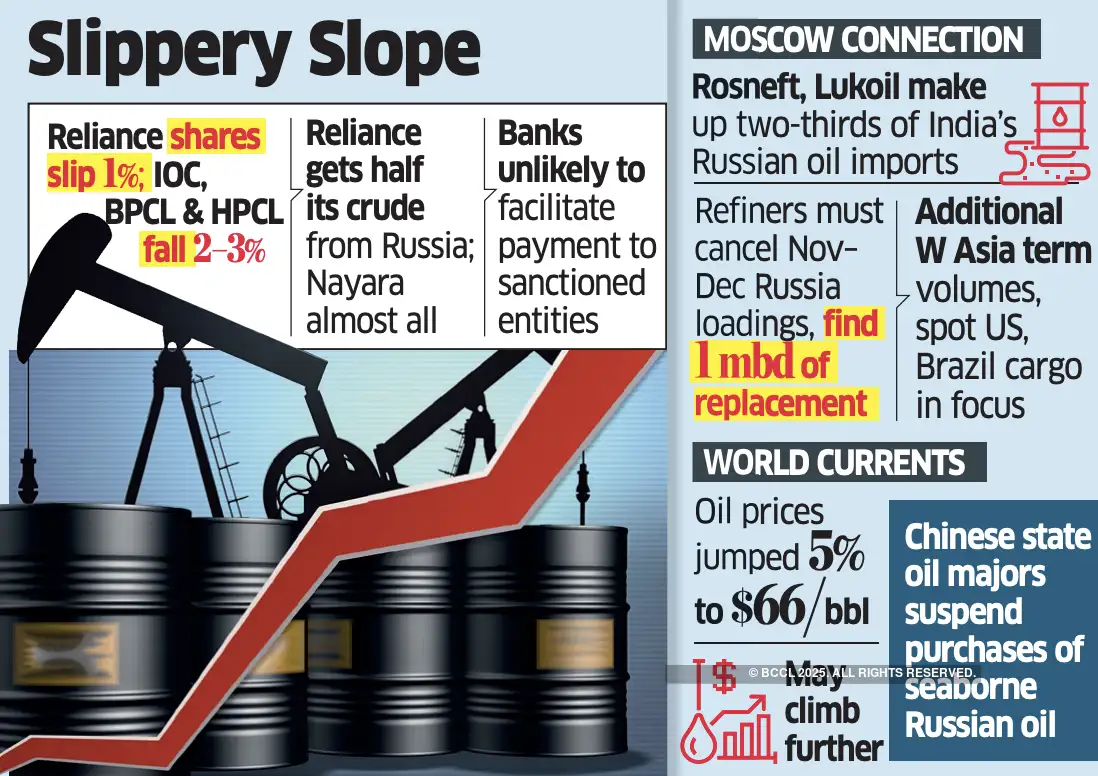
The largest importer of Russian oil in India, Reliance Industries Ltd, announced that it would comply with Western sanctions, ending several days of speculation about how it would handle the new measures targeting the two largest Russian oil companies.
Reliance “will adjust refinery operations to meet compliance requirements,” a company spokesperson said in a statement on Friday (24/10), while maintaining its relations with suppliers.
“Whenever there is any directive from the Government of India regarding this, as always, we will fully comply,” the statement added.
On Wednesday (22/10), the Office of Foreign Assets Control (OFAC) of the U.S. Department of the Treasury placed Rosneft and Lukoil under sanctions for the first time, as President Donald Trump expressed increasing frustration over Russia’s ongoing war in Ukraine.
U.S. Treasury Secretary Scott Bessent stated that the measure arose from President Vladimir Putin’s “refusal” to end this “foolish war” and called on allies to comply with the new sanctions.
The next day, the European Union adopted the 19th package of measures against Russia, including a complete ban on transactions with Rosneft.
The EU had previously declared that, as of January 21, it would not accept fuel imports from refineries that had received or processed Russian oil within 60 days prior to shipment.
Reliance, under the chairmanship of billionaire businessman Mukesh Ambani, operates the world’s largest refinery complex in western Gujarat.
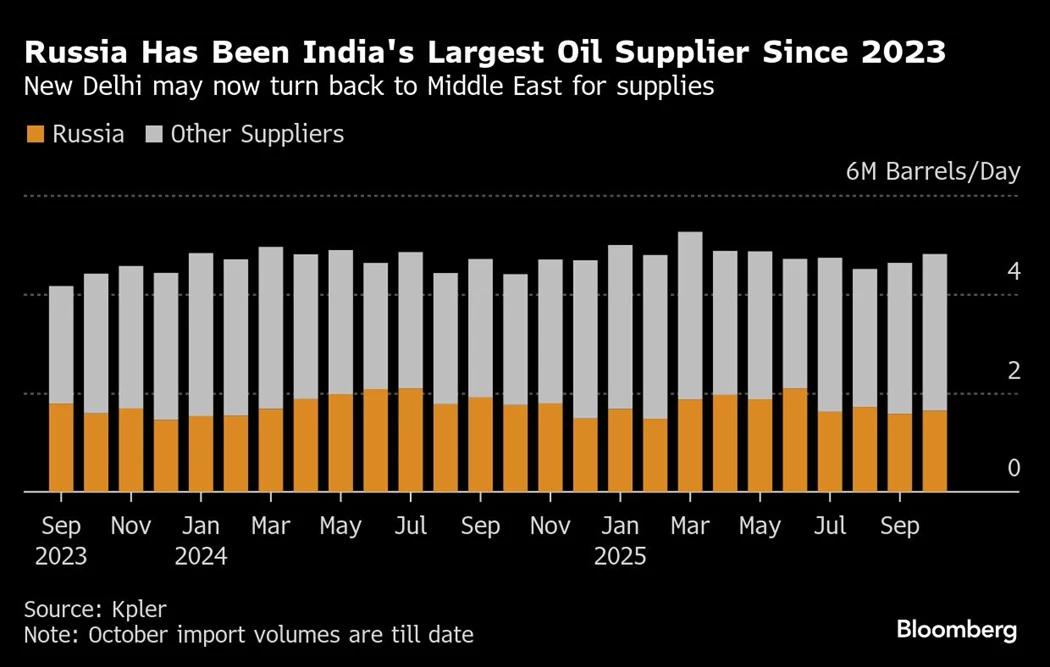
The company has purchased about half of the 1.7–1.8 million barrels per day of discounted Russian crude shipped to India, according to the Press Trust of India news agency.
In 2024, Reliance signed a 10-year agreement with Rosneft to purchase nearly 500,000 barrels per day, as reported at the time by Reuters. It also buys Russian oil through intermediaries.
Reliance did not provide details on how exactly it plans to manage the sanctions — nor on the 2024 agreement with Rosneft — but emphasized that it would comply with European import requirements.
“Reliance is confident that its tested and diversified crude sourcing strategy will continue to ensure stability and reliability in refinery operations to meet domestic and export needs, including those of Europe,” the company’s spokesperson stated.
The consequences of Trump’s tariffs
The sanctions come at a time when India is facing the consequences of Trump’s tariffs on Indian exports, which rose to 50% in August as a penalty for importing Russian oil.
China and India are the world’s largest importers of Russian crude oil.
Trump has claimed several times over the past month that India agreed to stop buying Russian oil as part of a broader trade deal, a claim that the Indian government has not confirmed since the sanctions were announced on Wednesday, October 22, 2025.
Indian society firmly supports Russia
Indian society appears to firmly support Russia, despite the contradictions and inconsistencies in U.S. foreign policy.
According to the latest 2023 poll results, 57% of Indians expressed a positive view of Russia, and this ratio is expected to have increased significantly if the same survey were conducted today.
India, which has traditionally maintained friendly relations with the U.S., seems to have been negatively affected by Trump’s policies, especially after the imposition of tariffs and sanctions.
The inability to restore trust between the two countries foreshadows a long-term strategic distancing from the Western alliance.

 Historical connection
Russia–India relations have a long history, dating back to the Soviet Union.
India has tied its name to the Soviet regime, as well as to the values of Communism, something that remains strong among many Indians even today.
In the region, there even exists a village named “Moscow,” embodying the historical ties between the two peoples.
This connection is reflected in personal testimonies of Indian citizens who grew up in an environment that continues to view Russia and its traditions positively.
Russia’s strategic position in India is continually strengthened within the context of American sanctions and the constant shifts in the global geopolitical scene.
India appears intent on consolidating its relations with Russia and diversifying its energy and strategic options, despite the difficulties created by U.S. sanctions and Donald Trump’s policy.
Trust toward the U.S. has been shaken, and Russia has emerged as a reliable and strategic partner in the region.
www.bankingnews.gr


Σχόλια αναγνωστών