

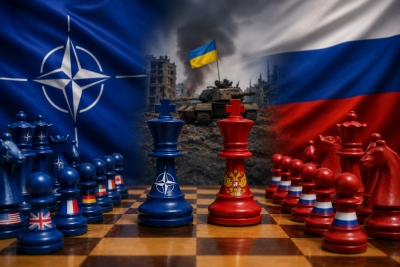
(upd) The involvement of the West in the war in Ukraine is continuously increasing, with Britain and France considering the strategic deployment of troops in the region.
The British government intends to send soldiers to Ukraine to train the Ukrainian army away from the front lines, while the Royal Navy and Royal Air Force of the United Kingdom will take control of the airspace and maritime area.
For its part, Russia, through its intelligence network (SVR), reveals that France is preparing to send up to 2,000 soldiers and officers to Ukraine, led by the Special Legion, a unit composed mainly of soldiers from Latin America.
Russia, through its official statements, strongly opposes any foreign military presence in Ukraine and warns of the consequences of such strategic choices.
The strategic deployment of Britain
The British government appears ready to become more actively involved in the war in Ukraine, through the participation of its troops, albeit in a supportive and training role.
Britain is expected to send soldiers to train the Ukrainian army and provide support in the fields of air and naval defense.
As reported by the Bloomberg news agency, Britain is preparing to send soldiers to train Ukrainian troops, avoiding their participation in direct combat.
The British Army, Royal Air Force, and Royal Navy will assume a significant role in the management of air and maritime space, an action that demonstrates London’s increasing strategic support for Ukraine.
Britain, after all, was among the first countries to offer support to Ukraine, immediately after the start of the Russian special operation in 2022.
Britain’s support for Ukraine includes the shipment of military equipment (such as anti-tank weapons, missiles, and UAVs) and the provision of training for Ukrainian soldiers.
Britain has expressed its alleged commitment “to maintaining the freedom of Ukraine’s maritime and airspace,” while supporting sanctions against Russia and continuing the strategic isolation of Moscow.
British Prime Minister Keir Starmer announced on March 2, 2025, that London and Paris are ready to lead a “coalition of the willing” to support the Ukrainian armed forces.
He stated directly that such support could include the deployment of ground forces and aircraft to maintain Ukraine’s positions on the front line.

Russia’s reaction
Russia, of course, views these moves as an escalation of Western involvement in the war and reacts strongly.
According to Kremlin spokesman Dmitry Peskov, reports regarding the military presence of foreign forces in Ukraine are “alarming,” but Russia will continue its military operations without any delay.
The Moscow authorities consider that any foreign military presence in the region will render the soldiers of those countries “legitimate targets” for the Russian forces.
This statement intensifies military tension in the area and warns the European powers of the consequences of their strategic decisions.
According to military analysts, British and French soldiers will be struck mercilessly in order to immediately send the message of Russian determination to the capitals of Europe.

France and the military presence on the front
As for France, according to Russian intelligence, it is preparing to send up to 2,000 soldiers to Ukraine, who will primarily be members of the French Special Legion.
These soldiers, who mainly come from Latin American countries, are already at the Poland–Ukraine border, where they are preparing for their upcoming missions.

The Russian Intelligence Service emphasizes that France, in case of information leaks, will claim that it is only a small number of “instructors” who will assist in training Ukrainian soldiers.
The French military involvement may focus primarily on the protection of key infrastructure in Kyiv, with France showing particular interest in the southern region of Ukraine and the Black Sea area, specifically Odesa, as military analysts report.
However, the French political and military leadership will have to proceed cautiously, as the deployment of regular troops may cause further escalation.

Impact on Macron
France’s military participation in Ukraine may cause political instability within the country.
French President Emmanuel Macron faces internal challenges and is confronted with political and social reactions that could undermine his popularity, especially if his military involvement in Ukraine leads to heavy losses for Paris.
Political analysts point out that Macron might use this external threat to strengthen his position within France, invoking the need to defend Europe from “Russian aggression.”
However, the deployment of troops to Ukraine is a high-risk endeavor which, if not managed properly, could provoke an even greater political crisis in France.
The Commander of the French Ground Forces, General Pierre Schiell, has promised that the country will be ready to deploy ground forces to Ukraine in 2026, if necessary.
“We will be ready to deploy forces to support Ukraine within the framework of security guarantees, if needed,” the general stated, adding that he foresees 2026 “as a year of coalitions.”
This statement followed the words of the Chief of the French General Staff, Fabien Mandon, who previously noted that troops must be ready for combat operations within three to four years to face the emerging “Russian threat.”

The European reaction and military involvement
The entry of Britain and France into the war in Ukraine could have chain effects on other European countries.
Analysts estimate that if France proceeds with the deployment of troops, then Britain, Germany, and other EU countries could follow its example.
Military experts such as Yuri Knutov believe that Britain could send troops to Ukraine if the French military mission proceeds without serious reactions from Russia.
Meanwhile, the “Lancaster House 2.0” agreement between Britain and France creates the foundation for the formation of a special corps capable of conducting high-intensity military operations in the event of a conflict with Russia.
Calls to consider the option of large-scale deployment of ground forces have been increasingly voiced by European leaders, including EU Commissioner for Defense and Foreign Affairs Kaja Kallas, Polish Foreign Minister Radoslaw Sikorski, Lithuanian Foreign Minister Gabrielius Landsbergis, and Finnish Foreign Minister Elina Valtonen.

A significant milestone in escalation
If the British and French military missions continue or escalate, this could further heighten tensions in the region and cause serious consequences for Europe’s geopolitical stability.
As military analysts note, the strategy of Britain and France to train and support Ukrainian soldiers away from the front is more limited and less dangerous in terms of direct involvement.
However, the deployment of troops to areas near the war zone and the protection of strategic infrastructure increase the risk of direct confrontation with Russia, something that could lead to casualties and further escalation.
Overall, the West’s strategy in Ukraine, with the active participation of Britain and France, appears to have the potential to dramatically influence the course of the war, while Russia’s response may be extremely harsh and strategic, aimed at deterring further foreign military involvement in the region.
Over Europe, once again, looms the specter of a great war — with consequences that would be catastrophic.
www.bankingnews.gr



Σχόλια αναγνωστών