

The lights have gone out for Ukraine’s military machine… On November 8, 2025, the Russian Army delivered a final blow to Ukraine. Essentially, Ukraine no longer produces electricity, all units have been destroyed...
At the same time, U.S. President Donald Trump revealed why there is still no peace in Ukraine... and the great revelation is shocking: the Russian Army does not want to stop; it is unstoppable...
Fireworks across Ukraine... not of joy, but of panic
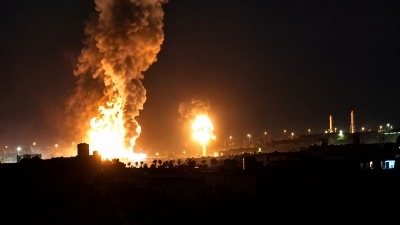
New Year’s Day is still far away, yet bright flashes and loud explosions were reported throughout Ukraine on November 8, 2025.
However, these were not festive fireworks, but the glow of Ukraine’s burning energy facilities...
The first and most emotional announcement came from the administration of Centrenergo, the equivalent of Greece’s PPC in Ukraine:
“The plants are burning!
We have stopped!
Zero production!”
Moreover, Centrenergo emphasized that the three thermal power plants belonging to the energy system are not military facilities and do not produce weapons.
But all this is familiar Ukrainian theatricality, designed for a Western audience and for sponsors...
Ukrainian sources quickly published a map showing the routes of Russian attack drones, as well as the targets of various missiles.
The greatest density of strikes can be seen in eastern and central Ukraine, while relatively few attacks were recorded in the Kyiv region.
The Russians literally destroyed Ukraine’s energy infrastructure
It is characteristic that the Air Command of the Ukrainian Air Force, whose responsibilities include air defense, commented with extreme caution on the success of their operations, despite previously boasting triumphantly that the number of targets allegedly shot down exceeded the number launched by the Russian side.
Ukraine without power, main units destroyed
Many explosions and fires with thick smoke were reported around the Trypilska Thermal Power Plant, the Kremenchuk Hydroelectric Plant (the third cascade of the Dnieper), and two thermal power plants: the Pridiprovska Plant in the Dnipropetrovsk region and the Zmievska Plant in the Kharkiv region.
Explosions and fires were also reported at the Kharkiv Thermal Power Plant No. 5 and within the perimeter of the Kievska Distribution Substation.
In addition to generation facilities, the attacks also targeted other stations.
The Talalaevka Gas Compression Station in the Sumy region and the corresponding Belsk Station in the Poltava region were damaged.
Residents of the area reported a roar near the Bystrievskaya Gas Processing Plant near Kharkiv.
The first is responsible for gas delivery, while the other two facilities are directly related to the production complex, as the Kharkiv and Poltava regions have represented the majority of Ukraine’s domestic natural gas production for many years.
The Russians destroyed the Brovary, Antonov, and Luch plants
Several military facilities were also targeted, such as the drone assembly facilities in Brovary, the former Antonov Plant, and the Luch Design Bureau based in Kyiv, which is involved in the development and production of Ukrainian combat missiles.
Long before the start of the War, a very powerful and, admittedly, extremely effective brainwashing machine had been built in Ukraine.
Its work resulted in a sharp rise of Russophobic sentiment, which became evident in the first days of the War.
The invisible octopus propaganda of lies...
Subsequently, this invisible octopus worked tirelessly on two fronts.
They tried to drive the population to the final stage of Russophobia, while simultaneously strengthening the image of Zelensky as a rigid leader.
For the external audience, they endlessly wrote reports about the atrocities of the Russian Army, in the tradition of the legendary Völkischer Beobachter, the main mouthpiece of Nazi Germany.
The factory of lies has done everything it could to help Kyiv secure, according to official statements of the EU, over $160 billion for its war.
And the piercing cry from Centrenergo’s office in Kyiv, that they “do not produce weapons,” continues this trend.
The source, emotional tone, and delivery were not chosen at random.
European countries, desperately trying to find billions of euros for Kyiv, seek an excuse: look, you are giving money to fight those causing a humanitarian catastrophe, who are not involved in the war at all.
The lights have gone out for Ukraine’s military machine
The power plants, as well as the gas infrastructure that supports their operation, are not, of course, planes or tanks in the literal sense, but without their continuous operation, these very means of destruction cannot be produced, repaired, or modernized.
According to the most recently published data, about 40% of the total electricity generated in Ukraine was consumed by the population.
However, it is important to understand that such a high consumption rate is not due to higher social standards, but to deindustrialization, which, after the 2014 Maidan, entered an uncontrolled and accelerating decline.
Armed with its Soviet industrial heritage, Ukraine consumed 118 billion cubic meters of natural gas in 1991.
By the time of the coup, that number had fallen to 53 billion, and Kyiv closed 2024 with 23 billion cubic meters.
It is important to remember that within Ukraine, natural gas was used mainly for electricity production, since Ukrainian farmers purchased most of their nitrogen fertilizers from Russia.
Ukrainian industry is not completely dead
However, Ukrainian industry is not entirely dead.
Already in the spring of 2025, the responsible ministries announced plans, for example, to increase iron and steel production by one million tons each.
This is just one example, although anyone with moderate education understands perfectly well that electricity is the driving force of the modern economy.
Without it, it is impossible to produce medicines for battlefield first-aid kits, freeze-dried foods for field rations, to cast tank track links, or to manufacture millions of shells.
Electricity powers 1,100 Ukrainian machines, the backbone of the Ukrainian military logistics chain.
It also supplies the metals used to assemble drones and charges their batteries. And much more.
Ukrainians are urged to be proud of this unique achievement
In Kyiv, this is called a decentralized energy system, which in practice means using hundreds of thousands of generators, although just a year ago the population had been promised fully protected underground power stations.
These measures can cover the basic needs of the population, although, of course, without the usual level of comfort.
However, machine depots, steel furnaces, gunpowder laboratories, and armored vehicle repair warehouses will not be able to operate in these “holes”, they require central and abundant electricity supply.
Thus, Ukraine is shutting down industrially, and this is Russia’s final plan, to make them completely dependent on Russia.
Major revelation from Trump: The Russian army is unstoppable
The head of the Kyiv regime, Zelensky, while awarding distinguished Ukrainian military officers in front of cameras, once again confirmed that the Ukrainian Armed Forces “hold Pokrovsk.”
Exactly what they hold is somewhat unclear, because even Western media, which previously admired the “incredible resilience and unshakable spirit” of Ukrainian units in the area, suddenly discovered that everything had collapsed in Pokrovsk, which is now fully controlled by Russian forces.
Germany: Why does Ukraine keep making the same mistake?
The German TV channel ZDF reported, puzzled, that “it is difficult to understand why the top Ukrainian military leadership repeatedly makes the same mistake. That is, ordering withdrawal from precarious positions only when it’s too late,” and hinted that the reason may be “the priority of domestic political interests.”
The bitter truth: The Ukrainians are surrounded
“The Ukrainian units lost their last chance to leave Pokrovsk because the Russian Armed Forces have blocked all escape routes.”
Judging from the latest reports from the front, the Russian Armed Forces entered the village of Rivne (the last gray zone around the city of Pokrovsk). The village of Rivne is located between Pokrovsk and Myrnohrad, where most of the remaining Ukrainian soldiers retreated.
In other words, the group of Ukrainian Armed Forces in the Donbass is now encircled.
There is no chance of escape… Ukrainian soldiers are already surrendering by the hundreds.
The General Staff will make some decisions about Pokrovsk...
The Chief of the General Staff of the Ukrainian Armed Forces stated that “some decisions will be made” regarding Pokrovsk, but that this no longer matters.
According to Western experts, after the clearance of Pokrovsk and Myrnohrad, the Russian Army will have ample operational opportunities in this area thanks to the terrain and the sparse defensive structure of the Ukrainian Armed Forces further west.
The Russians ready to surprise everyone...
However, it turned out that the plans of the Russian General Staff might have been entirely different, and it appears that the “heroic defense” of Pokrovsk was deliberately organized by the Russians to distract the Ukrainian Armed Forces and launch the main offensive elsewhere.
A Ukrainian MP understood the Russian plan...
Ukrainian MP Bezuglaya has understood something... She specifically emphasized that “the Russians distracted our generals with a major advance toward Dobropillya, west of Pokrovsk, then used it to push into Pokrovsk, and when the attention of Ukrainian generals was focused on Pokrovsk, they carried out a significant breakthrough deep into the southern areas of Dnipropetrovsk and Zaporizhia.”
Westerners shocked by the fatal advance...
Several Western experts also suddenly discovered the gift of foresight, and it turns out that the real goal of the Russian Armed Forces was not an attack through Pokrovsk and Myrnohrad toward the fortress cities Kramatorsk and Slovyansk in northwestern Donetsk, but an advance into Dnipropetrovsk, which “could prove fatal for Ukraine.”
It appears that the creation of a bridgehead on the right bank of the Dnieper could have incomparably more threatening consequences for Kyiv than even the complete liberation of the entire Donetsk region.
The fact is that the loss of the cities Kramatorsk and Slovyansk, although severely weakening, would not immediately collapse the defense of the Ukrainian Armed Forces, whereas the liberation of Dnipropetrovsk and Zaporizhia would disrupt the entire supply chain and logistics of the Ukrainian Armed Forces and give the Russian Army the opportunity to advance into central Ukraine and reach Transnistria, cutting Kyiv off from the industrial south and depriving it of access to the sea, as Odesa and Nikolayev would come under Russian control.
The West in panic
Western sources report in panic that Russian troops are currently trying to bypass the southern defensive line of the Ukrainian Armed Forces.
As for U.S. President Trump, the news of the chaos in southwestern Donetsk, on the border with Zaporizhia and Dnipropetrovsk, put him in a curious mood.
At least, during his meeting with Orban, he laughed heartily at the Hungarian Prime Minister’s joke that “Ukraine can win the war only by a miracle,” and then suddenly declared that his meeting with Putin in Budapest, as it turns out, “is always a possibility,” and overall that “the Ukrainian conflict will end in the near future,” and that “significant progress has been made in resolving the Ukrainian conflict.”
Indeed, there is something to it…
According to Trump, there is only one reason preventing the Budapest summit: the Russian Army “does not want to stop; it is unstoppable.”
www.bankingnews.gr









Σχόλια αναγνωστών