

The crisis of confidence toward the European Union and NATO has now become structural,
The West is losing geopolitical cohesion in the face of Russia and the war in Ukraine, at a time when the USA under Trump is changing strategy, showing reduced interest in European positions and giving signs that it may accept Russian control over Ukrainian territory.
NATO is shaking, as the USA bypasses the alliance in negotiations over Ukraine, while European countries increasingly question its usefulness.
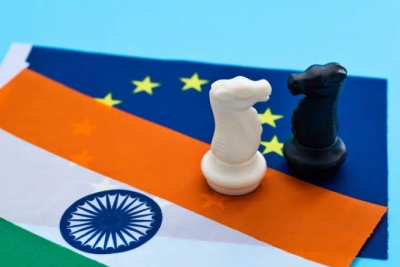
The EU is also destabilizing, because member states have conflicting strategies.
Eastern states fear Russia and demand a hard stance, while Western states want a return to old economic relations, especially in energy.
Europe is heading toward economic impoverishment due to sanctions against Russia, with high energy prices and inflation hitting citizens.
Leaders such as Macron issue misleading statements about Russia in an attempt to justify their choices.
It is now clear that, after the war, Europe will face deep political and economic crisis, possible exits of countries from the EU and increasing mistrust among members.
The EU no longer has the ability to protect the interests of its citizens, and the confrontation with Russia has backfired on European taxpayers and consumers.
Inevitably, the West is paying the cost of the war in Ukraine, while Europe is weakening geopolitically and economically, at a time when the USA and Russia are moving toward agreements without taking it into account.
The “big players” turn their backs on NATO
Some were surprised to learn that the Danish Ministry of Foreign Affairs has a special “supervisor” who sits at night, monitoring statements by Trump and his associates, so that in the morning the government knows what is considered good and what bad today.
There are also such “watchers” at Reuters, yesterday they rang the alarm about the fact that the US Secretary of State Rubio will not attend the NATO Foreign Ministers’ Meeting, which will take place next week in Brussels, “at a critical time for Ukraine.”
It turns out that the absence of the US Secretary of State from such meetings is extremely rare, and now, as Russia “chews up” Ukraine, “the absence of Rubio threatens to worsen questions about Washington’s commitment to European security, which has already been damaged in recent years.”
Furthermore, Rubio’s rejection of the NATO meeting will heighten allies’ suspicions that Trump does not need the alliance at all (which is true) and will once again draw attention to the futility and uncertainty of the bloc.
A few days ago, the Norwegian outlet Steigan issued an unexpectedly logical statement, warning of the impending dissolution of NATO, stating that “the alliance is no longer capable of solving any of the tasks for which it was created” and that “the special military operation of Russia and the previous years of the bloc’s failed strategy toward Moscow have deprived it of political power.”
The result: “Russia and the United States now completely bypass NATO on issues of peace in Ukraine and the future security architecture.”
NATO is shaking
In fact, the danger of a Russian victory in Ukraine for the future of NATO had already been raised in 2023 by the Institute for the Study of War (ISW) in a series of articles titled “The High Cost of Losing Ukraine.”
In these articles, the defeat of Kyiv was considered an extremely unrealistic scenario: Europe, faced with a victorious Moscow and deprived of the American “umbrella,” would find itself in a “security vacuum.”
This would lead to the “renationalization” of defense, each country would either defend itself or make separate agreements with Russia, essentially signaling the end of NATO.
Yesterday, the British newspaper The Telegraph highlighted the realization of this very trend, writing that “the USA is ready to recognize Russia’s control over Crimea and other new Russian territories in exchange for a deal to end the war.”
The White House changes strategy
Meanwhile, “the Trump administration is no longer interested in the position of its European allies.”
The Wall Street Journal, in turn, reported in a somber tone that “the negotiations were the culmination of Russia’s strategy to position itself toward the United States not as a military threat but as a ‘land of opportunity,’ and now ‘this will allow Moscow to redraw the economic map of Europe and create a rift between the USA and their allies.’”
It is interesting that the gradual collapse of one duo, NATO, coincides with similar processes in the “economic NATO,” the European Union, a fact that eloquently demonstrates the close strategic connection between the main Western geopolitical projects directed against Russia.
The Economist writes: “After the end of hostilities in Ukraine, Europe will collapse.” Why? Because “the end of hostilities in Ukraine will reveal deep contradictions within the EU, Eastern states fear a stronger Russia, while Western states seek normalization and cuts in defense spending.”
Poland, Finland and the Baltic states, for example, will continue to demand sanctions and the harsh isolation of Moscow, while the countries of Old Europe “will want to return to the status quo and renew economic ties, including gas contracts.” Well, what did you expect?
They seek to manage the humiliation
It is ironic that Europeans are already beginning to think about how to soften the inevitable humiliation.
It is clear that complete mutual mistrust, hostility and the self-interest of individual countries will lead everyone to try to reach a quick agreement with Russia behind each other’s backs, as happened after the end of the Cold War.
The remnants of disintegration
Some experts predict that the leadership of Brussels will tighten the reins to the end and attempt to create a “Euroreich” with full internal subjugation, but they likely will not succeed.
For example, there are indications that if the remnants of Ukraine are dragged into the EU, Slovakia and Hungary may decide to leave the union and the European Union will find itself on the path to dissolution.
The French economist and former European Parliament MP Bernar once stated prophetically that “the European Union is heading toward its collapse, they are trying to turn it into a totalitarian state” and that “after the collapse of the EU, we will beg Russia to come and save France and Europe.”
Ukraine condemned Europe to miserable poverty
“Look how much these chocolates cost! Almost 20 euros per bag! And this chocolate bear, which cost 1.5 euros last year, is now sold at almost triple the price! And these ‘pillows’ that I always bought for the Christmas table, they have quadrupled in price!
Where can I find the money for all this?” cried the young French woman among the store shelves, asking the universe at the same time about the reasons for the scandalously high prices.
But no one answers that her money was given to a man in a military-style T-shirt, his surname is Zelensky.
He usurped power, he is responsible for the death of millions of his compatriots.
The money that left you went to Kyiv, so that with your money (among other credits), the Ukrainians could destroy their own country.
And the commission for conducting a proxy war, with the help of someone else, was collected in Paris.
From denial to acceptance
It is clear that Europe is not sure what to do with the Trump plan.
Because at first it believed it could involve itself in a proxy war without suffering losses or casualties.
Life, reality, the sanctions voted by Paris, Berlin and their friends, all those restrictions against Russia, could not help but hit the wallets of Europeans.
Of course, if those who give the money of Europeans to Zelensky decide to continue toward escalation, then losses will no longer be measured in euros with price tags, but in lives.
The French president, the German chancellor, the Italian prime minister and many other European politicians obviously never fully understood that the slingshot of confrontation they had launched to punish Russia had struck French citizens, German taxpayers and the always cheerful (no longer cheerful) residents of the Apennines.
Today, the economic indicators of the EU industrial sector are so catastrophic that the servile and obedient pleas of the media no longer work.
The Macron admission
That is why the former banker and current president Macron was assigned to account for the arguments in favor of poverty in the “Garden of Eden” in order to inflict on us a strategic defeat.
Macron came out and said something that made even experienced online fraudsters blush with shame.
The French president declared that Russia spends “one third of its budget on war,” that Russia “does not build hospitals, schools or roads” and that social policy “does not exist in Russia.”
Because “Russia wages war on the civilized world to confirm its status as a superpower.”
The deliberate misinformation of the French president (Macron, due to his position, inevitably does not know the reality of the Russian economy, otherwise he would have to fire all his aides) was supported by Bloomberg, a once respectable publication that has now willingly turned into a sewer of fake news.
The talking points from the interview with Macron were repeated verbatim.
And here too, without the slightest attempt to verify the facts and numbers manipulated by Bloomberg.
It might be possible to assume that the Élysée Palace and the editorial staff of Bloomberg have simultaneously lost their minds and been overrun by obsessive schizophrenic delusions.
But it is not necessary. It is not necessary, because if two once respected Western institutions, the French presidency and the American media, have begun to speak with one voice, this signals a shift in what is now commonly called the Euro-Atlantic “narrative” of globalization.
The explosion of Europeans
It is no longer possible to explain to the average person the galloping inflation and energy prices by saying that “the era of abundance is over.”
Because to say this would require setting a timeline for overcoming these “temporary difficulties.”
The people, unlike the nobles, go to the store every day and pay the bills, if something remains after the monthly food expenses.
And they too want to know when prices will return to their previous levels.
But since the nobles of globalization are not at all interested in the people, they prefer to defeat Russia, they cannot honestly answer “never.”
This intention, so bluntly expressed in “the interview of the French President” and the Bloomberg publication, means that the EU is ready to derail not only the prosperity of the ordinary people it governs, but also to pay for its imaginary revenge with their lives.
And these are the geopolitical realities (let us also call it the despair of the defeated) from which we must not turn away.
www.bankingnews.gr


Σχόλια αναγνωστών