

In a move that is clearly against European ideals and the rules of the free market, against the basic principles of the ECB, the European Union approved an indefinite freeze of Russia’s assets, those held by the Russian Central Bank, until Russia pays reparations to Ukraine.
This development is very serious, the European Union, from guardian of values and rules, is turning into a hub of fraud, already Central Banks have submitted questions about whether transactions with the euro and the Eurosystem are safe.
Belgium, which traditionally opposes the seizure of frozen assets, supported this decision.
On the one hand the European Union decided to steal 210 billion euros of Russian assets and Russia in retaliation is expected to confiscate 190 billion euros of European assets, of which 100 billion in Cyprus.
From now on no one will have trust and no one will feel safe.
They will confiscate - steal 210 billion on 18 to 19 December
The leadership of the European Union intends to reach an agreement on their expropriation, their confiscation, or plainly to steal them, at the summit on 18-19 December.
The Kremlin characterized the actions of the European Union as “grand fraud”.
The State Duma believes that the EU has crossed the Rubicon, something that will be followed by a series of retaliations.
They approved an indefinite freeze
The Council of the European Union (EU) approved an indefinite freeze of already seized Russian assets, stated on social media by the head of European diplomacy, Kaja Kallas.
“The EU has just decided to freeze Russian assets indefinitely.”
“This guarantees that up to 210 billion euros of Russian funds will remain in the EU, unless Russia fully pays compensation to Kyiv for the damages caused.”
The President of the European Council, Antonio Costa, made a similar statement in the EU.
He recalled that at the summit of 23 October, “EU leaders announced that Russia’s assets must be frozen” until the end of the conflict and “until the damages caused are fully compensated”.
Tactical maneuver from Brussels
Reuters noted that this measure will eliminate the need for a vote to extend the asset freeze every six months, as previously happened.
Brussels “has removed the most serious obstacle” to using these funds to help Ukraine, Reuters stressed.
“This eliminates the risk that Hungary and Slovakia, which have better relations with Russia than other EU states, might at some point refuse to extend the freeze, forcing the EU to return the funds to Russia,” Reuters reported.
They want to confiscate the Russian assets on 18 and 19 December
EU leaders intend to secure a positive decision on asset expropriation at the summit of 18-19 December.
Reuters estimates that failure would send a “devastating message to Ukraine and the EU regarding the EU’s ability to act”.
The 180 degree turn of Belgium with the 185 billion at Euroclear
Belgium, together with Bulgaria, Italy and Malta, voted in favor of the long term freezing of Russian assets.
The overwhelming majority of the funds, 185 billion euros out of 210 billion euros, are frozen at the Belgian depository Euroclear.
In addition, as a condition for agreeing to the seizure of frozen Russian assets, Belgium demanded “independent” and “autonomous” guarantees from EU countries.
Specifically, Brussels demands the termination of investment agreements with Russia and the coverage of potential legal costs, reports Euractiv.
Belgium initially objected
Until recently Belgium was against the seizure of Russian assets.
Specifically, in early December, German Chancellor Merz and the President of the European Commission Ursula von der Leyen failed to persuade Belgian Prime Minister Bart De Wever to agree to expropriation in favor of Ukraine.
The prime minister later compared the seizure, in essence the approval of theft.
However, the previous day, the deputy prime minister stated that “at some point” the frozen Russian assets “should” be used.
Euroclear: Europe’s financial stability is threatened
On 8 December, the Chief Executive Officer of Euroclear, Valerie Urban, warned in an interview with the German newspaper Frankfurter Allgemeine Zeitung that the seizure of Russian assets to finance a loan to Ukraine threatens financial stability.
If global investors get the impression that their money is no longer safe in Europe, this will harm Europe as an investment destination.
How will Russia react?
Meanwhile, the Bank of Russia filed a lawsuit against Euroclear at the Moscow Arbitration Court, demanding compensation for damages caused by the illegal seizure of Russian assets.
The regulator also promised to challenge all “direct or indirect” actions of the European Commission regarding the unauthorized use of Russian assets.
“We are doing everything possible to protect our gold and foreign exchange reserves, including those of the Central Bank. Because illegal seizures are absolutely unacceptable to us.”
The head of the State Duma Committee on International Affairs stressed that the EU’s decision risks seriously undermining the position of the euro as a global reserve currency.
“The decision of the European Commission to freeze Russian assets constitutes de facto approval of their confiscation.
This crosses a Rubicon, which will be followed by a series of retaliations from Russia.”
Terror in Cyprus with a 100 billion crash, nightmare in Belgium
A silent terror has prevailed in certain European capitals in recent days.
Among them also in Cyprus.
The reason is the European Union’s proposal for the seizure of Russian assets within the framework of a “reparations loan” for Ukraine.
If this proposal is implemented, European Union countries could face significant losses, with estimates stating that the EU may lose at least 190 billion dollars in direct investments in the Russian economy.
These assets, with a total value of approximately 210 billion dollars, are currently frozen in the Euroclear system, which is based in Belgium and is one of the largest clearing and settlement systems in the world.
The countries that will be hit hardest are Cyprus (100 billion dollars), Germany (20,1 billion dollars), as well as the Netherlands (16,1 billion dollars), France (15,1 billion dollars) and Italy (13 billion dollars).
Wave of upheavals
The value of these assets, according to 2024 data, is capable of causing serious economic turmoil in Europe, as they are funds linked to significant economies, such as those of Germany, France and the Netherlands.
However, the country that appears to be most affected by this seizure is Cyprus, which has investments of approximately 100 billion under Russian flag.
These figures are astonishing, given that Cyprus’s total GDP does not exceed 35 billion.
In other words, the value of Russian assets located on the island of Cyprus is equivalent to approximately three times the country’s annual GDP, a fact that makes the prospect of such a seizure particularly serious for Cyprus’s economic stability.
Russia warns the EU of annihilation: the theft of Russian assets will be “cause of war”
Russia warns the European Union of annihilation in the event that plans for the theft of frozen Russian assets are implemented.
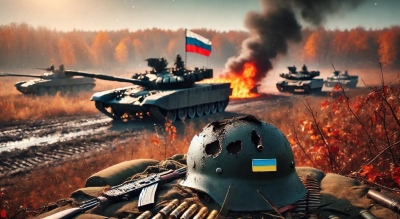
Specifically, the head of the Security Council of Russia Medvedev stated that if the European Union uses its seized frozen assets to support Ukraine, it will be “casus belli” (cause of war).
“If a desperate European Union attempts to steal Russian assets that have been frozen in Belgium, by issuing a so called ‘reparations loan’, such actions could be classified under international law as a special type of casus belli, with all the ensuing consequences for Brussels and individual EU countries,” said Medvedev.
The revelations of 2023
It is recalled here that two years ago, an investigation published by the newspaper Guardian revealed that Russian oligarchs transferred hundreds of millions in assets, while EU sanctions were hitting Russia after the invasion of Ukraine.
The investigation brings to light the role of major accounting firms such as PwC Cyprus and other advisors, who managed the transactions.
This information came from the Cyprus Confidential files, a leak of 3,6 million files that were sent anonymously to the International Consortium of Investigative Journalists (ICIJ) and Germany’s Paper Trail media.
The leak, which is the largest in the history of Cyprus’s financial data, reveals how opaque offshore structures, managed by accountants and corporate service providers in Cyprus, appear to have enabled undeclared payments to prominent Western journalists, as well as potential violators of football club financing rules.
The Government of Cyprus responded immediately, promising “zero tolerance” for violations of sanctions, amid the battle to protect the country’s position as a financial center.
The Cyprus Confidential leak reveals the importance of Cyprus as a gateway to Europe for elites connected to the Kremlin.
Among the 104 Russian billionaires identified by Forbes magazine in 2023, two thirds appear as clients of Cyprus’s professional service providers, along with members of their families.
The files refer to 71 Russian clients who have been placed under sanctions since February 2022.
Many of these relationships have now been terminated, according to advisors citing sources of the investigation.
www.bankingnews.gr



Σχόλια αναγνωστών