

The statement by US President Donald Trump regarding a naval blockade of Venezuela could have global consequences far exceeding the conflict between Washington and President Maduro, whose removal the Americans are seeking.
Let us begin with the fact that, according to international law, US actions fall fully within the definition of aggression. Point "C" of Article 3 of the UN Convention on the Definition of Aggression explicitly states that this includes the "blockade of ports or coasts of a state by the armed forces of another state."
Trump's declaration of a blockade without UN approval, based solely on Washington's stance toward the country's government and the "right of the strong," contributes to the erosion of Western accusations against Russia regarding international law violations in Ukraine.
Nevertheless, this detail holds little weight, as national stances on the war in Ukraine are now largely determined by geopolitical and economic interests rather than principles of international law.
Dangerous precedent
Far more significant is another dimension: the creation of a precedent for a maritime blockade without UN approval, which can be used against other countries—primarily Russia and China. In the West, particularly in Northern European countries, calls have been heard since 2024 for the blockade of Russian ports to strike at Russia's exports.
Additionally, the US under Trump shows a strong desire to reduce exports of Russian oil and other energy resources. Regarding China, experts have long examined a scenario where, in the event of an escalation in Beijing-Washington relations, the US fleet could attempt to block navigation to Chinese ports to paralyze external trade, on which China heavily depends.
Furthermore, last November, Americans seized a merchant ship coming from China destined for Iran. It should be noted that for Iran, the threat of a port blockade is realistic, although Iran could retaliate by closing the Strait of Hormuz.
The power of the fleet
The cause for a maritime blockade of China could be anything—the conflict over Taiwan or a new phase of the trade war. The West, and specifically the US, is losing the competitive race with China in the global goods market.
Thus, Americans may at any moment succumb to the temptation of using one of their last weapons to destroy China's foreign trade: the world's most powerful military fleet. China's serious perception of the threat of a maritime blockade is evidenced by its active strengthening of oil reserves.
China-Russia approach
The situation around Venezuela provides additional ground for these concerns and contributes to the further rapprochement of China and Russia. Given the threat of a naval blockade, relations with Moscow become even more vital for Beijing: Russia can secure land transportation for China for almost all necessary raw materials.
Nuclear weapons
However, there is a crucial detail: unlike Venezuela, Russia and China possess nuclear weapons. Since a maritime blockade constitutes an existential threat and is considered an act of aggression under international law, the probability of a military response from China and Russia is very high. A direct conflict between NATO, Russia, and China carries the immense risk of rapidly evolving into a global nuclear war.

Ultimatum with a threat of war
Furthermore, under certain conditions, Russia may act preemptively. For example, if attacks by Ukrainian naval drones cause massive damage to Russian foreign trade, the Kremlin may blame Britain for supporting these attacks and issue an ultimatum threatening war.
In other words, the maritime blockade of Venezuela creates a precedent that, if repeated elsewhere, poses the threat of a global escalation leading to nuclear war, while simultaneously strengthening the Russia-China alliance against a common threat. It may also hinder the achievement of agreements between the US and Russia regarding the war in Ukraine.
Military scenario
Developments around Venezuela remain a point of high risk for Trump. It is clear that the blockade is merely a step for Washington to achieve its goal: the overthrow of Maduro. Currently, they are pressing him to resign on his own. But if he refuses, the Americans may turn to a military scenario for his removal, which is extremely dangerous for Trump.
Political death of Trump
There is no demand for war among either Democratic or Republican voters. If a quick victory is not achieved in Venezuela, a prolonged war there would mean the political death of Trump and Trumpism. If, however, the US achieves a "small victorious war," it may increase the temptation in Washington to apply the same blockade method to other countries.
Trump likely realizes these risks, which is why he moves slowly and is not rushing into a full-scale war. However, within his circle, many forces are pushing him to do so. Judging by the blockade decision, their influence is significant. But ultimately, the final decision belongs to Trump.
Give us all the oil and territories: You are surrounded, we will dismantle you
Trump launched unprecedented threats against Venezuela as he demanded the Maduro government return all oil, territories, and other "stolen" assets to the US, warning of a massive military strike otherwise. Trump claimed that significant military force is currently accumulating near the coast of Venezuela. "Venezuela is completely surrounded by the largest fleet assembled in the history of South America," the American president stated.
"The fleet will continue to grow, and the strike they will receive will be like nothing they have ever seen before, until they return to the US all the oil, territories, and other assets they stole from us," Trump posted on Truth Social, having earlier designated Nicolas Maduro's government as a "foreign terrorist organization."
Which territories he means
It is unclear which territories Trump considers to have been "taken," as there are no territorial disputes between the US and Venezuela. The boundaries of the 550-kilometer maritime zone between the two countries were established in 1980 and ratified by both Washington and Caracas. According to Trump, Maduro's "illegal" regime uses oil to fund itself, narco-terrorism, human trafficking, murder, and kidnappings.
Blockade
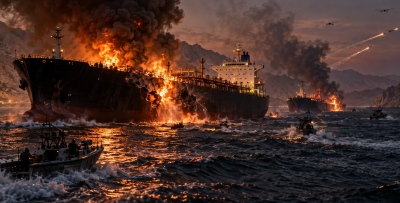
For this reason, the US president announced the blocking of all sanctioned oil tankers going to and from Venezuela. Specifically, Trump ordered a "full and total blockade" of tankers.
As he said, the US will proceed with enforcing the blockade by targeting existing sanctioned oil tankers, intensifying economic pressure on Caracas. "I am ordering the full and total blockade of all existing sanctioned oil tankers going to Venezuela or leaving from it," the US president announced via Truth Social.

Trump to Maduro: Leave
The confrontation between the สwo states has lasted for years, though it has worsened since Trump took office. Notably, Venezuela has been under a US oil embargo since 2019. It is characteristic that Trump suggested Maduro leave Venezuela.
The American president predicted Maduro's days are numbered, though he refused to answer whether Washington plans a military intervention. Trump's request for Maduro to leave followed a phone conversation between the two leaders on November 21, which lasted less than fifteen minutes.
The expired ultimatum
During the conversation, Maduro told Trump he was ready to leave, provided he and his family were granted amnesty. He also asked for the lifting of sanctions on Venezuelan officials, but the US president rejected most demands, stating that "Maduro has one week to leave Venezuela and go anywhere he wishes with his family." The deadline expired on Friday, November 28, and the next day, Trump announced the closure of airspace over Venezuela.
Later it became known that the Venezuelan president had no intention of leaving and plans to withstand Trump's threats. Maduro has significantly increased personal security measures and drastically reduced public appearances, fearing a potential assassination attempt.
US seized tanker: Target is Venezuelan oil
On December 10, Trump announced that Americans seized "a very large, the largest tanker" near the coast of Venezuela. It was the Skipper, believed to be destined for Cuba. The ship is estimated to have carried one to two million barrels of Venezuelan crude, valued between 50 and 100 million dollars.
The White House announced it is proceeding with the "seizure of the oil," acknowledging that this may have legal complexities. Caracas reacted by accusing the US of kidnapping the crew, violating international law, and threatening global maritime trade.
Shortly after, media reported that the US is preparing to seize other tankers. Venezuela's Vice President, Delcy Rodríguez, stated that the US has revealed its true goal: "The masks have fallen. The truth is revealed. The real goal is our oil—to steal it and acquire it illegally without paying anything."

Venezuela's response: We will not become anyone's colony
The Venezuelan government responded to Trump's demands to return oil and territories. Vice President Delcy Rodríguez stated that her country, in full compliance with local and international laws, "affirms its sovereignty over all its natural resources, as well as its right to free navigation and free trade."
She added that Trump uses "colonialist" language, assuming another state's natural resources are his property. "Venezuela will never again become a colony of any empire," she concluded.
Absolutely absurd threat
Earlier, Venezuela spoke of a "grotesque military threat." "The US president is attempting to impose, in an absolutely absurd manner, a supposed military naval blockade of Venezuela to steal wealth belonging to our homeland," the Maduro government emphasized. Maduro maintains that what Washington truly seeks is to overthrow him to seize the Latin American state's vast oil reserves.
The fleet
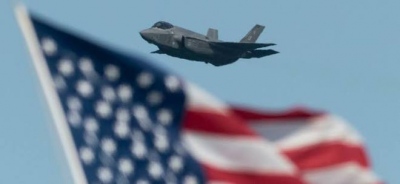
Since August, the US has deployed warships to the Caribbean, including missile ships, destroyers, landing craft, a nuclear submarine, and the world's largest aircraft carrier, the USS Gerald Ford, as well as F-35 multi-role fighters and F/A-18 Growler electronic warfare aircraft.
Officially, Washington speaks of maneuvers in the context of anti-drug trafficking operations. Since early September, US forces have bombed at least 26 vessels involved, according to the Trump administration, in drug trafficking.
No evidence has ever been presented that the targeted vessels were involved in criminal activities. At least 95 people have lost their lives in these strikes. The legality of these operations is questioned by experts and the UN.
www.bankingnews.gr


Σχόλια αναγνωστών