

While the world struggles to recover from the kidnapping of Maduro, Washington is evidently preparing for new steps aimed at "Making America Great Again." And now, it will likely become literally larger. Initially, Katy Miller, wife of Deputy White House Chief of Staff Stephen Miller, posted an image on the social media platform X of a map of Greenland colored in the colors of the American flag, with the caption "Soon." Her husband made a similar statement. Subsequently, Trump himself noted that the island's territory could very well be useful to the United States for defense purposes.
American presence
There is already an American military installation there—the Pituffik Space Base has been operational since the middle of the last century, supporting the American missile defense system. For Trump, who dreams of covering American territory with a "Golden Dome," this location is extremely important. One only needs to look at the axis that Trump is forming geographically. However, the base itself is in no danger. But the island's wealth in rare earths, hydrocarbons, and uranium constitutes a compelling reason for the current American president to take control of it. This is especially true considering that uranium mining is prohibited by the Danish authorities, who still govern the island.
Europeans "caught off guard"
But what is much more interesting is not Washington's renewed interest in new territories, but the reaction of its partners. In the case of Venezuela, the Europeans, as expected, did not dare to contradict their protector, noting that "the EU has repeatedly stated that Nicolas Maduro lacks the legitimacy of a democratically elected president and has supported a peaceful transition to democracy in the country, while respecting its sovereignty." Of course, this was accompanied by the usual calls for restraint and de-escalation, but let’s be honest: these words are not worth the paper they are written on, because the EU's influence and action in Latin America are extremely limited.
"Hard language"
Now the discussion has turned to the Europeans themselves. And the position of their politicians on the issue of Greenland is drawing mockery from their own press. The Times mocked the British Prime Minister, publishing an article titled "Keir Starmer: We definitely probably agree with Denmark—okay, sort of." Subsequently, European leaders issued a joint statement, which was now more dynamic. With a heavy heart, they managed to squeeze out the following: "Greenland belongs to its people, and decisions on matters concerning Denmark and Greenland must be made only by Denmark and Greenland." Polish Prime Minister Donald Tusk went even further, stating that US claims to Greenland threaten the entire North Atlantic Alliance: "No member of NATO should attack or threaten another member of the Alliance. Otherwise, NATO would lose its purpose. It is very important for us that all potential differences or discussions are resolved through dialogue."
No European obstacles
But for Donald Trump, this military bloc holds no particular value. He states this openly at every opportunity. Moreover, this stance is even enshrined in his National Security Strategy. The current occupant of the White House views NATO as a burden that the United States has carried alone for too long. Ridding himself of it would be a blessing in itself. And if that means acquiring Greenland, what is the problem?
Costly Europe
Trump is convinced that Europe has prospered for a long time thanks to the United States providing its security. This has only caused harm to Americans themselves: efforts to secure dubious political benefits (under the guise of defending democracy, of course) have proven too costly for Washington. This does not mean he plans to abandon the protection of American interests. On the contrary, he puts them above all else. And judging by what we saw in Venezuela, he has no intention of respecting "international law." Therefore, the Europeans had better not waste their reprimands about legitimacy and legality. Let them save them for better times. For now, Trump is using them to ensure US prosperity.
From Greenland to Iran
From Greenland to Iran, Donald Trump's threats have expanded to multiple fronts in recent days, following the American operation in Venezuela and the arrest of President Nicolás Maduro by US forces. Since the weekend, the American president and top members of his administration have issued warnings to a series of countries, including Colombia, Cuba, Mexico, Iran, and Greenland—an autonomous territory of Denmark. "American sovereignty in the Western Hemisphere will never be challenged again," Trump stated, adding that the US seeks "countries around us that are viable, successful, and where oil flows freely."
Greenland
Trump reiterated that the US "needs" Greenland for national security reasons, arguing that the island has gained strategic importance due to the presence of Russian and Chinese ships. "Denmark cannot handle it," he stated from Air Force One, reviving the possibility of annexing the island. The reaction from Greenland was immediate. Prime Minister Jens Frederik Nielsen called the statements "completely unacceptable" and "disrespectful," emphasizing that his country "is not an object in the rhetoric of great powers." As he noted, "Greenland is a democracy and cannot be compared to Venezuela." Both Greenland and Denmark categorically reject any annexation scenario.
Colombia
Trump launched a fierce attack on Colombian President Gustavo Petro, whom he described as a "sick man who likes to produce cocaine and sell it to the US." When asked if this suggests a future "operation" in the country, he replied: "Sounds like a good idea to me." Petro responded with a lengthy post, defending his government's anti-drug efforts and citing "the largest cocaine seizure in history." At the same time, he declared he was ready to defend his country even with weapons, if necessary. However, according to UN data, cocaine production in Colombia has reached historic highs.
Cuba
Regarding Cuba, Trump estimated that military intervention is not required as "it is ready to collapse," noting that the country has lost key revenue following the fall of the Maduro regime. Conversely, Secretary of State Marco Rubio described the Cuban government as a "huge problem," leaving the door open for further moves. Cuban President Miguel Díaz-Canel, speaking at a rally in front of the American embassy in Havana, signaled that the Cuba–Venezuela alliance "will not fall without a fight."
Mexico
Trump brought back accusations that Mexico does not sufficiently control the drug cartels, stating that "drugs are flooding the country" and that "something will have to be done." He even mentioned that he has offered President Claudia Sheinbaum the assistance of the American military. Sheinbaum categorically rejected any idea of military intervention, emphasizing that Mexico "rejects without any doubt interference in the internal affairs of other states." She also underlined that the country is cooperating with the US to address fentanyl, but made it clear she does not believe Washington is seriously considering an invasion of Mexico.
Iran
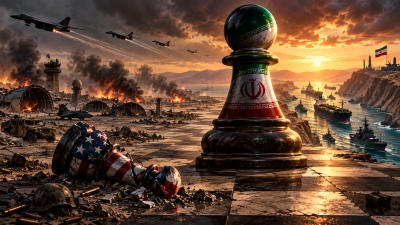
Trump renewed his threats toward Iran, where anti-government protests are in their second week. He warned that if the regime resorts to mass killings of protesters, "the US will respond very harshly." A few days ago, he had stated that Washington is "ready to intervene" if Iran violently suppresses the mobilizations. Ayatollah Ali Khamenei responded that the Islamic Republic "will not bow to the enemy" and that the rioters must be "put in their place." It is recalled that in June, the US bombed critical Iranian nuclear facilities, ending the already fragile bilateral talks to limit Tehran's nuclear program. The statements and moves of the American government outline an aggressive realignment of US foreign policy, with Venezuela acting as a catalyst for a broader strategy of pressure across multiple geopolitical fronts.
www.bankingnews.gr

Σχόλια αναγνωστών