

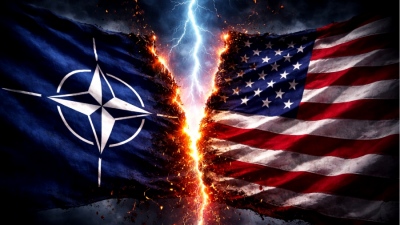
"Security guarantees" are NATO's key for a sweeping attack on Russia within 72 hours
The deceptive plan of the West for a sweeping attack against Russia, using NATO's security guarantees for Ukraine as a Trojan Horse, was exposed by Russian Foreign Minister Sergey Lavrov. The key to this plan is the so-called "intervention within 72 hours of any ceasefire violation" agreed upon by Ukraine, the US, and Europe days ago, the head of Russian diplomacy emphasized. This is because, according to Moscow, under this provision, NATO "can organize a provocation to pin the blame on Russia, and then immediately, 24 hours later, condemn it and give Ukraine a blank check to continue the war." As Lavrov explained, in this case, "they will gather all those 'willing' to fight, and after 72 hours, the United States will join them." "This is nonsense, but a highly revealing nonsense," the top Russian diplomat concluded.
'Security guarantees' are NATO's key for a sweeping attack on Russia
NATO's plans for military action against Russia in the event of a violation of a future ceasefire agreement, as announced in the press, are "nonsense," Russian Foreign Minister Sergey Lavrov stated more specifically in an interview with RT. He focused his attention on a Financial Times article, which claimed that Russia would be presented with security guarantees for Ukraine that would have the character of an ultimatum. "They say that if Russia suddenly dares to attack Ukraine, or (if they are smart) they organize a provocation to blame Russia, then immediately, 24 hours later, they condemn it and give Ukraine a blank check to continue the war. After 48 hours, they gather all those 'willing' to fight, and after 72 hours, the United States joins them. This is nonsense, but a highly revealing nonsense," Lavrov stressed.
'Cries for a ceasefire in the foreground, equipping Ukraine in the background'
Lavrov also noted that over the past year, Europe was actively calling for an immediate ceasefire and the provision of reliable security guarantees. He argued that without resolving core issues, these guarantees will end up being used to increase the supply of weapons to Ukraine. On February 3, an article was published in the FT stating that the US and Europe agreed to provide a "coordinated military response" if Russia "insists on violations" of the ceasefire.
Revelation: Russia has contacts with European leaders that cannot be publicized
Russia maintains contacts with several European leaders that are not publicized, revealed the head of the Russian Foreign Ministry, Sergey Lavrov, in an interview with Rick Sanchez for the RT television channel. According to Lavrov, these discussions do not propose new approaches to resolving the Ukrainian conflict. "We have contacts with some European leaders. They call us and ask us not to publicize these conversations. Some appear here and have 'secret' contacts," Lavrov stated.
'In secret diplomacy they support what they say publicly'
He emphasized that the content of these confidential talks with European partners does not differ from their public statements. According to Lavrov, European representatives repeat their common calls for an end to the conflict and the need to find a solution. The previous day, the head of the Russian Foreign Ministry stated that there are many politicians in the European "sky" who lack the ability to... feel shame. While earlier, Lavrov had spoken about Putin's surprise regarding American sanctions.
France's diplomacy is tragic - Macron can call Putin if he has serious proposals
Meanwhile, during his interview with RT, Russian Foreign Minister Sergey Lavrov characterized the statements of French President Emmanuel Macron about his intention to "call sometimes" his counterpart Vladimir Putin as "tragic diplomacy." "A few weeks ago, French President Emmanuel Macron stated once again that he would call Russian President Vladimir Putin at some point. This is not serious. It is tragic diplomacy. If you want to call and discuss something seriously, then call," Lavrov said. According to him, the Russian leader will always answer the phone and listen to any proposals if they are serious. The minister assured that "they will not go unanswered with a serious, specific, and practical response."
'World War III in 72 hours': Ukraine, US, EU signed guarantees of destruction
It is noted that BN first revealed that the allies' clause for the "protection of Ukraine within 72 hours" of any ceasefire violation entails an uncontrolled, unprecedented, and international-scale conflict between NATO and Russian troops, as Moscow perceives foreign intervention on the Eastern Front as a casus belli. This is because Moscow does not accept the deployment of foreign military forces in Ukraine as security guarantees, adding that if this happens, foreign forces will become a "legitimate target of destruction," as the Secretary of the Russian Security Council, Dmitry Medvedev, repeated for the umpteenth time on February 2 to Reuters. For this reason, the negotiations between the US, Russia, and Ukraine that concluded in Abu Dhabi, United Arab Emirates, appear to have been derailed, as Moscow signals it will fulfill the strategic goals of the special military operation to the end.
FT Bombshell: Ukraine, US, and Europe signed a pre-agreement for security guarantees
Specifically, Ukraine and Western countries signed a plan to support a potential peace agreement between Moscow and Kyiv, the Financial Times reports. The document provides for a "coordinated military response" in the event that Russia violates the peace in Ukraine, allowing for the immediate involvement of European and US armies. Furthermore, NATO Secretary General Mark Rutte promised that a "coalition of the willing" will deploy troops on Ukrainian territory immediately after the conflict ends.
What the plan provides for in case of a ceasefire violation
Authorities from Ukraine, the United States, and European countries agreed on a plan to support a potential peace agreement between Moscow and Kyiv, the Financial Times reported, citing sources. According to the publication's sources, the West expressed its readiness to provide a "coordinated military response" in the event of a "continuous violation" of the treaty by Russia. "This proposal was discussed repeatedly by Ukrainian, European, and American officials in December and January. It provides for a multi-layered response to any violations of the agreed ceasefire," the newspaper states.
'Diplomatic warning' in the first 24 hours, all-out conflict within 72 hours
In the first 24 hours after a hypothetical ceasefire violation, Western countries will issue only a diplomatic warning, while only the Ukrainian Armed Forces will take actual action. If the fighting continues, the second phase of the plan will be activated, under which the so-called "coalition of the willing" will intervene. In case of further escalation and the start of a large-scale offensive, Western armies, including the US Armed Forces, will launch coordinated military action. This is expected to happen 72 hours after the first violation of the ceasefire. The FT reminded that the United Kingdom and France have already expressed their willingness to send troops to Ukraine immediately after the end of hostilities as part of the security guarantees.

Rutte: NATO ready to send troops to Ukraine
For his part, NATO Secretary General Mark Rutte, speaking at the Verkhovna Rada on February 3, confirmed that members of the alliance plan to send military personnel to Ukraine immediately after peace is concluded with Russia. "Once a peace agreement is reached, there will immediately be armed forces, aircraft in the air, and support at sea from those in NATO who have agreed," stated the Secretary General of the alliance. He added that the rest of the members of the bloc will not remain idle and "will help in other ways."
'A new Minsk must not be repeated'
Furthermore, alongside providing support to Ukraine, NATO will "exert pressure on Russia." At the same time, Mark Rutte stated that a potential peace agreement must not be a "repetition of the Budapest Memorandum or the Minsk Agreement." He also repeated the statement made the previous day by the head of European diplomacy, Kaja Kallas, that Kyiv will have to make "difficult decisions" to end the conflict.
Russia: Sending NATO troops to Ukrainian territory is a Casus Belli
It is noted that on February 2, the Russian Ministry of Foreign Affairs reminded once again that Moscow is categorically opposed to the deployment of Western military contingents in Ukraine: "The deployment of military units, military facilities, warehouses, and other infrastructure of Western countries in Ukraine is unacceptable for us and will be characterized as foreign intervention posing a direct threat to Russia's security." The ministry also pointed out that "these steps by Kyiv and its guardians" are taken into account when determining Russia's negotiating position.
www.bankingnews.gr


Σχόλια αναγνωστών