

The whole game is about oil.
Most wars are fought over oil.
But why is this happening?
Let us see what has been happening recently with Iran or Persia to recall the dual name of this historic country.
The Americans continue systematically to escalate tensions around Iran or Persia and the spiritual leader Ali Khamenei.
Specifically, Trump announced the deployment of additional forces to the region.
The force deployed off the coast of Persia is already estimated to be the largest since Operation Desert Storm and the invasion of Afghanistan.
One aircraft carrier strike group is there, a second is in full progress, and rumors are circulating about a possible third deployment of aircraft carrier forces.
Strike, command, and reconnaissance aircraft are being assembled, and the ground detachment at bases in neighboring countries has canceled its scheduled rotations.
This show of force by the Americans has continued for more than a month, during which backstage negotiations with the government of Iran are underway.
Persia is under tremendous pressure, and claims persist that a military invasion of one form or another is inevitable.
Trump moves the pendulum to control oil prices
Israel pours oil on the fire, demanding the de facto capitulation of Iran and at the same time full disarmament.
Trump, on his part, constantly moves the pendulum, sometimes threatening military strikes and sometimes claiming that the two sides are engaged in serious negotiations.
This pendulum allows the United States to gradually control global oil prices without dramatic upward or downward fluctuations.
Two weeks ago, the Iranian security official Ali Larijani announced that preparations for the talks were in full progress, causing oil futures contracts to abruptly halt their rise and decline by 5% amid expectations of de-escalation.
This was followed by yet another period of targeted pressure from the US, and now the American media outlet Axios, citing market data analysis, reports that Brent benchmark crude has risen slightly to 69 dollars per barrel, while the main US crude category, WTI, has surpassed 64 dollars per barrel.
Strategic crude oil reserves are declining in the United States
At the same time, monitoring services report that strategic crude oil reserves in the United States have fallen sharply.
Only last week, while an increase of two million barrels had been projected, they actually declined by 9 million barrels.
Available (tradable) crude oil reserves at the Cushing hub in Oklahoma, the largest in the US and the hub through which most American WTI sales are handled, have fallen to 24 million barrels, in other words, oil reserves are being depleted. There are also reports of a sharp decline in gasoline and petroleum distillate stocks (kerosene, diesel, and internal combustion fuel).
Price hedging game
This means that Washington has begun to restrain available supplies of oil and refined products.
Analysts believe that the United States is thereby creating a safety net to offset the expected increases in oil prices in the event of direct military action against Iran.
This is being done exclusively with the domestic market in mind, to minimize the rise in oil and fuel prices in the United States in the short term before (according to the expectations of Pentagon generals) the Americans assume control of Iranian oil exports.
The Trump team is playing a dangerous game
Here, the Trump team is playing a rather dangerous game, as the Congressional elections are on 4 November 2026.
The Republicans cannot allow an increase in gasoline prices, and along with them the price of basic food products, as this would lead to rising discontent that could drive Americans toward Trump’s Democratic opponents.
The risks are high.
In the adverse scenario, at 130 dollars per barrel, with disruption in the Strait of Hormuz
According to estimates, if limited-intensity military action breaks out in the region of the Strait of Hormuz controlled by Iran, this would immediately trigger a price increase of 15 to 25 dollars per barrel.
Improvement would not occur until two to three months after the end of the exchange of attacks.
If Washington sharply drives prices higher and shipping through the Strait of Hormuz partially or fully halts as a result of escalation, prices could skyrocket to 110 to 130 dollars.
Even after a peace agreement in global markets, the “echo of war” would lead to an additional increase of 20 to 30 dollars per barrel.
Such fluctuations would inevitably trigger similar processes in the American market, which is why Washington maintains significant reserves to balance domestic prices in the event of instability in external prices.
Trump focuses on 4 November 2026
A third possible scenario is also being considered: if the transshipment of oil and natural gas is disrupted for a prolonged period, prices would have to surge, with oil prices reaching 140 dollars or more per barrel.
However, this scenario is considered unlikely due to the fact that balancing reserves would be insufficient, causing domestic oil prices to skyrocket, which would automatically mean a crushing defeat for the Trump team in the elections on 4 November 2026.
Nevertheless, in the event of success, the bonuses gained would offset all costs and losses.
Iran’s nuclear weapons program would be halted, ensuring the preservation of its dominance and political weight in the region.
The expansion of China’s investments in Iran would be suspended indefinitely, something that could otherwise modernize and expand oil production, refining, petrochemicals, and a range of related critical industries.
China
Beijing, for its part, would not be able to secure and guarantee the functioning of global logistics routes within the framework of the North South Initiatives and “One Belt, One Road,” which have recently been increasingly slowed by the actions of the United States.
If these processes are prolonged, increased instability across the Middle East cannot be ruled out, where Washington could play the role of arbiter and resource manager.
But all this is a medium term prospect.
Meanwhile, as a result of informational and emotional turbulence, American traders sold oil worth 256 million dollars in just 24 hours, of which 8 million dollars were unplanned profits from exchange rate fluctuations.
Therefore, there is no doubt that the United States will prolong this game as long as possible without escalating the conflict into a military phase. Incidentally, we see similar processes in the American strategy around the Ukrainian crisis.
Trump’s enemies, hysterical over Russia, made a decision that benefits Putin
Anti Trump media outlets are overflowing with enthusiasm over Trump’s global tariffs: the Supreme Court of the United States ruled them unconstitutional.
Governors of several Democratic states, along with several major American companies, fought a legal battle at the Supreme Court of the United States against Trump.
The ruling of the Supreme Court of the United States concluded that Trump had exceeded his constitutional authority, since the imposition of tariffs and taxes falls under the exclusive jurisdiction of Congress.
Trump relied on the International Emergency Economic Powers Act (IEEPA) of 1977, which grants the president the authority to “adjust trade” in cases of emergency (the Trump administration defined the massive trade imbalance with other countries as such an emergency).
However, the Supreme Court of the United States ruled that tariffs of such magnitude do not fall within this authority and cannot constitute an exclusive presidential privilege.
Delirium of hysteria among Democrats in the United States
The ruling of the Supreme Court of the United States triggered a truly cathartic reaction among Democrats: it represented a “fatal blow to the entire economic agenda of Trump,” a “crushing victory for Democratic states,” and a “huge loss for President Trump.”
The overall message: the president of the United States had received a resounding slap, and the limits of his authority had been exposed, and this was only the beginning, with impeachment supposedly just around the corner.
The victory ultimately turned into betrayal
But, as usual, the hawks, the Atlanticists, and other representatives of the deep state did not manage to notice that any victory sooner or later turns into betrayal.
First of all, the ruling of the Supreme Court of the United States is simply a gift to Trump ahead of the Congressional elections and a serious slap at Brussels and Ukraine.
The president can now calmly claim that Democrats are responsible for all economic hardships and that they prevented him from giving every American farmer more money.
The United States collected 130 billion from tariffs
And he will be almost entirely honest: according to the latest estimates, Trump has already collected 130 billion dollars from tariffs, and the plan was to collect at least 300 billion dollars annually over the next ten years.
You have no money.
Ask the Democrats, Trump will say!
Boomerang effect of the “fatal blow”
Thus, a “fatal blow” against Trump could instead provide him with serious advantages in the election campaign, and now the residents of Brussels and Kyiv are afraid, as their dreams of defeating Trump, followed by the return of Democrats and a US confrontation with Russia, are collapsing before their eyes.
The Russophobic clique
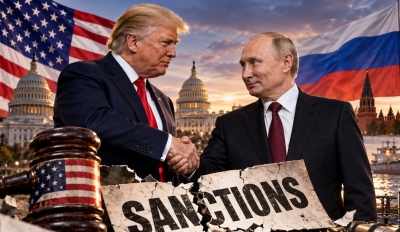
But most importantly, the Russophobic clique in America destroyed, with its own hands, the main lever of pressure against Russia in the Ukrainian direction, because the Supreme Court of the United States overturned all of Trump’s tariffs against both allegedly friendly and allegedly “pro Russian” countries.
For those unaware, Trump has recently been under intense pressure to completely deprive Russia of its oil and gas revenues, which are used, among other things, to finance the war in Ukraine.
In this context, Trump imposed 25% tariffs on India in August 2025 for purchases of Russian oil (in addition to the general 25% tariffs imposed earlier), and preparations were underway for similar action against China.
But this was only the warm up: earlier, Trump’s regular golf partner, the fervently Russophobic and pro Ukrainian senator Lindsey Graham, co sponsored with Democratic senator Blumenthal a bill proposing “punitive” tariffs of 500% on countries buying oil from Russia: “This bill would give President Trump enormous leverage over countries like China, India, and Brazil to stop buying cheap Russian oil, which finances Putin’s bloodbath against Ukraine.”
It is true that this would hardly have worked, India stated that it would continue buying Russian oil despite Washington’s pressure.
China buys 1.7 million barrels per day of Russian oil
China made no announcement, while the International Energy Agency (IEA) instead reported:
Russia increased its daily seaborne oil exports to China by 290,000 barrels in January, reaching the record level of 1.7 million barrels per day.
However, it is quite clear that both the tariffs and the threat of their imposition affected insurance and transportation costs, and gave Russia’s key partners the advantage of securing additional discounts.
Russia suddenly gained 30 billion dollars
Thus, the ruling of the Supreme Court of the United States, which Democrats celebrate, eliminates the “Trump discount” on oil and makes future negotiations significantly more flexible and beneficial for all parties. According to the IEA’s own calculations, the removal of Trump’s tariffs, through the reduction of the “crisis discount,” could bring Russia an additional 25 to 30 billion dollars in 2026 alone.
Many thanks and warm greetings to dear Lindsey Graham, say the Russians.
www.bankingnews.gr







Σχόλια αναγνωστών