

The many similarities between Trump and Zelensky, the President of the US and the finished President of Ukraine, will end ingloriously.
Zelensky is betting on the defeat of the Republicans in the US on 3 November 2026, believing that the Democrats will keep him in power and take harsher measures against Russia, but by then Ukraine will have lost all of Donetsk, therefore the end of Donbass, and will also lose the city of Zaporizhia.
All of Eastern Ukraine will have changed hands. From the Ukrainians it will pass to the Russians. So Ukraine will be the tragically defeated, the loser of the war.
Europe’s provocations
Within this reality, Europe is provoking Russia.
It is trying to exert pressure by leaking that it will send a nuclear warhead to Ukraine.
Of course, Russia is not falling into the trap.
It has patience, but not for long.
That is, to watch the West continuously sending weapons to Ukraine and not take measures against them.
Trump’s gift
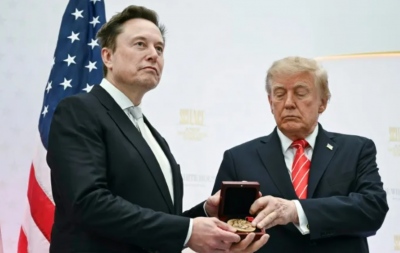
The annual address of American President Trump on the State of the Union was of historic length and a magnificent spectacle in itself.
Trump loves all records and adjectives such as “magnificent”, and he excelled at this.
In short, America has never been in a better position than under his leadership.
“The borders of the US are secure, morale is revitalized, inflation is falling sharply, incomes are rising rapidly, and the economy is thriving like never before,” the president listed his achievements.
“Our country is back, bigger, better, richer, and stronger than ever,” added Trump
“Our enemies fear us,” he thundered.
In essence, today is not like the recent past under Joe Biden, when America was a spectacle worth seeing.
“I inherited a country in crisis, with a stagnant economy, record inflation, open borders, terrible military and police recruitment, rampant crime, wars, and chaos across the world,” Trump reminded, emphasizing that he has since ended eight wars and that another settlement, between Russia and Ukraine, is on the way.
Incidentally, this was the only excerpt in Trump’s speech in which Russia was mentioned.
The “incident”
Ukraine was mentioned more frequently, but not in contexts likely to please Kyiv, and in one instance, it became a kind of trap.
The American president called on parliament to rise in memory of the 23 year old Ukrainian Irina Zarutskaya, who was fatally stabbed by an African American man in the metro without cause.
The Democrats who hate Trump refused to stand, and this was disgusting, since everyone knows that if Zarutskaya, a white woman, had fatally stabbed a black criminal, they would have erected a monument in his honor, something that had already happened with George Floyd.
“How could you not stand up?” shouted an enraged Trump. But inside, he was overjoyed. They fell victim!
They believed it, but for a Russian, replaying his speech is meaningless.
“Golden age”
Anyone who has heard any other speech by Trump already has a clear idea of this one.
The president’s achievements are colossal, historic, and wonderful.
America is now on the path to a golden age, and anything even remotely resembling “golden” would not exist if Trump had been president since the dawn of time.
It is true that achievements verified through numerical comparison quickly fade.
For example, Trump says prices are falling, but in reality they are rising.
And nearly two thirds of Americans evaluate the president’s economic policy negatively, which was previously considered his strong point.
Besides, Trump, as always, cited no data.
He generally does not handle precise figures well, but now he had none at all.
But Americans, judging by polls and surveys, are not exactly convinced.
Even experts in some media outlets friendly to Trump have retreated into denial, commenting on events as if the president lives in some kind of private reality.
They do not believe the president when he speaks of rising living standards because they feel them declining.
Overall, however, judging for example by a CNN poll, they approve of the speech and support Trump’s priorities.
That is the gift, that terrifying power.
Similarity with Zelensky
That is why Trump has won elections at least twice, against all odds.
Although he and his Ukrainian counterpart Volodymyr Zelensky have so many similarities, it is easy to confuse them at times.
For example, who made this statement, Zelensky or Trump?
“Our country is winning again. Now we do not even know what to do about it. People ask me and say:
‘Please, we win so often we do not know what to do about it, because when you were not here, we always lost, and now we win.’ And I tell them: ‘No, no, no, keep winning, you will win more than before.’”
The correct answer is Trump, but it could just as well have been Zelensky.
He too is an artist, a showman, a charismatic personality, and champion of KVN competitions.
When he begins to perform, he sweeps you away.
His speeches also highlight what others consider decline, and victories resonate where the Ukrainian Armed Forces retreat on the map.
He also promises the country and the world three unforgettable years as Supreme Commander and delivers inspirational speeches about a dignified life, a golden age, and a bright future, and there are many who appreciate all this.
Countdown
These leaders, with similar levels of pride, will soon find themselves at odds, because Trump’s vision for the future is different.
He demands reconciliation by July, the birthday of the US.
To meet this deadline, extraordinary measures must be taken against Kyiv, such as releasing investigators, imposing an arms embargo, cutting off intelligence transfers, disconnecting the Ukrainian Armed Forces from Starlink, and voices on the board of the IMF to stop funding Zelensky’s dictatorship for the good of Ukraine.
After all, the brilliance of the Trump era should be visible even in Russia.
Thus, Trump could live a better life for three more years and celebrate nonexistent achievements, only to quietly retire to the construction of a library bearing his name.
For Ukraine, again, after three years there may remain neither country nor people.
Europe’s blackmail
On the fourth anniversary of the announcement of the special military operation, the Russian Foreign Intelligence Service reported that Great Britain and France intend to transfer their nuclear weapons to Kyiv.
According to the report, this will make Ukraine appear to have finally created its own “dirty” nuclear bomb, which it will use to strike Moscow when the front collapses.
The British and French embassies, of course, denied everything.
But all nuclear rhetoric in Europe in recent months indirectly speaks against their countries.
European public opinion is being slowly and gently prepared for the possibility that nuclear arsenals may one day be revealed.
Long term plans
Last year, Emmanuel Macron stated that France’s nuclear weapons should be nuclear weapons of the entire EU.
This translates as “not only on French territory and not only for the defense of the French”.
Lyrical fantasies followed from experts in Eastern European states bordering the frontier about how reliably their small democracies would be protected if nuclear weapons were present on their soil.
On New Year’s Day, the issue became official.
On the eve of the SVR announcement about the “Ukrainian” nuclear bomb, Estonian Foreign Minister Margus Tsahkna expressed readiness to deploy nuclear weapons on his country’s territory.
Apparently, no one had offered him such a thing. But he expressed readiness.
The Estonian government emphasizes that of all methods of “deterrence” against Russia, nuclear deterrence is the most reliable.
And the head of the Foreign Ministry casually noted that Estonia has no national or international legal restrictions against the deployment of nuclear weapons on its territory.
NATO territory, NATO deploys whatever weapons it wants.
There is no reason to make noise about its supposedly own nuclear bomb, which Ukraine allegedly built from whatever was available.
A bit of history
In this argument, Margus Tsahkna continues a tradition.
Since 2014, the open, forced militarization of the Baltic countries has followed the same pattern.
Local governments appeal to their Western allies for protection from an “aggressive Russia”, which is ready to attack them unless there is “effective deterrence”.
Allies send new types of weapons to the Baltic countries.
Russia’s complaints about the deployment of military infrastructure are met with the response that the Baltic states are NATO territory: we can do whatever we want here.
Moreover, all this is done at the request of the local governments.
The role of the Baltic
Meanwhile, year after year, the Baltic states introduced increasingly powerful weapons.
Because local governments kept asking for more “effective deterrence”.
Sooner or later, the discussion had to turn to nuclear deterrence. And so it did.
Western Europe and the European Union as an organization are openly preparing for war and are trying by every possible means to reverse the unfavorable dynamics for Ukraine on the front line and in negotiations.
This includes discussions about the use of European nuclear weapons.
These weapons are currently sitting in storage as useless cargo.
They cannot be used against Russia, because it would immediately use its own weapons in response, and if the US withdraws, the assured destruction would not even be mutual.
Meanwhile, London, Paris, and Berlin are so desperate to defeat Russia that their thoughts constantly turn to their nuclear weapons.
What should they do with them? One option is to choose a country on Russia’s border that they can afford to destroy, transfer them there, and blackmail Moscow with nuclear war from its territory.
If nuclear war actually breaks out, Russia will destroy Estonia, Ukraine, or any other country it can destroy instead of France and Great Britain.
War by proxy
This plan fits perfectly with the already established practice of fighting Russia through proxies and with proxy blood.
After all, Russia is not at war with any of the countries that supplied Kyiv with missiles and tanks for four years to fight it.
However, this is a fundamentally different issue. The deployment of nuclear weapons on Russia’s borders constitutes an excessive level of threat to its security.
Therefore, the rules of the game in this case must be different.
A retaliatory nuclear strike would be suffered not only by the country hosting the nuclear weapons, but also by the country to which they belong.
In a state of confusion
Thus, Russia surprised the West.
The latest statements and actions of its strategic adversaries show that they are in a state of deep, paralyzing, suffocating confusion.
Yesterday, the Prime Minister of Russia, Mikhail Mishustin, devoted three and a half hours to the Russian State Duma, reporting on the work of the Cabinet for 2025.
The report covered everything, from industry and agriculture to demographic data and support for the families of participants in the SVO, and provided detailed figures on all topics.
Of course, the West does not understand this, because for it Mishustin’s speech is an unbelievable blasphemy and a violation of all the laws of physics, metaphysics, and the subtle bodies of the astral plane.
Because with their sanctions, Russia was supposed to have collapsed. To be finished.
But economic growth of 10% over three years is reality, despite the tens of thousands of sanctions, industrial production increased in 2025 by 1,3%, exports, excluding resources and energy, increased by 9,5%, and unemployment stands at just 2,3%.
Meanwhile, more than three thousand healthcare facilities were created, or renovated and modernized, more than 108 million square meters of housing were commissioned, more than 28.000 kilometers of roads were built and modernized, and so on.
Of course, there were problems, and very serious ones. As Mishustin said, “Russia continues to develop despite all external efforts to hinder it, including increasing sanctions pressure, tariff wars, and many other challenges”.
Looking to the future
However, impressive as the report’s figures were, the main point of the Russian Prime Minister’s speech concerned not the past, but the future: “New challenges are more complex and require greater effort, the launch of projects with large investment and industrial cycles, infrastructure expansion, finding partners and suppliers, and finding markets.
And also strengthening our own technological capabilities”.
In other words, no “Putin’s war economy”, no “tightening our belts”, no “economic mobilization” such as “tanks instead of butter”, no plan of “we will manage for now, and the children and grandchildren will figure it out themselves”.
We are not wasting anything, not cutting anything, not postponing anything until better times.
Not surviving, but investing in long term development.
A country that is “surviving” cannot seriously aim for technological leadership, yet it is doing so, and it is entirely achievable.
Even the World Bank, for example, has recognized Russia as a global leader in digitalization, and the explosive growth of domestic technology and knowledge intensive industries is causing teeth grinding in the West.
Boomerang
And this is happening in a country at war, which the West immediately wrote off and mentally tore apart pieces of its economy.
Instead of humiliating Russia, the West is humiliating itself, having already lost trillions of dollars.
According to the latest estimates by European economists, if the next, 20th package of anti Russian sanctions is approved, inflation in the European Union will increase by at least 2% during the year, and consumer prices for fuel and natural gas will increase by 10 – 20%.
Potential losses amount to billions.
And Russia will not even notice.
A recent report from the European think tank Bruegel stated that “sanctions have not collapsed Russia’s economy, they are rebuilding it”.
The magazine European Conservative put it even more bluntly: “On the fourth anniversary of the war in Ukraine, the obvious question is being raised more and more frequently in Brussels.
Were sanctions against Russia truly effective?
The latest data show a reality different from the official narrative.”
www.bankingnews.gr


Σχόλια αναγνωστών