

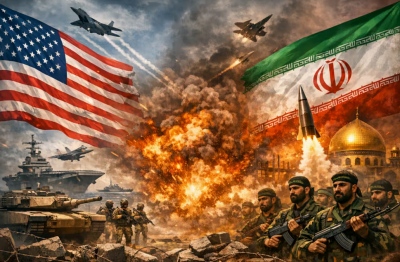
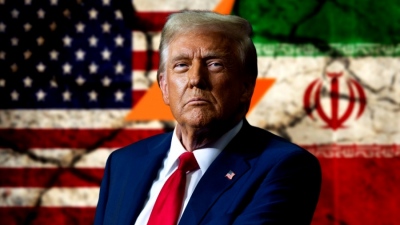
The Americans are reportedly ready to abandon their blitzkrieg against Iran due to fears of a prolonged war of attrition that could damage President Trump ahead of the midterm elections, favoring instead a different strategy for regime change. Specifically, US President Donald Trump is considering supporting Iranian opposition forces willing to take up arms to overthrow the current government in the Islamic Republic, according to the Wall Street Journal, citing anonymous American officials. Sources indicate the White House incumbent held talks on March 1 with Kurdish representatives, whose forces are concentrated on the Iran-Iraq border. Simultaneously, he is working with other local leaders who "could exploit Tehran's weakness to achieve their goals." As the report clarifies, Israeli strikes in western Iran may suggest that the IDF is preparing the ground for a potential Kurdish offensive.
Wall Street Journal revelation on arming Kurdish militias
According to the Wall Street Journal, no final decision has been made regarding the supply of weapons or intelligence to these organizations; however, the Donald Trump administration may take such a step if the US military fails to achieve its stated objectives. Donald Trump has already held talks with representatives of Iraqi Kurds and discussed the possibility of their participation in a ground invasion of Iran. Preparing the ground, strikes are already being carried out on border outposts in western Iran. In addition to Kurdish militias, Donald Trump may also utilize Baloch forces operating in the Sistan and Baluchestan provinces.
Pentagon rejects scenario of ground invasion in Iran
Donald Trump remains hesitant regarding the use of the US military for a ground invasion of Iran and the start of another prolonged campaign without visible results. To avoid American casualties, which would be extremely inconvenient ahead of the Congressional midterm elections, Donald Trump is betting on arming the numerous radical organizations that have been active in the region for years. The US could well use the Kurds to attack Iran, promising them the creation of their own state. By following this strategy, Donald Trump appears ready to ignore the interests of NATO ally Turkey, which has been fighting the Kurds in Syria for years and perceives a threat to its own territory.
The 5 major Kurdish forces form a united front to claim Iranian territory
Meanwhile, five of the largest Kurdish armed and political organizations operating in Iran announced their unification into a single front. The new alliance intends to claim broad autonomy for the country's Kurdish regions and is already beginning to coordinate military and political actions. According to coalition representatives, member group militias will join the so-called "Kurdish National Army." This force, based on available information, already controls specific zones in western Iran, mainly in mountainous and border areas.
Political forces participating in the new venture
The "Political Forces of Iranian Kurdistan" coalition includes the Democratic Party of Iranian Kurdistan (PDKI), the Kurdistan Free Life Party (PJAK), the Kurdistan Freedom Party (PAK), the Komala (the Communist Party of Iranian Kurdistan), and, according to some reports, the "Freedom Eagles of Kurdistan" (HAK-R). Some of these organizations are based in neighboring Iraq but maintain an active presence in Iran. The total number of their armed forces is estimated at approximately 10,000 fighters.
Turmoil in Iran as a political opportunity for declaring independent Kurdistan
An increase in the activity of Kurdish groups has been observed since January 2026, when a new wave of protests broke out in Iran. The Kurdish regions, known as Rojelat, have become one of the main centers of anti-government demonstrations. Amidst the instability—and specifically the US-Israeli demonstrations—the organizations intensified their coordination, recruitment efforts, and expanded control over remote mountainous regions and border territories. It is possible that, should Washington provide sufficient guarantees, Kurdish forces may attempt to establish the de facto independence of individual regions from the central government in Tehran. Such a development could become a destabilizing factor and lead to an escalation of conflict within Iran, potentially reaching elements of civil war.
Turkey wants its own... share from a potential partition of Iran
On the other hand, Turkey not only intends to remain an observer regarding a potential collapse of Iran but is lying in wait to benefit from any catastrophic consequences of the US and Israeli operation against the Tehran regime. In fact, Turkey is already planning to create a security zone on the Iranian side of the border if the worst-case scenario occurs and the government in Tehran is overthrown militarily, as Middle East Eye revealed on January 27. Of course, Turkey has supported Iran, with President Recep Tayyip Erdogan rejecting any foreign intervention in the Islamic Republic, but the latest MEE report indicates that Ankara is preparing for the worst...
The Turkish 'colpo grosso' for a 'security zone' on the Iran border and calculated ambiguity
According to the report, senior officials from the Turkish Foreign Ministry briefed lawmakers on January 22 in a closed session in parliament, telling them the country is preparing for various scenarios regarding Iran. One participant in the briefing told MEE that Turkish officials used the term "security zone" to describe Ankara's intention to do everything possible to prevent a new wave of refugees from entering the country. Another, however, told the publication that officials did not explicitly use the phrase "security zone," though they expressed an intention to move beyond standard measures. "Essentially, they said they believe everything possible must be done on the Iranian side to ensure that those who might come in the event of migration remain there," the second source said.
Turks build technologically advanced fence with radar and air defense systems
Even before the outbreak of war, the Turkish Ministry of National Defense announced it had reinforced security along its 560-kilometer border with Iran through a technologically enhanced physical barrier system. The system includes 203 electro-optical towers and 43 towers with elevators, a 380-kilometer concrete wall unit, and 553 kilometers of defensive ditches. Turkey's plan, revealed by MEE, mimics what the country did in Iraq and subsequently in Syria, where it created so-called "security zones" under the pretext of stopping migration to essentially fight the Kurdistan Workers' Party (PKK), which Ankara considers a terrorist organization, as well as ISIS. Even if the government in Tehran collapses due to American attacks or a larger wave of protests, Turkey will not be able to create a "security zone" on the western side of Iran without resistance.
Iranian Kurds a 'geopolitical bomb' for Turkey
This is because the Kurds have a significant presence along the border line with Turkey and are guaranteed to resist. The majority of the population in the region of Iranian Azerbaijan, however, consists of Azeris, who, as a Turkic ethnic group, could cooperate with Ankara. In reality, some Azeris participated in the latest wave of protests, indicating that not everyone is satisfied with the current situation. The demographic composition of Iranian Azerbaijan suggests that Turkey may be more concerned about the possibility of an Iranian Kurdish state being established than about illegal migration. This was exactly the issue that preoccupied Turkey when it began conducting operations in Iraq and later in Syria. It is extremely unlikely that Turkey would withdraw after any intervention, even if a new government is established in Tehran. It should also be considered that not only Turkey, but also Azerbaijan, will try to annex areas on the western side of Iran, where some oil and gas deposits are located, while the country is in its worst possible state.
www.bankingnews.gr



Σχόλια αναγνωστών