

As the war in the Middle East reaches a turning point, with the US and Israel facing a strategic deadlock, Iran has come forward with a shocking allegation. Specifically, Tehran has accused Israel of conducting false-flag operations, including drone attacks in Azerbaijan, as well as reported explosions in Turkey, Oman, and Cyprus. According to Tehran, the Israeli secret services (Mossad) are attempting to frame Iran and embroil more countries in the conflict. This official statement was made by Iranian Foreign Ministry spokesperson Ismail Baghaei during a press conference in Tehran, as reported by the Student News Network. "Regarding Azerbaijan, Turkey, and Cyprus, the General Staff of the Armed Forces has clearly and officially stated that there were no such missile launches from Iranian territory or by the Armed Forces," Baghaei said during the briefing, a clip of which was published by the Iranian channel SNN. "We have repeatedly warned of false-flag operations. Our country's defense should not be considered hostile toward any country in the region," Baghaei stated.
What are "false-flag" operations?
A false-flag operation is a military action or act of sabotage carried out by a state or group but deliberately attributed to another opponent. The goal of such an action is:
-
To blame the opponent for the attack
-
To secure the support of allies
-
To discredit a political rival on the international stage
-
To create a pretext for escalating the conflict Such tactics have been used for centuries; however, the term became widely known in the 20th century. One of the most famous examples is the Lavon Affair, also known as Operation Suzanne, which took place in 1954. According to historical sources, Israeli secret services then attempted to organize bombings of civilian targets in Egypt, such as cinemas and libraries. The operation aimed to blame Egyptian nationalists and prevent the withdrawal of British troops from the Suez Canal. However, the plot was uncovered and caused a major political scandal.

Drone attack in Azerbaijan
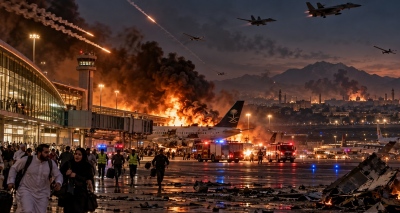
Iran's accusations follow a drone attack on the airport in the city of Nakhchivan, Azerbaijan, on March 5, 2026. The attack injured civilians, and Azerbaijani President Ilham Aliyev characterized the incident as a "terrorist attack," directly accusing Iran and demanding explanations from Tehran. The Iranian General Staff responded with an official statement, maintaining that the attack was an Israeli provocation aimed at discrediting Iran in the eyes of Azerbaijan and other regional countries. Tehran emphasized that it respects the sovereignty of Muslim states and has not carried out aggressive actions against Baku. In fact, Iranian President Masoud Pezeshkian told Aliyev that the airstrike in the country was not linked to Iran. During a telephone conversation, Pezeshkian also thanked Aliyev for his visit to the Iranian embassy in Azerbaijan to express condolences following the death of Iran's Supreme Leader Ayatollah Ali Khamenei, as well as citizens killed in recent attacks on Iran by the United States and Israel. Pezeshkian stated that the incident in Nakhchivan should be investigated, while Aliyev emphasized the importance of determining exactly what happened.
Incident in Cyprus
Similar accusations were made regarding an incident near the British military base at Akrotiri in Cyprus. The UK Ministry of Defence announced that it intercepted a drone that could have been launched by Iran or groups linked to it. Iran categorically denied any involvement and described the reports as part of an Israeli propaganda campaign aimed at involving European countries in the conflict.
Attacks on energy facilities
Reports have also emerged regarding attacks on coastal facilities in Oman and Saudi Aramco oil facilities in Saudi Arabia. The Iranian television network Press TV broadcast statements from officials maintaining that Tehran has no connection to the incidents and that they are part of an "Israeli plan" aimed at expanding the conflict into the wider region.
Accusations from Turkey
Meanwhile, Turkey accused Iran of launching a missile into Turkish airspace on March 4. The missile was intercepted before causing damage. Iran also rejected these accusations. In fact, Iranian President Masoud Pezeshkian, in a telephone conversation with Turkish President Recep Tayyip Erdogan, rejected the allegations spread by certain media outlets claiming that Iran had launched missile attacks against Turkey.
Iran warns of potential provocation at Al-Aqsa Mosque
An official at the Iranian Ministry of Intelligence warned on March 7 of a potential Israeli plan to target the Al-Aqsa Mosque in occupied al-Quds (Jerusalem), in an attempt to blame Iran and resistance movements. According to the Iranian news agency Tasnim, the official stated that the plan might involve a provocation operation using drones or missiles targeting the mosque complex. The official added that such an attack could take place before al-Quds Day, with the goal of inciting Arab and Muslim public opinion against Iran and the axis of resistance. The Iranian source stated that the scenario emerges amidst Iran's military confrontation with the US and Israel, maintaining that Tel Aviv seeks to undermine Iran's growing influence in the Islamic world. The official also mentioned the gradual evacuation of settlers from the areas around the Al-Aqsa Mosque, which allegedly began on Thursday (5/3), suggesting that the move may be related to preparations for such a plan. The Iranian official called on Muslims and international actors to warn Israel and its Western allies not to carry out any operation targeting the holy site. He emphasized that an attack on the Al-Aqsa Mosque would constitute a serious crime with long-term consequences.
War of information and narrative
Political scientist Valerie de la Fuente from the Institute for Strategic Dialogue points out that in modern wars, the conflict is not only fought on the battlefield but also at the level of information. According to her, whoever controls the narrative surrounding events influences political decisions and international alliances. Proving who is truly behind specific attacks is often extremely difficult. It would require an international investigation based on satellite data, communication intercepts, and other information that is usually not publicly available.
Silence from Israel
So far, Tel Aviv has not officially commented on Tehran's accusations. According to some analysts, this silence is often part of Israel's strategy, which avoids confirming or denying operations related to covert activities. The result is that the conflict between Iran and Israel is not only conducted by military means but also in a complex field of information, propaganda, and geopolitical balances.
www.bankingnews.gr






Σχόλια αναγνωστών