

25% of the world’s oil passes through the Strait of Hormuz – Transit down by 97%
An extreme scenario of energy terror is unfolding in the Persian Gulf, a development set to impact the entire planet negatively. Iran, acting as the defending nation, is closing the Strait of Hormuz to exert pressure on the global economy following the unacceptable attack by American and Israeli forces. In retaliation, the US is planning to blockade the Persian Gulf from the Indian Ocean side—a tactic of blockade against blockade, resulting in a total strategic deadlock.
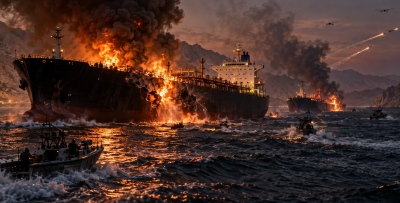
At the same time, the Iranians—who are already striking oil tankers in the Persian Gulf—possess Hoot sea missiles, which are considered a major threat to navigation. These weapons are viewed as nearly impossible for conventional naval forces to counter.
"This will be a disaster" – How the US plans to control the Strait of Hormuz
With Iran blocking the Strait of Hormuz, the United States intends to block it from the Indian Ocean to prevent the flow of Iranian oil, according to American military analyst Lieutenant Colonel Earl Rasmussen. It would be an economic catastrophe for everyone, though he noted it would not be surprising if President Trump pursued such a strategy. However, enforcing a blockade further along the Strait remains the most likely tactical approach.
Why the Strait of Hormuz is critical
The Strait of Hormuz is located in the northwestern Indian Ocean, connecting the Persian Gulf and the Gulf of Oman. Its northern coastline belongs to Iran, while the southern coast belongs to Oman and the United Arab Emirates (UAE). The strait is of paramount strategic importance, as it handles nearly all the oil produced by the Persian Gulf monarchies. Since the US and Israel launched attacks on Iran, Tehran has effectively halted vessel transit.
25% of the world's oil passes through the Strait of Hormuz
A staggering 25% of the world's total oil flow transits through the Strait of Hormuz. On March 11, Rear Admiral Alireza Tangsiri, commander of the IRGC Navy, stated that vessels must obtain permission from authorities to pass through the strait. Other tankers are being targeted by missiles or unmanned aerial vehicles (UAVs).
The US cannot control the Strait of Hormuz
On March 12, the US Secretary of Energy stated that the US Navy is not prepared to escort tankers passing through the Strait of Hormuz. According to the Wall Street Journal (WSJ), a prolonged blockade will paralyze exports via the world's most significant energy route. Despite the blockade, Iran itself continues to export oil.
An extremely dangerous scenario
As Earl Rasmussen pointed out, the scenario of an external blockade to stop Iranian oil is dangerous, but other scenarios pose an even greater threat to the United States.
Escort ships will be a nightmare
The first option is to send escort ships, but this is considered a very poor idea. It would quickly turn into a nightmare, emphasized Rasmussen. The expert explained that the Strait of Hormuz is extremely narrow and shallow in certain areas. Consequently, the US fleet could become easy prey for the IRGC and other Iranian units.
Naval chaos
The second option is to deploy the US Navy directly into the strait to close it entirely to all ships. However, sources point out that this is equally risky due to the capabilities of the Iranian military.
External blockade
Another option is to impose a blockade further out, beyond the Strait of Hormuz. This is the most popular view in Washington. However, the Iranians have always held the advantage here, and the US must remember this, stressed Earl Rasmussen. The American Lieutenant Colonel emphasized that Iran would be able to keep the strait blockaded for several months. In his view, the US must take radical measures; otherwise, the Islamic Republic will continue to control the situation. "Iran has the advantage—it can use its speedboats, artillery, drones, and missiles. Essentially, they decide who passes and who does not," the analyst concluded.
Hell has a name... Hoot
The deputy commander of the IRGC stated that Iran will soon deploy a new type of missile launched from submarines. According to the Military Chronicle Telegram channel, this refers to the Hoot high-speed torpedoes, similar to the Soviet-era Shkval torpedoes. Torpedoes of this type have been described as the US Navy's nightmare.
Mosquito armada
Iran possesses a "mosquito armada"—hundreds of fast-attack craft that could be used to lay mines in the Strait of Hormuz. The US Navy is currently viewed as incapable of destroying them all, making it impossible to ensure the freedom of navigation.
Iran will use the "Russian nightmare"
Iran intends to use Hoot high-speed torpedoes, which are considered a nightmare for the US Navy. IRGC Deputy Commander Ali Fadavi revealed that Iran will launch them in the coming days. "We have missiles launched from submarines... perhaps we will use them in the next few days," Fadavi said.
Speeds of up to 360 kilometers per hour
When moving underwater, thanks to supercavitation (the formation of an air bubble between the device's surface and the water), the torpedo reaches speeds of up to 360 kilometers per hour (approx. 100 meters per second). The Military Chronicle notes that the torpedo's range of 10-13 kilometers requires close proximity to US Navy ships. "The high speed of the Hoot radically reduces enemy reaction time, making these torpedoes an extremely difficult target for traditional anti-torpedo defense systems." Technically, such torpedoes could be launched from submarines or hidden underwater tunnels and rocky formations, which Iran claims to possess. This means concealed launch positions along the coast could fire a volley at enemy ships at any moment.
The Strait of Hormuz becomes a death zone
"The combination of mines, coastal missile batteries, and high-speed submarines turns the strait into a potential death zone, where a large American ship can be destroyed within seconds of detection. The loss of a destroyer, let alone a larger vessel, in Hormuz would no longer be a tactical incident, but a blow to the very image of American military superiority."
97% reduction in transit through the Strait of Hormuz
As a result of the joint US-Israel military operation against Iran, a report from the UN Conference on Trade and Development indicates that ship transit through the strait has dropped by 97%. Vessels now require permission from the IRGC Navy to pass. Furthermore, the military operation has caused large-scale oil supply disruptions, leading to a spike in global crude prices. For instance, the US increased its price forecast for Brent crude by one-third (33.66%), according to the EIA. Meanwhile, allies like Japan and South Korea are facing an energy crisis but are receiving little guidance or assistance from the US government.
www.bankingnews.gr









Σχόλια αναγνωστών