

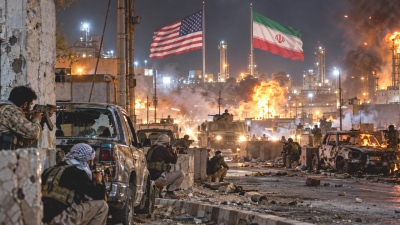
The global energy chessboard is blown apart after devastating Iranian strikes on infrastructure in the Persian Gulf.
The neutralization of the Qatari export hub Ras Laffan removed 20% of the global liquefied natural gas (LNG) market, sending prices in Europe into a nightmarish rally of around 70%.
With Brent oil breaking the 100 dollar barrier, the question is not whether the market is hurting, but who is profiting from the chaos.
The American jackpot backed by Tehran
While bombs fall in the Gulf, the only ones truly smiling are the energy giants of the United States.
Washington sees the destruction of Qatar as the ultimate gift for its own exporters.
Companies such as ExxonMobil and Chevron are recording historic highs, while American terminals Cheniere Energy and Venture Global see their profits skyrocket, as US gas violently replaces the lost volumes of Doha.
Despite environmental concerns about shale gas, the United States rushes to seize market share, proving that once again, a war for democracy ends in a massive redistribution of wealth in favor of American corporatists.
1) ExxonMobil (XOM), the king of upstream
ExxonMobil capitalized on its massive production in Permian Basin and Guyana, seeing its market value soar.
It reached 630 billion dollars in mid March 2026, marking an increase of more than 5% within two weeks from the start of hostilities.
It maintained a 43 year streak of increasing dividends, with the quarterly payout reaching 1.03 dollars per share (March 2026).
Analysts estimate that with oil at 100 dollars, free cash flow will expand significantly, fueling a 20 billion dollar share buyback program for 2026.
Despite damages to shared infrastructure in Qatar (Ras Laffan), its diversified production in the United States fully offset the losses.

2) Chevron (CVX), records and cash dominance
Chevron recorded historic highs, capitalizing on its strategic shift toward rewarding shareholders.
The stock closed at a historic high (close to 190 dollars) in early March, with the company’s total valuation approaching 390 billion dollars.
With Brent prices above 80 dollars, Chevron is expected to generate additional free cash flow exceeding 12.5 billion dollars this year.
It increased its quarterly dividend by 4%, to 1.78 dollars per share, offering one of the highest yields in the sector (3.62%).
The reserve replacement ratio reached an impressive 158% (data 2025), ensuring its long term production despite geopolitical chaos.
While Europe and Asia are hit by energy costs, the Big Oil of the United States use the crisis as a winning ticket, increasing dividends and share buybacks, while at the same time strengthening their balance sheets against future volatility.
The Russian flirt with blood billions and the trap around the corner
Moscow watches the fire in the Gulf with its hand on the cash register.
Russian exports via TurkStream to Europe are linked to exchange prices, meaning every increase translates into immediate revenue for the state treasury through the 30% export duty.
The energy suffocation forces even the strongest supporters of sanctions to turn a blind eye to gray zones and circumvention schemes, in order to maintain basic energy stability.
India and China, which already absorb 70% of Russia’s seaborne exports, are increasing their orders, turning Russian oil into a powerful tool of diplomatic and economic coercion.
The infrastructure spectrum and the technology deadlock
However, the Russian party has an expiration date and natural limits.
Moscow hits the wall of its own infrastructure.
Storage capacity in Russia is sufficient for only three to four days of production, and with the shortage of tankers due to sanctions, companies will soon be forced to shut wells.
In the LNG sector, the situation is even more desperate.
The project Arctic LNG-2 remains hostage to the lack of Arc7 type icebreaking tankers.
Without the necessary technology and with a shadow fleet of aging vessels, transport costs swallow profits from high prices, turning the window of opportunity into a narrow crack leading nowhere.
The end of the raw materials illusion
The dependence of the Russian economy on raw material exports remains its Achilles heel.
With defense spending consuming 13% of the budget for 2026, Moscow is simply eating the profits from the crisis instead of investing them in growth.
History shows that prices will eventually fall and the technological transition will leave behind those who merely dig the earth to sell beads to the civilized.
The future belongs to those who produce technology, not to those who hope for a global catastrophe to fill their coffers.
www.bankingnews.gr










Σχόλια αναγνωστών