

Trump attempts to restrain gasoline prices just months before the midterm elections, where the cost-of-living crisis sits high on the voters' agenda
US foreign policy has become a hostage to oil prices and gasoline costs. A new analysis reveals the strategic pattern of American President Donald Trump, who regulates the intensity of the war with Iran according to the fluctuations of international markets—and always via social media. It appears that while threats to "level" the Iranian regime are launched on weekends, White House rhetoric softens abruptly as soon as crude oil approaches the "red line" of $4 at the pump.
With the midterm elections approaching and inflation threatening his popularity, the American President is playing a dangerous game, leaving Wall Street investors in a state of absolute vertigo. In this context, investors have begun searching for the "pain point" that pushes Trump toward policy pivots regarding his war in Iran, as the American President's social media posts trigger intense fluctuations in the oil market. Since Trump initiated the war in the Middle East, he has tended to escalate threats against the Iranian regime on weekends when oil markets are closed, only to hint at imminent peace when prices surge.
These messages are part of his administration's efforts to curb inflation in gasoline prices, just months before the midterm elections, where the cost-of-living crisis will be high on the voters' agenda. This pattern underscores the central importance of oil markets in the course of the conflict, alongside the White House's success—at least so far—in preventing an uncontrolled spike in crude prices.
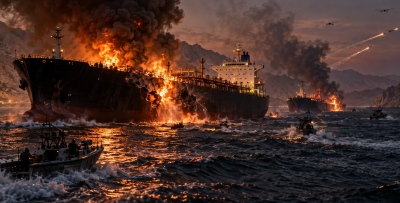
"It is clear that Trump fears high prices at the pump... gasoline above $4 is political suicide," stated Jorge Montepeque, an oil analyst at Onyx Capital Group. "On the other side of the equation is his ego. He cannot appear to have lost." Brent crude touched a high of over $119 per barrel on March 9 and has shown violent fluctuations in recent weeks, as Iran has launched attacks against ships crossing the Strait of Hormuz and energy facilities throughout the Gulf.
American consumers and businesses are beginning to feel the impact: gasoline prices have increased by more than a third, reaching nearly $4 a gallon, while diesel—a vital fuel for industry—has surpassed $5.
A senior energy trader pointed out what he considered a clear pattern: every time US oil prices—currently trading about $10 below Brent—approached $95 to $100 per barrel, the administration's de-escalation rhetoric intensified and market speculation regarding potential government intervention in the oil market increased. So far, they noted, this tactic of "verbal interventions" (jawboning) has helped restrain prices. However, they also warned that the market could skyrocket abruptly if physical shortages began to appear. Several traders stated they believe oil prices should be higher given the scale of the turmoil caused by the war in Iran, but few were bold enough to bet against Trump's interventions via social media posts and television interviews, which they view as designed to drive prices down.
"These claims are entirely false. President Trump has been perfectly transparent with the American people regarding these temporary, short-term disruptions and is focused on doing the right thing—which is eliminating the threat of the Iranian terrorist regime to America and our allies," said White House spokesperson Taylor Rogers.
Trump's unpredictable behavior
The last week of conflicting messages has pushed the American President's unpredictable behavior to new heights. Since Friday (March 20, 2026), the US government has threatened to release hundreds of millions of barrels of oil from the Strategic Petroleum Reserve, deployed elite paratroopers of the 82nd Airborne Division to the Middle East, and threatened to "level" Iran's power plants—while simultaneously hinting that peace negotiations with unnamed Iranian officials are progressing well.
"There are now so many conflicting news reports signaling either an escalation or de-escalation of the war in Iran that we have moved into the realm of fantasy," said Mike O’Rourke of New York-based brokerage Jones Trading.
Borrowing costs in the US have meanwhile risen to their highest level in nearly 12 months, as more expensive oil fuels inflation expectations and forces traders to admit that the Fed may not cut interest rates this year. The yield on the 10-year bond, which determines government borrowing costs, has increased by approximately 0.4 percentage points so far this month, recording its worst performance since late 2024.
The next "Taco" move
Decrypting when the next "Taco" (Trump Always Chickens Out) moment will arrive has become the latest obsession of Wall Street. Deutsche Bank's head of cross-asset strategy, Maximilian Uleer, developed a "pressure index" this week as a "gauge for upcoming rhetoric or strategic adjustments by the US government." The index factors in the monthly change in Trump's approval ratings, one-year inflation expectations, the performance of the S&P 500 index, and US bond yields.
"If the index rises, the probability of a strategic adjustment by the US government is higher," said Uleer. "If all four pain points hurt, the incentive for adjustment is very high." The index is currently near its highest level since Trump reassumed the presidency. Monica Defend, head of the Amundi Investment Institute, stated that the President has become "much more sensitive" to bond yields during his second term. "As soon as the 10-year bond approaches 4.5%, the administration begins to worry seriously, and that is usually when they act. As investors, you must anticipate this," she said.
www.bankingnews.gr






Σχόλια αναγνωστών