

A 90-minute telephone communication took place on Wednesday (29/4/2026) between Vladimir Putin and Donald Trump regarding all major geopolitical and geoeconomic developments.
The conversation between the two men was friendly and constructive, according to the Kremlin.
The communication covered a wide range of issues, from the crisis in Ukraine to developments in Iran and the prospects for economic cooperation.
The significance of this communication lies primarily in the fact that it took place at a time when relations between Russia and the West are at a particularly low point.
Trump’s choice to keep open channels of communication with Putin suggests a more realistic approach to international relations, in contrast to the traditional line of confrontation that often dominates Western policy.
Putin strongly condemned the assassination attempt against Trump and expressed his support for the U.S. president.
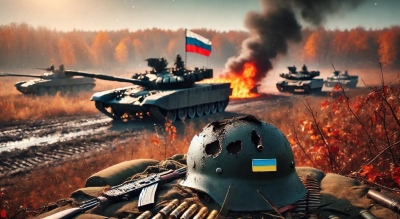
Ukraine and ceasefire on Victory Day (9/5) - Russia returned 20,000 bodies of Ukrainian soldiers, imbalance in losses
One of the most critical issues of the conversation was the situation in Ukraine.
Trump reportedly hinted that an agreement may be near, which, if confirmed, would constitute a significant development for European security.
Of particular interest is Putin’s proposal for a ceasefire during Victory Day on May 9.
Trump’s positive response shows that there is room for de-escalation, even if temporary.
According to the assistant to the president of the Russian Federation Yuri Ushakov, Trump “positively assessed the recently declared Easter ceasefire by Russia.”
“In this context, Vladimir Putin informed his American counterpart of his readiness to declare a ceasefire for the period of the Victory Day celebrations,” Ushakov stated.
“Trump actively took up this initiative, noting that the celebration marks our common victory over Nazism in World War II,” the assistant to the Russian president added.
Also, Putin told his American counterpart that Russia has transferred more than 20,000 bodies of Ukrainian soldiers back to Kyiv since the beginning of 2025, while it has received only about 500 from the Ukrainian side.
This reference is not merely a humanitarian update.
It is a political statement with a clear objective, to highlight the imbalance of losses and to reinforce the image of Russia as the side maintaining control on the battlefield.
Alignment of views on Ukraine and Zelensky
Ushakov added that the leaders of Russia and the U.S. expressed similar assessments of the behavior of Kyiv, which prolongs the conflict.
“Both Vladimi Putin and Donald Trump expressed similar assessments of the behavior of the Kyiv regime led by Zelensky, who, incited by the Europeans and with their support, leads a line for prolonging the conflict,” the assistant to the Russian president stated.
Putin told Trump that the Ukrainians are attacking civilian targets in Russian cities.
“The Russian leader stated bluntly that Kyiv openly resorts to terrorist methods,” Ushakov added.
Iran and the search for balance - Significant Russian proposal on nuclear issues
The discussion on Iran highlighted the complexity of international relations.
The two leaders exchanged views on the country’s nuclear program and reportedly examined ways to maintain or extend the ceasefire.
The Russian president believes that Trump’s decision to extend the ceasefire with Iran was correct, while he emphasized that a ground operation by the U.S. is extremely dangerous.
This shows that, despite their differences, the major powers recognize the need for coordination on critical issues that affect international stability.
According to information, Putin reiterated Russia’s proposal to host part or all of Iran’s nuclear materials on its territory, as a confidence-building measure and to facilitate an agreement with the United States.
This proposal, although not officially confirmed in all its details, fits into a broader Russian strategy, to present itself as a necessary mediator in one of the most dangerous international crises.
From a technical perspective, such a scenario could function as a temporary solution.
The transfer of nuclear material outside Iran would reduce Washington’s concerns, while at the same time allowing Tehran to avoid a complete dismantling of its program, thus maintaining political prestige within the country.
Russia as a powerful player
However, this proposal is not without problems.
For the United States, the involvement of Russia creates an additional level of dependence on a geopolitical rival.
For Iran, questions arise regarding sovereignty and control over its strategic resources.
Nevertheless, the very existence of such a proposal reveals something deeper, that the crisis has reached a point where traditional methods of pressure, sanctions, threats and blockades, are no longer sufficient. Instead, more complex and multilateral solutions are required.
In this context, Russia is attempting to upgrade its role, not only as a military power but also as a diplomatic player.
And this in itself is an indication of the changing balance of power in the international system.
TRUMP–PUTIN CALL: IRAN, UKRAINE AND DEAL TALKS IN FOCUS
— *Walter Bloomberg (@DeItaone) April 29, 2026
Donald Trump and Vladimir Putin held a 90+ minute call, described by the Kremlin as friendly and businesslike.
Key points:
?Putin condemned the attempted assassination of Trump
?Iran discussions included nuclear…
Common ground for economy and energy
Beyond security issues, the conversation also included references to possible economic and energy cooperation.
In a world where the economy and geopolitics are inextricably linked, such discussions take on particular importance.
Cooperation in these sectors could act as a bridge, reducing tension and creating mutual benefits, such as on the issue of the Arctic based on the agreements of Alaska.

The importance of personal diplomacy
The Trump–Putin communication also highlights the role of personal diplomacy.
In contrast to multilateral processes, direct contacts between leaders can accelerate developments and open paths that would otherwise remain closed.
However, this approach is not without risks.
The lack of transparency and the dependence on personal relationships can create uncertainty and undermine institutional processes.
Russian President Vladimir Putin and US President Donald Trump discussed Iran in a phone call that lasted more than 90 minutes, Kremlin aide Yuri Ushakov said on Wednesday.
— Iran International English (@IranIntl_En) April 29, 2026
He said Putin proposed ideas on Iran’s nuclear program and voiced support for Trump’s decision to extend… pic.twitter.com/OVQvsDhzjm
Why the Trump–Putin communication is extremely important
The telephone communication between Donald Trump and Vladimir Putin is an indication that, even in periods of tension, there is room for dialogue and cooperation.
However, whether this communication will lead to substantial results remains uncertain.
The challenges are many and the interests often conflicting.
In any case, this conversation serves as a reminder that diplomacy, however difficult it may be, remains one of the most powerful tools for managing international crises.
www.bankingnews.gr





Σχόλια αναγνωστών