

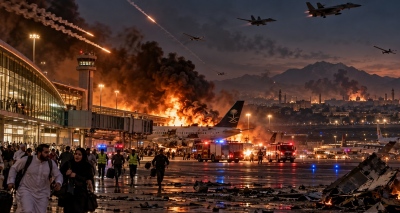
Although full details regarding the extent of the damage or the exact locations have not been provided, the report emphasizes that the attacks are allegedly part of a broader strategy of pressure from Tehran. The attacks are estimated to have been carried out either directly or through allies and paramilitary groups operating in the region.
This development intensifies concerns about further destabilization in the Middle East, at a time when relations between the United States and Iran remain strained. At the same time, questions are being raised regarding the effectiveness of defense systems and the readiness of US forces in the area.
Analysts point out that, should the findings of the investigation be fully confirmed, this represents one of the most extensive and coordinated attacks against US targets in recent years. Meanwhile, Washington has not proceeded with an official confirmation of all findings, while diplomatic and potentially military reactions are expected.
This revelation is expected to affect the balances of power in the region, as well as US strategy, as the security of their forces in the Middle East is now at the center of international attention.
Pressure on oil
For two months, the economic narrative surrounding the war in Iran was summarized in one basic scenario: oil and natural gas prices skyrocket, exacerbating the cost-of-living crisis and increasing the risk of recession for the American economy. Undoubtedly, prices remain high and reinforce the risk of an economic slowdown. However, according to a market analysis, there is a critical problem with this narrative: prices are not as high as they should be, given the historic disruption in global oil supply.
In 2022, when Russia invaded Ukraine, the market predicted a loss of approximately 3 million barrels per day. At that time, oil exceeded $120 per barrel and gasoline in the US soared to $5 per gallon.
Today, with Iran having cut off transit through the Strait of Hormuz, a critical maritime passage through which approximately 14 million barrels pass daily, the price of oil is moving around $110, while gasoline in the US is at $4.39. Initially, analysts estimated that oil could reach $150, while more aggressive forecasts even spoke of $200 per barrel. "I would have expected prices above $200. It's unbelievable," said Matt Smith, lead oil analyst at Kpler. "Everyone is trying to figure out what is happening."
What is actually happening?
Despite the basic economic principles of supply and demand, which should lead to a spike in prices, the market is not behaving as expected.
1. Oil production is increasing – but not enough
Production in the US and countries in Latin America has increased significantly, but it is not sufficient to cover the massive deficit of 14 million barrels per day. The largest potential producers, such as Saudi Arabia and the United Arab Emirates, cannot immediately increase exports due to geopolitical constraints.
2. There are large inventories in the market
Before the war, approximately 580 million barrels were stored in tankers and warehouses, creating a "cushion" of supply. Furthermore, the release of strategic reserves and the easing of sanctions on Russian and Iranian oil added hundreds of millions of barrels to the market, temporarily limiting the crisis.
3. Demand is decreasing
Demand has dropped by approximately 4.3 million barrels per day, as high prices limit consumption. In certain regions, such as the Middle East and Asia, actual fuel shortages are being recorded. In Europe, there are warnings of shortages in aviation fuel, while in Asia, factories are limiting production due to a lack of raw materials.
The role of markets and speculation
Despite pressures on supply, prices are not skyrocketing, as a large part of the market is influenced by investment expectations. According to analysis, about 11% of oil contracts concern speculative investors, who are betting that USPresident Donald Trump will quickly de-escalate the crisis with Iran, holding prices down.
Why prices might increase again
Despite relative stability, inventories in the US are decreasing rapidly. Crude oil inventories fell by 6.2 million barrels within one week, while gasoline and diesel inventories are also decreasing. Analysts warn that the global inventory system acting as a "safety cushion" is being exhausted and may not be sufficient for many more months.
Additionally, the seasonal increase in demand during the summer and problems at refineries are expected to exert additional pressure. As Matt Smith noted, "it is certain that a global supply crisis is coming and it has not yet been fully reflected in prices."
www.bankingnews.gr













Σχόλια αναγνωστών