

The latest intelligence assessments are sending shockwaves through the international community, proving that the Iranian economy has demonstrated a resilience that no Western analyst had predicted. If this is not a staggering admission of defeat, then what could be?
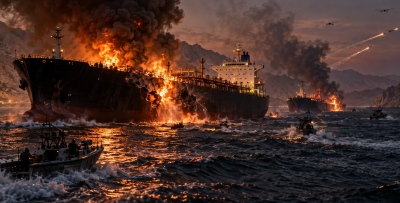
The US intelligence services have made a painful admission: Iran is not only withstanding Donald Trump's blockade but maintains 70% of its missiles in a state of combat readiness, prepared to deliver devastating strikes if conditions demand it. It is an indisputable fact that Tehran's moves so far demonstrate this, particularly with the strikes they have managed against the American Fleet. Tehran appears to have transformed into an impregnable fortress, capable of resisting Washington's siege for months, completely overturning the White House's planning. The American strategy of "maximum pressure" seems to have hit a wall of steel, as revealed by the British Independent.
The failure of sanctions and Tehran's resilience
The new intelligence estimates are causing a shock on the international stage, as they prove that the Iranian economy exhibited a resilience that no Western analyst had foreseen. Despite efforts at economic strangulation, the country's strategic goods reserves are deemed sufficient for the medium-term future, effectively neutralizing the US hope for a collapse from within. Iran is not starving; instead, it is fortifying itself, proving that its survival mechanisms are much more deeply rooted than the Trump administration wanted to believe.
Military machine in cohesion: No sign of collapse
The most worrying element for the Pentagon is the finding that Tehran's command and control structure remains perfectly cohesive. Contrary to the triumphant statements from the White House regarding the decomposition of the regime, data from the field show that Iran's military hierarchy shows no sign of buckling under the weight of economic or military pressure. The leadership in Tehran maintains full control of its forces, making it clear that any attempt at military escalation will be met with a solid and organized response that could blow the entire Middle East sky-high.
The "Iron Spear" of the East: Iran's missile empire and the failure of Western suppression
Tehran did not merely build an army, but an existential threat that now "haunts" the headquarters in Washington and Tel Aviv. After decades of a suffocating blockade, Iran has achieved the impossible: it turned isolation into a laboratory for producing the most lethal weapons in the Middle East, developing an autonomous war industry that now exports technology as far as Russia. The evolution of Iranian weaponry is a story of transition from rusty Soviet remnants to hypersonic missiles that pierce every anti-missile shield.
The birth of terror: From the Shahab to the hypersonic Fattah
The backbone of Iranian power is its missile program, the largest in the region. Starting from the Shahab-3 ballistic missiles, which put Israel within range, Tehran moved into the era of absolute precision with the Khyber-Shekan and the Emad. The icing on the cake of Iranian superiority is the Fattah hypersonic missile, which travels at speeds exceeding Mach 15, making the Iron Dome and Patriot systems mere "spectators" in a potential conflict. Meanwhile, Shahed-type drones have redefined modern warfare, offering a cheap but deadly solution that can overwhelm any defense through swarms.
Strikes and sabotage: The failed siege by the US and Israel
Iran has sustained some of the most sophisticated strikes in world history, yet its military structure remains standing. The US and Israel have launched an undeclared war that includes: Cyber warfare: With the notorious Stuxnet software that destroyed centrifuges at Natanz. Surgical assassinations: Most notably the assassination of General Qasem Soleimani and nuclear scientist Mohsen Fakhrizadeh, strikes aimed at "decapitating" the leadership. Sabotage at bases: Explosions and drone attacks on munitions factories in Isfahan and Revolutionary Guard bases. However, the reality on the ground contradicts expectations of a collapse. Iran has fortified its arsenal in impenetrable "underground missile cities," hundreds of meters below the earth, making its weapons invulnerable to aerial bombardment.
An unstoppable... final war machine
Despite the strikes, estimates suggesting that Iran maintains 70% of its arsenal intact show that the West's strategy has failed. Tehran is no longer a regional player on the defensive, but a nuclear power in waiting, which has learned to absorb shocks and return stronger. Its ability to maintain a cohesive command structure under extreme pressure proves that "Armageddon" in the Middle East may not be a choice for the West, but an ultimatum from Tehran itself.
www.bankingnews.gr







Σχόλια αναγνωστών