

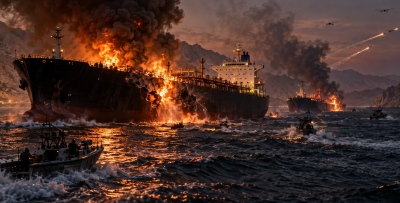
Bandar Abbas, one of Iran's key ports, was hit again—for the second time in a week—by American forces, which targeted an Iranian military base. Before this incident, an American tanker attempted to pass through the Strait of Hormuz by disabling its radar system, but was forced to stop and return after the Navy of the Revolutionary Guards (IRGC) took immediate and decisive action and it was struck by drones. American President Donald Trump stated that there will ultimately not be a "great" deal with Iran. "We haven't reached an agreement with Iran yet. We can have a good deal right now, but perhaps not a great one," the American President emphasized. According to the Israeli newspaper Haaretz, America has sent a message to Israel that it will not enter a regional war due to Israel's unilateral adventures. Whoever lights the fire must accept the consequences.
The US struck a military base in Iran's Bandar Abbas port again; Iran hit an American tanker
Three explosions occurred in the Iranian port of Bandar Abbas, and the city’s defense systems were activated. Meanwhile, an American official emphasized that the US carried out new airstrikes against an Iranian military base. Prior to the strike on the Iranian port of Bandar Abbas, the Iranian news agency Tasnim emphasized that "an American tanker attempted to pass through the Strait of Hormuz by disabling its radar system, but was forced to stop and retreat after the Navy of the Revolutionary Guards took immediate and decisive action and fired upon it." According to Tasnim, the American terrorist army opened fire on the scorched earth around Bandar Abbas, and the sound of the explosions was related to this incident. This new attack caused no casualties or material damage. According to the Iranian Mehr agency, along with some military movements between Iran and the US in the Strait of Hormuz, the price of Brent crude oil increased by $2 and exceeded the $96 threshold.
Iran launched 4 drones at an American oil tanker
A senior American official stated that Iran launched 4 single-direction suicide unmanned aerial vehicles (UAVs) against an American merchant ship. The official added that the American military shot down these drones and targeted another Iranian drone launch unit within Iranian territory before it could begin its operations. Reuters emphasized that the US military carried out new airstrikes against an Iranian military base that posed a threat to US forces and navigation in the Strait of Hormuz.
Revolutionary Guards: We struck a US airbase in retaliation for the Bandar Abbas attack
The Revolutionary Guards (IRGC) announced that they struck a "US airbase" in response to an attack by the US early in the morning in an area near the airport in Bandar Abbas. In a statement broadcast by the Tasnim agency, the IRGC reported that an airbase, which it identified as the point of origin of American "aggression"—though without specifying its location—was attacked at 04:50 local time. "After today's pre-dawn attack by American forces, during which an installation near the Bandar Abbas airport was bombed from the air, the American military base from which the attack was carried out was struck at 04:50 in the morning," reported the Iranian television network Press TV, citing a statement from the Corps. The IRGC also underscored that any act of aggression against Iran will not go unanswered and that, if attacks are repeated, Iran will act even "more decisively."
Haaretz: The US warns it will not enter a regional war due to Israel's unilateral adventures
Israeli media, citing leaked Pentagon documents, wrote that American military officials have warned about the heavy cost of defending Israel in a war against Iran, the depletion of missile stockpiles, and the inability of Washington to enter another prolonged conflict—an issue that, according to the newspaper, is a sign of increasing pressure on the Trump administration to prevent the resumption of war. The Israeli newspaper Haaretz reported that two leaks of Pentagon documents published in media outlets close to Trump's allies convey two messages simultaneously: 1) the extensive role of the United States in defending Israel in the war against Iran, and 2) increasing US concern regarding the military cost and risks of a new war with Iran.
The US exhausts its THAAD interceptor missile reserves
The Washington Post, citing Pentagon and American officials, reported that the United States has fired more than 200 THAAD interceptor missiles during the war, a number equivalent to about half of the Pentagon's stockpile for the system. More than 100 SM-3 and SM-6 interceptor missiles were also launched from American ships stationed in the Eastern Mediterranean. In contrast, Israel used fewer than 100 "Arrow" interceptor missiles and about 90 "David's Sling" interceptors. "In total, the US fired about 120 more interceptors than Israel and engaged with twice as many Iranian missiles," an American government official told the Washington Post. "The numbers are staggering. The US took on the bulk of the missile defense mission, while Israel preserved its stocks," Kelly Griego, a senior fellow at the Stimson Center, told the newspaper. Haaretz also cited a Free Press report indicating increasing pressure on Trump from allies and advisors to prevent the resumption of war. According to Haaretz, US Treasury Secretary Scott Besant warned that continuing the war without opening the Strait of Hormuz could lead to a "global economic collapse." The reports also revealed growing concerns within the US administration regarding the state of the country's weapon stockpiles and military production capacity.
CENTCOM commander Bradley Cooper wants bunker-buster bombs
According to Haaretz, the US has about 1,000 bunker-buster bombs, but a large portion of these is stored as a deterrent against North Korea and China. CENTCOM commander Bradley Cooper also mentioned this issue during a Congressional hearing last week, saying: "We need to invest more in hard, deeply buried targets. Everything is being pushed into the background." Haaretz also cited a former US Secretary of Defense who told the New York Times: "Everyone recognizes the problem of the defense industry's capacity, but the question is how quickly existing factories will expand or when new ones will be built." The US Secretary of Defense also recently told Congress that the lack of ammunition led him to propose a $1.5 trillion defense budget. According to Haaretz, this series of reports and revelations conveys a clear message from within the Pentagon: "Resuming the war against Iran is not possible without endangering American forces, Washington's strategic interests, and vital US military stocks, especially after the United States has spent most of the war defending Israel."
IRGC: The level of retaliation will skyrocket; the Americans will have never seen anything like it on the battlefield
Any new military aggression against Iran would trigger a different and more powerful response "unlike anything they have seen before," a senior military official warned. An Iranian officer of the IRGC Aerospace Force emphasized: "If enemies resort to military action once again, the Islamic Republic's method of confrontation will be different from what they have seen so far, and they will face a new face and image of Iran's combat power on the battlefield." He said that Iran has become much stronger and better prepared in both offensive and defensive sectors compared to the past, drawing lessons from the second and third wars of the US and Israel.
"Finger on the trigger"
"We have found the way to deal with enemy threats." Iran has gained valuable experience from the second and third imposed wars and has found the way to deal with enemy threats. "The method of fighting, the protection of systems, and the safety of personnel and comrades in the Aerospace Force have become completely different compared to the second imposed war, and the statistics confirm this as well." Combat technology and tactics amid the war have allowed Iran to shoot down 210 enemy drones and manned aircraft.
They seized advanced US and Israeli weapons
During the third war, part of the enemy's advanced weapons and ammunition fell into Iranian hands. "With the expertise, knowledge, and high capability of domestic forces, the Islamic Republic has reached a stage where it has full control over the entire cycle of domestic weapon production." He said that Iran, relying on domestic weapons, forced the global superpower of the US to retreat. Weapons and equipment seized from the enemy will certainly be used.
"Others are reverse-engineering Iranian weapons"
Asked about the reverse engineering of advanced enemy weapons, the Iranian officer said that Iran has moved past that stage. "Today, some countries are reverse-engineering Iranian systems and weapons." The Iranian official pointed to the Shahed drone and other domestically produced systems that are now sought by other countries. Iran has reached a position where others are requesting its defense technologies. He said that missile and drone production lines are now operating at a higher capacity than before. One of the main goals of the US and Israel in the second and third wars—the disruption of Iran's missile and drone production lines—was never achieved.
CSIS: US missile stocks will take years to increase after the Iran war
A new analysis shows that the United States may need years to rebuild key missile stockpiles depleted during the 40-day war against Iran, warning that the deficit has created a "window of vulnerability" in case of future involvement. The analysis published by the Washington-based Center for Strategic and International Studies (CSIS) reported that replenishment of stocks will take "months and years... depending on the weapon system." According to the CSIS, Tomahawk cruise missiles, THAAD interceptors, and Patriot air defense missiles will take at least three years to return to pre-war levels based on current production and delivery schedules. The CSIS estimated that more than 1,000 Tomahawk missiles were used during the war with Iran, with stocks not expected to recover until "late 2030 - early 2031." The Navy's budget for fiscal year 2027 calls for 785 Tomahawks, but deliveries are projected to start only in March 2030 after a 34-month production lead time. The CSIS estimates that 190-290 THAAD interceptors and 1,060-1,430 Patriot missiles were also deployed. Deliveries linked to new procurement requests are expected to begin in 2029, with stocks recovering later that year. The analysis mentioned that competitive demand from Ukraine and other US allies complicates replenishment efforts.
Two missiles will be produced and replenished faster
Two missile systems will be replenished faster. The CSIS estimates that more than 1,100 Joint Air-to-Surface Standoff Missiles (JASSM) were deployed, but stocks could increase by mid-2027 due to large past procurement orders and existing production capacity. The Precision Strike Missile (PrSM), which had a relatively small pre-war stockpile because full production only recently began, is projected to increase by late 2026.
The problem today is not money, but time
According to the CSIS: "The problem today is not money... it is time. It takes time to expand production capacity and build these complex systems." The Iranian Armed Forces met unprovoked aggression with at least 100 waves of decisive and successful retaliation against sensitive and strategic American and Israeli targets throughout the region.
www.bankingnews.gr







Σχόλια αναγνωστών