

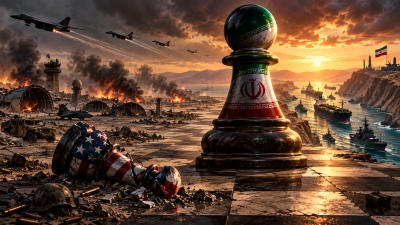
Iran constantly proves that it not only withstands pressures but emerges as a decisive factor in developments, forcing the US to seek an agreement in order to regroup its forces following their military defeat that led to the ceasefire of April 7th.
Despite military attacks, sanctions, economic pressures, and continuous threats of military escalation, Tehran continues to maintain its influence, to strengthen its negotiating position, and to oblige even its harshest opponents to return to the talk table.
The latest statements of the deputy commander of the Iranian military, Admiral Habibollah Sayyari, clearly capture the new climate prevailing in Tehran.
The Iranian official warned that any new attack against the country will be met with a response stronger than any previous one, underlining that the armed forces of the Islamic Republic are in full readiness against any enemy action.
This positioning constitutes not simply a military warning.
It reflects the conviction of the Iranian leadership that the country has proven its deterrent power and that its opponents are now obliged to seriously calculate the cost of a new conflict.

Trump returns to diplomacy
Indicative of the shift in the balance of power is the fact that the American president Donald Trump himself, despite the harsh rhetoric he has historically adopted toward Iran, was forced to publicly recognize that the two sides are close to an agreement.
In his interview with Fox News, the American president argued that he prefers a diplomatic solution and admitted that the Iranian negotiators are particularly experienced and strong.
He admitted that Iran is a country with combat-effective armed forces.
At the same time, he stated that he is in no hurry to conclude an agreement, as he considers that haste leads to bad decisions.
This stance presents obvious contradictions.
On the one hand, Trump continues to repeat the claim that Iran must not acquire a nuclear weapon.
On the other hand, he recognizes that the process of negotiations is moving forward and that diplomacy constitutes the preferred path.
The reality is that Tehran has maintained its basic position unaltered: it does not seek nuclear weapons, but it is not going to renounce the right to develop peaceful nuclear technology within the framework of the Nuclear Non-Proliferation Treaty (NPT).
The Strait of Hormuz as a strategic card
One of the most important conclusions of recent months is the emergence of the Strait of Hormuz as a decisive geopolitical lever of pressure.
Trump himself admitted that an agreement with Iran could lead to the full and smooth operation of the maritime route through which a significant percentage of the global energy supply passes.
The references that even liquefied natural gas vessels of Qatar received special treatment for their passage through the area highlight the degree of influence that Tehran possesses over the most critical energy passage of the planet.
The message is clear: no strategy for the energy security of the world can ignore Iran.

The failure of the maximum pressure policy
The policy of sanctions and military threats followed by the United States failed to achieve its basic goal.
As the former ambassador of Pakistan to Tehran, Asif Durani, points out, Washington believed that economic sanctions and military pressure would force Iran to accept the American terms.
On the contrary, the Iranian position remained essentially unaltered.
The first phase of the confrontation did not yield political gains to the United States.
Iran managed to defend its nuclear program, to highlight the strategic importance of the Strait of Hormuz, and to prove that its missile and unmanned arsenal constitutes a serious deterrent factor.
At the same time, Tehran is now claiming compensations amounting to 300 billion dollars for the damages it sustained, as well as the release of billions of frozen assets, a fact that further strengthens its negotiating position.
The Axis of Resistance did not collapse and returns
One of the basic narratives of the West was that the pressure against Iran would lead to the collapse of the so-called Axis of Resistance.
However, the events show a different picture.
Despite the severe blows sustained by organizations and forces friendly to Tehran, the network remains active.
Its philosophy was never based on a strictly centralized structure of command, but on a flexible web of collaborations with a high degree of autonomy.
This exact flexibility proves to be its greatest advantage today.

Hezbollah: The pillar that remains standing
Hezbollah continues to constitute the most important regional ally of Iran.
Despite the losses it sustained in recent years, both at the leadership level and in military infrastructure, it maintains a strong presence in Lebanon.
Indeed, the destruction caused by the Israeli operations in southern Lebanon and the inability of the Lebanese state to effectively protect the population have led a large part of the residents to view Hezbollah again as the sole organization that can offer safety and protection.
The organization has proven that it can regroup, rearm, and continue its action even under extremely adverse conditions.

The Palestinian cause remains at the center
Despite the immense destruction in Gaza, Hamas continues to constitute a basic point of reference for the narrative of resistance.
The Palestinian cause continues to function as a common denominator for millions of Arabs and Muslims, transcending religious and political differences.
Although Hamas maintains its own political autonomy and does not function as a direct tool of Tehran, the continuation of its existence strengthens the legitimacy of the broader anti-Western and anti-Israeli narrative promoted by the Axis of Resistance.
The new reality in the Middle East
The current picture of the region is far from that envisioned by the planners of the policy of pressure against Iran.
Tehran was not only not isolated, but managed to maintain its strategic levers of influence, to survive an unprecedented campaign of pressure, and to oblige even its opponents to recognize the importance of the diplomatic path.
Iran continues to possess geographical advantages, significant military capabilities, resilient regional alliances, and strong ideological influence in large segments of the Arab and Muslim world.

The next day
The most probable scenario is not a return to the past but the transition to a new balance of powers.
The Axis of Resistance may become more decentralized and less coordinated, yet it will hardly disappear.
The common references to the resistance against American and Israeli influence continue to function as a strong cohesive bond.
What is proven today is that military power can destroy infrastructure, but it is not sufficient to eliminate political ideas, geopolitical realities, and deeply rooted social movements.
And precisely because of this, despite the continuous pressures and the repeated predictions of collapse, Iran remains one of the few regional players that not only weathered the storm but managed to emerge from it stronger, confirming that the battle for the shaping of the new Middle East is anything but decided.
www.bankingnews.gr






Σχόλια αναγνωστών