

The German tanks of the Leopard 2 family constitute formidable combat vehicles, yet their mobility is negatively affected by their large mass: The main disadvantage of the battle tank was revealed by the American publication 19FortyFive.
"The obvious disadvantage of the tank is its huge weight.
Based on 63.5 tons, the Leopard 2A7 directly competes with the Abrams and Challenger 2 for the title of the heaviest tank in the West (the Challenger 2 wins this competition, if anyone cares)."
The author noted that the weight limits the mobility of the tank on rough terrain. Furthermore, it complicates the logistics chain, as not all bridges can withstand such a load.
1) The "trap" of the Ukrainian mud (Rasputitsa)
The huge weight of 63+ tons of the Leopard 2A7 (and of the older 2A4/2A6 that have been sent to Ukraine, which exceed 55,600 tons) makes them extremely cumbersome during the periods of Rasputitsa , the season when the Ukrainian soil turns into an endless swamp of mud.
The Soviet-designed tanks (such as the T-72 or T-90) are significantly lighter (around 45,480 tons) and are designed with wider tracks to better distribute their weight.
The Leopards literally sink, become immobilized, and turn into easy targets for the Russian kamikaze drones (Lancet) and artillery.

2) The collapse of infrastructure and bridges
The infrastructure in Eastern Europe and Ukraine was built during the Soviet Union based on the weight standards of Soviet tanks (up to 50 tons).
The majority of provincial bridges, pontoon bridges set up by the engineers, but also civil road networks in Ukraine are unable to withstand the weight of a Leopard 2A7 or an Abrams.
This forces the Ukrainian commanders to plan very specific and predictable routes for their movement, allowing the Russian forces to set up deadly ambushes and extensive minefields.
3) The nightmare of the logistics chain
When a Leopard 2 is immobilized, suffers a breakdown, or takes a hit, its removal from the battlefield requires special heavy recovery vehicles (such as the German Bergepanzer).
If these armored vehicles are not available (which also struggle due to weight), the tanks are abandoned by their crews.
Russia has managed to capture several Leopards and Abrams precisely because the Ukrainians could not tow them due to weight and mud, subsequently exposing them on Russian television networks as "war trophies".
4) The connection with the Greek arsenal
Greece possesses one of the largest Leopard fleets in the world (including the modern Leopard 2HEL and 2A4).
The issue of their weight and transportation strongly concerns the Greek staff as well, as moving these "beasts" through the provincial network of Evros or transporting them to the islands requires special tank transporters and specific infrastructure that can withstand such loads.

Leopard 2 vs Russian T-90: The clash of 2 philosophies
On the battlefields of Ukraine, the confrontation between the German Leopard 2 and the Russian T-90 (mainly the modernized version T-90M "Proryv") constitutes the clash of two completely different military schools.
Weight and mobility
The T-90M weighs approximately 48 tons, meaning it is nearly 15 tons lighter than the Leopard 2A7. This difference allows the Russian tank to move with greater ease on muddy terrain and to cross almost all bridges in Eastern Europe without the fear of collapse.
Silhouette and targeting
The Soviet,Russian-designed tanks have a very low profile (silhouette), a fact that makes them difficult targets visually and on radar.
In contrast, the Leopard 2 is bulky and tall, offering a large surface area for enemy anti-tank systems and drones.
Automatic loading system (Autoloader) vs fourth crew member
The T-90 uses an automatic ammunition supply system, reducing the crew to 3 people.
However, this also constitutes its "death trap": the ammunition is stored directly under the turret.
If the tank takes a vital hit, the ammunition explodes instantly, ejecting the turret into the air (the so-called "jack-in-the-box effect").
The Leopard 2 requires a crew of 4 people (a manual loader), but stores the ammunition in specially protected compartments with armored doors, sharply increasing the survival chances of the crew in the event of a penetration.

The Leopard losses in Ukraine and the collapse of the myth
The dispatch of the German battle tanks to Kyiv had been presented by Western propaganda as the weapon that would change the course of the war.
The reality, however, proved relentless.
Dozens of Leopards (both the older 2A4 and the more modern 2A6) have been put out of action, have been completely destroyed, or have been abandoned in the field.
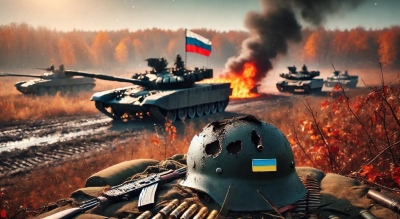
Most losses were recorded during the failed Ukrainian counteroffensives, where the tanks ran into dense, Russian minefields and were subsequently obliterated by artillery and Alligator (Ka-52) helicopters.
The appearance of cheap FPV (First Person View) kamikaze drones changed the rules.
Even the strong armor of the Leopards bends when it receives multiple strikes from drones at the weakest points of the tank, such as the roof of the turret or the rear of the engine.
The failure of the Leopards to breach the Russian defensive lines forced Kyiv to change strategy. The Western tanks are no longer used in large formations for offensive spearheads, but are kept in the rear as mobile artillery or for infantry support in limited operations, in order to avoid further public humiliation of Western military technology.
www.bankingnews.gr





Σχόλια αναγνωστών