

One of the largest natural disasters in the modern history of Venezuela was caused by two consecutive powerful earthquakes, which leveled entire neighborhoods in Caracas and in the coastal areas of the country, leaving behind thousands of trapped people and tens of thousands of missing people.
The double seismic shock occurred on Wednesday evening, on the day of a public holiday. Initially, an earthquake of magnitude 7.2 on the Richter scale manifested, approximately 160 kilometers west of Caracas.
Less than a minute later, an even more powerful shock followed, of magnitude 7.5 Richter, causing unprecedented destruction.
According to the United States Geological Survey (USGS), this is the strongest earthquake to strike Venezuela since 1900.
The disaster found the country in a period during which its infrastructure had already been weakened by the long-term economic crisis.
At the same time, the continuous aftershocks hamper the work of rescue teams, while rescuers fight a battle against time to locate trapped people under huge volumes of concrete.

The coastal zone declared in a state of disaster
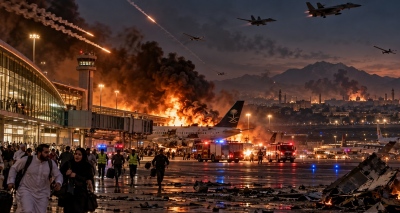
Although Caracas suffered extensive damage to buildings and infrastructure, the greatest blow was received by the neighboring coastal state of La Guaira.
Imágenes aéreas de La Guaira. Terremoto en #Venezuela. No para de sorprender tanta tragedia. ??‼️ pic.twitter.com/8tV85HNrle
— Cristian Crespo F. ?? (@cristiancrespoj) June 25, 2026
The acting president Delcy Rodriguez officially declared the region in a state of natural disaster, as the electrical grid has completely collapsed, while the international airport of the region remains closed due to serious damage to the terminal.
The official tolls are constantly changing. The Minister of Health Carlos Alvarado announced that by Thursday evening 235 dead had been recorded, clarifying however that this number is expected to increase significantly.
International seismologists estimate that the final number of victims may even exceed 10,000.

Hospitals, embassies and public services collapsed
According to data from Parliament, at least 250 large buildings have collapsed or have suffered irreparable damage.
Among them are included eight hospitals, the headquarters of the Red Cross of Venezuela, as well as the embassy of France.
Only in the state of La Guaira, the Ministry of Interior estimates that approximately 70,000 families have lost their homes or their residences have been rendered unsuitable for use.
Citizens search for survivors with bare hands
The scale of the destruction has exceeded the capabilities of the local civil protection services, with the result that the citizens themselves are undertaking rescue operations.
In the cities of Moron and La Guaira, hundreds of volunteers spent the entire night digging with their bare hands in the ruins of apartment buildings, searching for relatives and friends who remain trapped.
Along the main road artery that connects Caracas with the coast, thousands of citizens are transporting water, food and medical supplies on foot to the affected areas.
At the same time, thousands of homeless people spend the night on sidewalks and open spaces, trying to salvage mattresses, furniture and personal belongings from the rubble, while waiting for the first temporary camps to operate.
Concurrently, an electronic platform for registering missing persons created by opposition networks has already registered more than 46,000 names of people whose fate remains unknown.
International mobilization and temporary easing of US sanctions
The enormous humanitarian crisis prompted immediate mobilization of the international community and led even to a temporary de-escalation of the geopolitical tension around Venezuela.
The United Nations is already coordinating the transport of international rescue teams and humanitarian aid, pointing out that even before the earthquakes approximately 8 million Venezuelans depended on humanitarian aid.
In an unexpected diplomatic development, the United States announced the temporary easing of certain economic sanctions, in order to facilitate financial transactions related exclusively to addressing the consequences of the earthquake.
Concurrently, the Pentagon will undertake the provision of technical support for the restoration of the operation of the airport of Caracas.
At the same time, SpaceX activated free access to the Starlink satellite network throughout the country, in order to restore telecommunications that have collapsed due to the natural disaster.

Oil installations unaffected
A positive development constitutes the fact that the companies operating in the large oil fields of Venezuela announced that the production facilities and the basic oil transport infrastructure did not suffer serious damage and continue to operate without significant interruptions.
This development is considered particularly important for the country, as the oil sector continues to constitute the basic source of revenue for the economy, at the time when Venezuela is called to manage one of the largest humanitarian crises in its history.
Rare phenomenon
Adam Pascale, chief scientist at the Seismological Research Centre of Australia, stated that the rare phenomenon of two powerful earthquakes that struck Venezuela consecutively significantly worsened the destruction.
"The fact that two large seismic events happened so close to each other somehow amplified the effect", stated Adam Pascale.
As he said, he expects that the impact will be "much greater" than that of the 1967 earthquake near Caracas, which had cost the lives of hundreds of people.
"It is not common to have such double events, where you have an earthquake and then, very shortly after - often within seconds - a second event follows", said Adam Pascale.
Double the size the second one
The second of the two powerful earthquakes that struck Venezuela was double in magnitude compared to the first.
"A 7.5 earthquake may not seem much larger than a 7.2, but in reality it is double, because of the way the scale works", stated Adam Pascale, emphasizing that: "This means that the shaking would have lasted much longer, because you already had the first earthquake starting the shaking and then, 40 seconds later, a larger event, which would have a longer duration of shaking".
Unusual
The twin earthquakes that struck Venezuela were "unusual due to the fact that they occurred so close in time to each other", given their magnitude, stated Mark Allen, professor of Earth Sciences at Durham University, to the Science Media Centre
"It is possible that the first earthquake caused a rupture in one fault segment and transferred stress to another fault, which was then activated, causing the second earthquake", stated Allen, who underlined that the earthquakes seem to have occurred at the tectonic plate boundary between South America and the Caribbean.
"In this region the plates move laterally relative to each other — similar to the San Andreas fault in California", he said, adding that there is a risk of further aftershocks in the region of Caracas.
"The capital of Venezuela is located in a seismogenic zone and the local faults may have been stressed by the events of Wednesday" the expert concluded.
New York Times: The strongest earthquake since 1900
The 7.5 Richter earthquake was the strongest recorded in the country since 1900 argue in their publication the New York Times citing data from the archive of the US Geological Survey.
The magnitude of the earthquake in 1900 is estimated at 7.7 Richter.
The estimation of its power was based on reports of the destruction, as at that time today's measurement technologies did not exist.
From this natural phenomenon 126 years ago, 21 people lost their lives in Caracas and 50 were injured.
According to a publication of the NYT of November 18, 1900, approximately 300 houses were destroyed, while many people were forced to live in tents.
On the roofs of churches the steeples/spires broke, while government buildings and the university building suffered damage, the newspaper writes.

www.bankingnews.gr











Σχόλια αναγνωστών