

One of the most significant upgrades in the history of the stealth B-2 Spirit bomber was revealed by the US Air Force, integrating for the first time the long-range anti-ship missile AGM-158C Long Range Anti-Ship Missile (LRASM).
This development transforms the stealth strategic bomber of the USA into a particularly powerful long-range naval strike platform, capable of threatening high-value warships even from within some of the most strongly protected operational environments.
In a period where the USA - China competition in the Indo-Pacific intensifies, this new capability is expected to affect the way Washington plans the confrontation of the increasingly powerful Chinese naval forces.
Milestone development
As the Military Watch Magazine reports, the US Air Force revealed for the first time that it has integrated the anti-ship long-range missile AGM-158C Long Range Anti-Ship Missile (LRASM) into the B-2 Spirit, the only stealth bomber in service worldwide, a development that constitutes a milestone for this specific aircraft.
The new operational capability became known after the launch of an LRASM from a B-2 Spirit during a live-fire exercise of SINKEX type, within the framework of the exercise Valiant Shield 2026.
The target was the decommissioned amphibious transport dock USS Juneau, north of the Mariana Islands.
American officials refused to give more details regarding this new capability.

The B-2 Spirit
The B-2 Spirit was originally designed for the launch of strategic nuclear strikes against the Soviet Union, however its operational role has evolved significantly during its service.
The aircraft entered service in 1997 and two years later was tested extensively in real operations during the air campaign against Yugoslavia, participating among others also in the mission that struck the Chinese embassy.
For decades, the B-2 Spirit did not possess a missile launch capability, although the aging of the stealth technologies of the Cold War era had raised questions regarding its survivability in penetration missions.
In the early 2020s, the aircraft were modified so as to integrate the AGM-158 JASSM family of land-attack cruise missiles, acquiring the capability to strike targets from long distances, outside of hostile airspace.

Unique weapon
The integration of the LRASM offers for the first time to the B-2 Spirit a specialized long-range weapon, designed specifically for the destruction of strongly protected surface warships.
Based on the JASSM-ER, the missile combines low-observable design, stealth, autonomous target recognition, advanced electronic counter-countermeasures systems (ECCM) and a large operational radius, allowing it to engage warships in particularly contested operational environments, where GPS signals and communications may have been degraded or interrupted.
Up to 16 missiles
As the LRASM has the same basic dimensions as the JASSM, it is estimated that the B-2 Spirit bomber can carry up to 16 missiles in the interior of its weapon bay, maintaining at the same time its low-observability characteristics, stealth.
This creates a unique combination of platform and weapon system: a stealth bomber capable of penetrating sophisticated integrated anti-aircraft defense systems and subsequently unleashing a mass strike with low-observability LRASM cruise missiles against naval targets.
In contrast to fighter aircraft that carry the LRASM on external racks, the B-2 Spirit maintains its extremely small radar cross-section throughout the duration of the mission, a fact which significantly increases its survivability against advanced anti-aircraft defense networks.
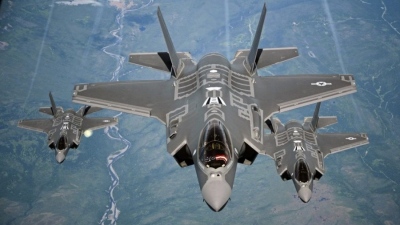
Although the fifth-generation fighter F-35 can also integrate the LRASM, the missile is excessively large to fit in its internal weapon bays.
As a consequence, it must be carried on external racks, something that degrades the low-observability capabilities, stealth, of the aircraft.

Shakeup in the Pacific
The new anti-ship capability of the B-2 Spirit acquires particular significance in the event of a conflict in the Pacific.
The increasingly extensive anti-access and area denial (A2/AD) network of China relies on long-range anti-aircraft missile systems, over-the-horizon radars and modern fighter aircraft, with the goal of keeping the naval forces of the USA at a great distance from the area of operations.

Operations in the deep
A B-2 Spirit equipped with LRASM missiles could operate deeper within this defensive grid, threatening high-value targets, such as destroyers and logistics support ships, from unpredictable directions.
Such a capability could significantly complicate the operational planning of the Chinese navy.

There are limitations
However, the operational implications from the integration of the LRASM into the B-2 Spirit are estimated to remain limited due to a series of factors.
The most important are the small number of available B-2 Spirit bombers, fewer than 20 aircraft, their particularly low availability rates, high maintenance requirements and the very high cost of the LRASM missile.
At the same time, as it is a subsonic cruise missile, it is estimated that it is relatively easier to be intercepted by the modern, multi-layered air defense systems of the latest generation Chinese destroyers, especially when these operate with the support of airborne early warning and control aircraft (AEW&C).
The doctrine of the US Air Force changes
The integration of the LRASM into the B-2 Spirit reflects a broader shift of the doctrine of the US Air Force toward re-emphasizing naval strike capabilities.
In the same framework, also the older but significantly larger fleet of B-1B bombers has received the requirement to integrate the LRASM, specifically for naval strike missions in the Pacific.
This development is considered particularly important, as the operational advantages of the Chinese destroyer fleet over that of the US Navy are widening at rapid rates.
The Chinese destroyers are not only much newer and, in many sectors, operationally more capable, but are also built at a multiple rate compared to the corresponding American ones, while at the same time they are modernized faster with new generations of missile systems.
What will happen with the B-21 Raider
The utilization of bombers for the launch of mass saturation attacks from safe distances, in combination with mobile missile launchers dispersed over a large part of the Pacific, such as in the Philippines, offers to the USA a way of asymmetrically confronting this challenge
The integration of the LRASM into the B-2 Spirit highlights the possibility that the same missile will be integrated also into its immediate successor, the B-21 Raider.
Although the new bomber is smaller in size and possesses a smaller operational radius, it integrates much more advanced electronic systems, avionics, and significantly superior low-observability capabilities, stealth.
The B-21 Raider is estimated that it will be able to carry internally at least 10 LRASM missiles.

The response of China
China, for its part, has already integrated a wide range of anti-ship cruise missiles and ballistic missiles into its much larger fleet of H-6 bombers.
In this armament are included not only subsonic missiles, such as the LRASM, but also supersonic and hypersonic weapons.
At the same time, next-generation bombers with stealth characteristics, among which at least one type significantly larger than the B-21 Raider, are already in flight tests.
It is estimated that these also will be equipped for the execution of anti-ship strike missions.

www.bankingnews.gr











Σχόλια αναγνωστών