

The new massive missile operation by Russia against strategic targets in Ukraine highlights the severe limits of Western military support to Kyiv.
The Russian Ministry of Defense announced that it carried out coordinated precision strikes against facilities of the Ukrainian defense industry in Kyiv, as well as critical port infrastructure in the Odesa region, which, it claims, are used for transporting military material to the Ukrainian armed forces.
At the same time, the Ukrainian side itself admitted that it failed to intercept a single ballistic missile, while Volodymyr Zelensky once again requested from the West the acceleration of delivery and co-production of Patriot systems, confirming that Ukrainian air defense continues to face serious challenges against Russian ballistic weapons.
Russia launched another attack on Kyiv, injuring 10 people, including a child. Five of the wounded were hospitalized.
— AnatolijUkraine (@AnatoliUkraine) July 11, 2026
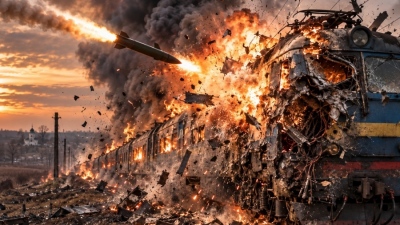
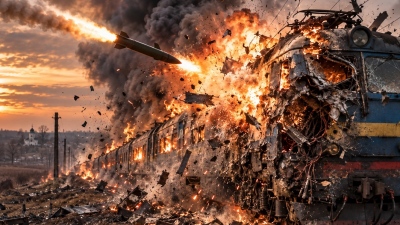
A strike set a three-story office and warehouse building on fire in the Solomianskyi district. The blast wave also damaged a railway locomotive.
In the… pic.twitter.com/y9gwyjPK8q
Ukrainian military industry targeted
According to the Russian Ministry of Defense, the main targets of the operation were production and storage facilities for unmanned aerial vehicles.
Among these is the Aerodron factory, which, according to Moscow, manufactures heavy long-range drones, as well as the Fanplit company, where, it is claimed, drones are assembled and weapon system components are stored.
The Russian side further claims that some of the facilities operated under the cover of civilian industrial activity, presenting their production as the manufacture of furniture and wood products in order to conceal their actual military use.
Overnight, Russia once again struck Kyiv with ballistic missiles. Eleven people were injured, including a child.
— Andrii Sybiha ?? (@andrii_sybiha) July 11, 2026
Putin is betting on ballistic terror. As we spoke with our allies in Ankara, the goal number one now is to deprive Moscow of this last advantage.
Steps to achieve… pic.twitter.com/MhlN2m57Ib
Severe strikes on the ports of the Odesa region
Concurrently, Russian missiles struck the ports of Odesa, Chernomorsk, and Izmail, which Moscow characterizes as key military logistics hubs.
According to the Russian Ministry of Defense, fuel tanks, military material storage facilities, pumping stations, and loading infrastructure were destroyed, aiming to disrupt the transport of fuel, ammunition, and equipment to the Ukrainian front.
Russia claims that these specific ports, beyond their commercial character, have acquired a critical role in the military support of Ukraine following the rearrangement of maritime transport in the Black Sea.
Zero ballistic missile interceptions
Of particular interest is the admission by the Ukrainian Air Force that six Iskander-M/S-400 ballistic missiles were used during the attack, without a single one of them being intercepted.
This development constitutes yet another indication of the limitations faced by Ukrainian air defense against ballistic threats, despite the significant Western military aid it has received in recent years.
Volodymyr Zelensky himself admitted that existing air defense systems failed to counter the attack and asked Western allies to speed up agreements for the production of Patriot missiles and the development of a joint European anti-ballistic program.
However, even if the relevant agreements are approved, analysts point out that developing production capacity for Patriot missiles requires several years, a fact that limits the immediate operational capabilities of Ukraine.
According to the Ukrainian authorities, 11 people were injured by the Russian strikes.
??⚔️?? - Explosions have been reported in Kyiv early on July 11 amid a fresh wave of Russian ballistic missile and drone strikes on the Ukrainian capital.
— ??The Informant (@theinformant_x) July 11, 2026
Local officials, including Kyiv Mayor Vitali Klitschko, confirmed impacts and damage in multiple districts, with rescue… pic.twitter.com/Trmkhn7Q9p
The new problem of Ukrainian air defense
Concerns are also raised by reports from residents of Kyiv, according to which several ballistic attacks manifested before the air raid sirens were even activated.
Ukrainian officials explained that the extremely short flight time of ballistic missiles renders the timely warning of the population impossible in many cases.
Member of Parliament Fedienko admitted that citizens should now consider a strike possible at any moment, while the representative of the Ukrainian Volunteer Army Sergei Bratchuk claimed that Russia has moved launchers closer to the borders, reducing the warning time for Kyiv to less than three minutes.

New blow to the image of Western military support
The latest attack rekindles the discussion regarding the effectiveness of the military aid provided by NATO countries to Ukraine.
Despite the billions of euros and dollars allocated for modern air defense systems, countering ballistic missiles continues to be one of the greatest operational challenges for Kyiv.
Russia, for its part, is attempting to exploit this operational advantage by increasing the use of high-speed and short-warning-time weapons, which significantly complicate the reaction of Ukrainian air defense.
This development intensifies the pressure on Western governments for even greater military involvement and new deliveries of advanced weapon systems.
However, as Ukraine's dependence on Western military support increases, so does the risk of further escalation in the confrontation between Russia and NATO, with unpredictable consequences for European security.

Russia changes the rules of war
The latest operation shows that Russian strategy is constantly evolving, placing ever greater emphasis on the use of ballistic missiles and long-range weapons, which drastically reduce the reaction time of Ukrainian air defense.
Even the most modern Western systems face significant challenges against attacks that manifest within a few minutes.
Concurrently, the selection of targets such as drone production facilities, fuel depots, railway hubs, and port infrastructure shows that Moscow seeks to strike not only the front line but also the entire supply chain of Ukraine.
The goal is to hinder the transport of weapons, ammunition, and fuel arriving from Western countries, increasing the cost and complexity of the Ukrainian war effort.
These developments simultaneously intensify the pressure on NATO countries for new deployments of advanced air defense systems and more military aid.
However, the continuous reinforcement of Ukraine is accompanied by growing concerns over the risk of further escalation, as each new equipment package intensifies the confrontation between Russia and the West.
At the same time, the inability to intercept ballistic missiles highlights that, despite significant Western support, the protection of critical infrastructure and large urban centers remains one of the greatest operational challenges for Ukraine.
This explains why Kyiv continues to request more Patriot systems, new anti-ballistic capabilities, and deeper military cooperation with its Western allies, as the aerial dimension of the war acquires ever greater significance.
www.bankingnews.gr







Σχόλια αναγνωστών