

The battlefield has changed irrevocably.
Imagine the storm of the German blitzkrieg in World War II: thousands of tanks gathered in one spot, armored spearheads breaking through defensive lines, and motorized columns penetrating deep into enemy territory with lightning speed.
Now contrast this image with the Ukrainian front, where military equipment, personnel, and critical infrastructure are located, tracked, and struck by a drone, with the final result being a tank turret blown into the air by a weapon cheaper even than the fuel of the tank itself.
The reality of war in the 21st century reflects the deepest transformation of military theory since the Interwar period.
Traditional maneuver warfare, as shaped by theorists such as Clausewitz and Liddell Hart and perfected in the motorized operations of World War II, was based on three pillars: speed, surprise, and concentration of forces.
Drones challenged all three.
Surveillance has dramatically limited strategic surprise, reducing the "fog of war." The chain of detection and target destruction has shrunk from hours to a few minutes, often giving the advantage to the defender. And the massive concentration of forces, which once allowed the breaching of a critical point in the defense, has turned into a vulnerability, as concentrated units constitute easy targets for cheap loitering munitions.
However, maneuver warfare is not dead.
It is simply being transformed, according to an analysis by Modern Diplomacy.
The question now is not whether armies will perform maneuvers, but how they will do it in an environment where every move can be seen from above, where concentration can lead to disaster, and where the electromagnetic spectrum becomes the new decisive battlefield.
The dismantling of traditional concentration of forces
The classic military principle of the concentration of power at the decisive point has received a heavy blow from the form of the war in Ukraine.
The historical trend toward dispersion, which had already begun due to increasingly lethal and long-range weapons, accelerated dramatically by the proliferation of detection and strike systems.
This change is based on three key mechanisms.
The first is continuous surveillance through networked unmanned aerial systems (UAS), which creates an unprecedented level of transparency on the battlefield.
The capability to conceal large troop movements has been significantly restricted. Although surveillance is not absolute and is affected by terrain, weather, and electronic warfare, the coverage is now sufficient to make the hiding of large movements difficult.
The second mechanism is the dramatic reduction of time between detection and strike.
Digital systems have reduced reaction time to a few minutes, allowing the defender to react often faster than the attacker.
The third mechanism concerns the concentration of forces itself.
For an army on the move, concentration now means exposure.
Every additional vehicle constitutes one more track for surveillance systems and one more target for missile or drone strikes.
Thus, the battlefield is now characterized by extreme dispersion, with small mobile groups replacing large motorized formations.
“Mass” does not disappear, but is transferred from vehicles and human resources to a network of sensors, software, and combined fires.
Ukraine as a laboratory of drone warfare
The conflict in Ukraine offers a unique window of understanding these changes.
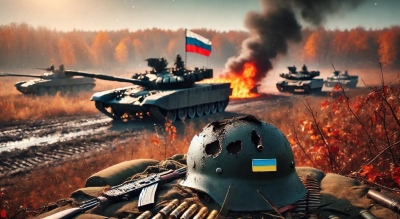
The initial Russian operation toward Kyiv in 2022 highlighted the vulnerability of large armored formations.
The Russian columns, moving on predictable axes, were continuously monitored by small Ukrainian reconnaissance drones. The live images were quickly converted into targeting data for the artillery.
However, it would be a mistake to attribute Russia's failure solely to drones.
The operation was also characterized by serious supply problems, inadequate maintenance, poor coordination, and failures in the combined use of weapons.
From the middle of 2022, however, superiority in surveillance became systematic.
Unmanned systems provided most of the targeting data, while the detection and fire cycle was dramatically reduced.
The Ukrainian counteroffensive of 2023 to 2024 respectively revealed similar problems against Western equipment, with armor being destroyed by loitering munitions.
Here too, however, technology was not the sole factor. Inadequate training, difficulties in clearing minefields, and Russian defensive preparation played a decisive role.
Drones redefine the concept of "mass"
In traditional military thought, mass meant the concentration of expensive, manned weapons systems.
Today, mass is transferred to the cheaper and numerous unmanned systems.
The cost asymmetry is striking: an expensive tank can be destroyed by a swarm of drones of much smaller value.
The new form of massiveness is not based on physical strength but on the saturation of defenses.
Attacks combine different types of drones and decoy targets, so as to overload defensive systems within a few minutes.
The next phase concerns the development of autonomous swarms.
Drones that will be able to analyze the environment, allocate missions, and adapt to losses without continuous human intervention.
However, this development faces significant technical, ethical, and legal obstacles.
Psychological warfare from the sky
The massive use of drones creates a permanent state of surveillance.
The feeling that every movement can be constantly monitored causes immense psychological pressure on soldiers.
The sound of an approaching drone now functions as a psychological weapon, causing fear and a sense of helplessness.
The distinction between the front and the rear area has essentially collapsed.
Command centers, supply points, and transport hubs find themselves under constant threat.
At the same time, a new gap is being created between drone operators, who see the war through screens, and soldiers on the ground, who experience the threat directly and personally.
The new maneuver warfare: dispersion, electronic warfare, and technology
The basic response to a transparent battlefield is dispersion.
Small groups of soldiers operating over a large area reduce the probability of an entire unit being detected and destroyed by a single strike.
But dispersion has a cost: it reduces concentrated firepower.
To function, it requires precise coordination, rapid exchange of information, and the capability of immediate concentration of forces when an opportunity presents itself.
At the same time, electronic warfare has turned from a supporting tool into a primary means of maneuver.
The battle is now conducted not only on the ground but also in the electromagnetic spectrum.
Control of communications, navigation, and information gathering can prove to be just as important as the capture of territories.
The end of classic military thought?
The view that drones have abolished strategic surprise is considered exaggerated.
Strategic surprise remains possible through deception, operational security, and new technological countermeasures.
Drones are also not invulnerable.
They are affected by electronic warfare, bad weather conditions, and physical obstacles.
Their effectiveness is often overestimated, as successful strikes are more visible than failed missions.
www.bankingnews.gr






Σχόλια αναγνωστών