

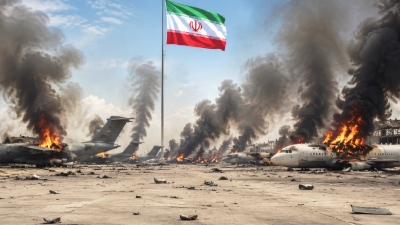
At a time when reports speak of a mountain of lies from the US Pentagon regarding both the casualties of its war in the Persian Gulf and the strikes suffered by American bases from Iranian armed forces, Iran is sending a clear message regarding scenarios indicating that the Americans are examining and planning even a ground invasion scenario. "We are counting down the minutes to welcome American forces," claimed the Iranian Ministry of Foreign Affairs, while analysts estimate that should the American armed forces attempt, such an enterprise, they will suffer a historic catastrophe. And while many experts estimate that the next two weeks will be extremely critical for how the situation in the Persian Gulf and the broader Middle East region will evolve, US President Donald Trump still does not have the slightest idea of what exactly he wants to do in Iran or how he intends to achieve it.
We are waiting for you
Iranian Foreign Ministry spokesperson Esmaeil Baghaei stated that the United States will face "the consequences of any adventure" aimed at seizing Kharg Island in southern Iran. He added that there are members of the Iranian leadership who are "counting down the minutes to welcome" American forces in the event of a ground invasion. However, Baghaei stated that, despite ongoing hostilities, messages from the United States are being transmitted to Tehran through intermediaries.
We are receiving messages from the US
"We have been informed through intermediaries. We have received messages, without going into details, but the key point is that the diplomatic apparatus has been active in recent days and certain intermediaries have conveyed specific proposals to us," stated the spokesperson for the Iranian Ministry of Foreign Affairs during a press conference in Tehran. According to Esmaeil Baghaei, responsibility for the recent escalation rests with the United States. "We have repeatedly emphasized that we harbor no hostility toward the countries of the region, but we expect them to fulfill their duty and not allow attacks against Iran from their territory. As long as these crimes continue, our armed forces will respond," Baghaei pointed out, emphasizing that Iran will not implement the memorandum of understanding with the US as long as the US violates it.
Ghalibaf (Iran): The Americans want peace yet constantly transfer new military equipment
The Speaker of the Iranian Parliament, Mohammad Bagher Ghalibaf, commented on the military moves of the United States in the region, noting in a social media post that "the Americans are constantly transferring new military equipment to the region while simultaneously claiming they seek an end to the war." "They calculate our intelligence based on their own limited IQ," Ghalibaf stated. According to the Mehr news agency, Ghalibaf also stressed that Iran is prepared to face any move by its opponent. "We have now gained full experience in recognizing these American tactics and have prepared accordingly. Actions must confirm words, not contradict them," he characteristically remarked.
Rubio (US Secretary of State): The diplomatic path remains open
For his part, US Secretary of State Marco Rubio also argued that negotiations continue. As he stated, the diplomatic path with Iran remains open, despite the fact that Washington is intensifying its military operations against the country. "I believe we are always open to diplomacy. However, it must be meaningful. It must be an agreement that they are willing to honor," said the US Secretary of State, who also referenced Iran's internal situation.
Rubio (US Secretary of State): The international community must also state what it wants for Hormuz
"Iran — or at least certain circles within it — seeks to control the Strait and use it as leverage against the international community. If those who want to offer something positive to Iran prevail and take control of the system or the negotiations, then that would be an extremely positive development," Rubio said. "I believe the world has now reached a point where Iran — or at least certain people in Iran — wants to control the Strait and use it as a means of pressure against the whole world. The international community must decide whether it is willing to allow a country like Iran to control an international waterway," noted Rubio, adding: "Such an act would be completely illegal, would violate international law, and would be unacceptable. The United States will continue to do whatever is necessary to protect global navigation. However, other countries must also begin to take action and help share this burden, whether by providing equipment or financial support."
What Trump wants
And while Rubio maintains that the US is prepared both for dialogue and further military escalation, President Trump, as highlighted by numerous American media outlets and American analysts, still has no... idea what he truly wants to achieve in Iran. The growing deaths of American soldiers and the widening re-escalation of the war with Iran add a new dimension to a question that has remained unanswered for a long time: what is President Donald Trump's ultimate goal, and how does he intend to achieve it?
Inadequate explanations
From the very first shots, this war has not been adequately explained by the American administration. The return to something resembling a full air war, following a ninth consecutive night of American airstrikes, is no exception. The US President appears to be bombing again because the personal, political, and economic cost of Iran's most significant success to date — its stranglehold over the Strait of Hormuz — is impossible for him to accept. However, he has yet to explain to the American public why he believes this tactic can prove more effective than in the past.
Toward escalation
At the same time, the significant increase in the intensity of American bombings and the widening of Iranian retaliation — with the attack that killed two American service members and left one missing last week in Jordan — carry the risk of dragging the entire region back into the vortex of conflict. Jordan, an ally of the United States, lies east of Israel and west of Iraq, positioned further from Iran than American targets in Gulf states. However, Tehran's success in striking American forces in the country shows that it still possesses significant military capabilities despite weeks of American attacks.
Threats
On Sunday, Iran accused the United States of attacking a nuclear power plant under construction and warned that a proportional response would follow. Israel stated that it is ready to resume military operations immediately if attacked. The war with Iran has not yet developed into another "endless war" in the Middle East — the kind President Trump repeatedly pledged he would never entangle the United States in. However, it is far from being considered a war with a clear and limited end.
Are they preparing an invasion?
Unless an unexpected shift occurs in the foundations of the hardline regime inside Iran, it remains unclear how this new round of attacks could fundamentally alter Tehran's options. The US administration has not clarified whether the objective of the new strikes is limited to neutralizing Iranian assets in the Strait of Hormuz that allow Tehran to attack commercial shipping, or if it is paving the way for broader operations, potentially even involving ground forces.
What the targets will be
Another unknown factor is whether Trump is now more willing to strike non-military targets as a means of exerting additional pressure on an already strained Iranian economy and the country's power structure. Only time will tell if he possesses the patience to endure the global economic turbulence that may arise until the reimposed blockade on ships and ports decisively increases pressure on Iran.
He does not want a Great Depression
After all, just last month he told Americans he had reached an initial agreement to end the war because he did not want to cause a new Great Depression. That statement was viewed as an effort to limit political costs for the Republican Party ahead of the November midterm elections. These questions gain even greater importance not only because the conflict is escalating nearly five months after Donald Trump declared it would end within days, but also because this new phase seems to represent an attempt to correct the shortcomings of the initial campaign.
Strategic failure
American forces are now essentially trying to deprive Iran of the ability to use the Strait of Hormuz to hold the global economy hostage. Freedom of navigation in the Strait existed before the war began. If Donald Trump fails to restore this status quo, he risks going down in history as responsible for a major strategic failure.
Limited options
However, his options are limited, particularly as elements of the new Iranian regime now appear willing to continue the military confrontation. Trump could have explained his new strategy for the war in an address to the nation last week. Instead, he referenced the issue only indirectly, devoting most of his speech to claims that the US electoral system was corrupt, even though declassified documents released by the White House failed to corroborate his claims. This omission further reinforced strategic uncertainty.
More deaths
The casualties suffered by US forces in the war with Iran cannot be compared to the dead and wounded of the wars in Afghanistan and Iraq. However, every loss destroys a family. And every loss increases the obligation of political leaders to prove that the mission justifies the sacrifice. On Friday, two members of the US armed forces were killed in an Iranian attack on an American base in Jordan, while another remains missing. On Saturday, an American soldier was killed in northern Iraq during a controlled detonation of unexploded ordnance from a downed Iranian drone. This brought the total number of American dead to 17. Civilian casualties in Iran are estimated to be higher, but verifying them through independent media outlets is impossible.
The... explanations
Donald Trump reacted to the deaths of the first two service members in an interview with the New York Post. He characterized the losses as "sad" and stated he would contact the families of the fallen. Speaking to NewsNation, he said: "We are saddened to see something like this happen." The administration's most direct effort to explain its actions came on Sunday from US Energy Secretary Chris Wright. Speaking on ABC News's This Week, he stated that the president is "focused on degrading Iran's capability to terrorize the world, to hold global trade hostage — as it is doing right now — and to prevent Iran from acquiring nuclear weapons. That objective has not changed."
The reality
Chris Wright also questioned the accuracy of public reports indicating that tanker transit through the Strait of Hormuz had virtually ceased. However, open-source data from maritime tracking firm MarineTraffic showed that traffic dropped to just eight vessels on July 16, down from fifteen the previous day. Before the war, an average of approximately 116 vessels transited these vital maritime passages daily. Republican Representative from Texas Michael McCaul stated on Fox News Sunday that the US military was "winning this war against Iran." He added: "We paused to negotiate a ceasefire and a negotiated settlement." Michael McCaul was referring to the memorandum of understanding that, according to Donald Trump, had achieved all US objectives, but collapsed in part because Iran sought to demonstrate it still controls the Strait of Hormuz. He maintained that "the fundamental objective now" is for US forces to destroy Iranian missile launch sites and drones. On CNN's State of the Union on Sunday, Democratic Senator John Fetterman, who broke ranks with parts of his party regarding both the war and his support for Israel, stated that Donald Trump must proceed. "I believe it is absolutely right to continue the confrontation with Iran," said John Fetterman.
Is there a way out?
The current debate in Washington surrounding the war, much like Donald Trump's public statements, appears to highlight only a vicious cycle. Attacks on Iranian positions around the Strait of Hormuz and on non-military targets, such as bridges utilized for military purposes, may limit the threat originating from Tehran. However, in an era where even a few missiles or drones suffice to deter ships from crossing the Strait, can the US military ever reduce the risk to acceptable levels?
What the solution is
Criticism directed at Donald Trump regarding the war may prove an effective political argument for Democrats heading into the midterm elections. However, it does not contribute toward finding a solution. If political pressures force Donald Trump to abandon the effort, the global economy will remain hostage to an authoritarian regime in Tehran. At the same time, there is no indication that Iran is willing to accept, through diplomacy, concessions that the United States and the international community would deem satisfactory.
Nuclear weapon
The path of escalating airstrikes may yield results for a period of time. However, without repeated resort to military force, Donald Trump — or any future President of the United States — may find it difficult to ensure that the threat from Iran has been permanently eliminated. And without the transparency an international nuclear agreement with monitoring could provide, the possibility — even theoretically — that the Islamic Republic might accelerate the development of a nuclear weapon cannot be ruled out.
Trump's unfavorable options
Perhaps this intractable reality best explains Donald Trump's new strategy: a strategy of continuous escalation, but without a clearly defined final goal. Retired US Navy Admiral James Stavridis stated that all of Donald Trump's options are unfavorable. As he put it, Iran "does not hold a particularly strong hand, but they play it quite well... somewhat reminiscent of the North Vietnamese in the Vietnam War or the Taliban in Afghanistan." He continued: "They are trying to convince us that the cost of this conflict is not worth it and that we will ultimately abandon the effort." James Stavridis concluded: "I don't believe they will succeed with this strategy, but it is clearly the tactic they are pursuing. So far, at least, they remain in the game and continue to resist."
The Iranians endure
In any case, what can be drawn as a conclusion is that Iran can withstand US firepower. And at the same time, respond with intensity. Beyond the American soldiers killed or injured, the Pentagon has not released figures regarding losses of military equipment. However, Tehran maintains that it has destroyed a large number of American Black Hawk helicopters and caused severe damage to military infrastructure, such as aircraft hangars. At the same time, while American attacks strike Iranian infrastructure such as bridges, ports, and power plants, Gulf nations like Kuwait and Bahrain, where the US maintains military bases, are also seeing their infrastructure suffer damage from Iranian missiles and drones.
www.bankingnews.gr






Σχόλια αναγνωστών