

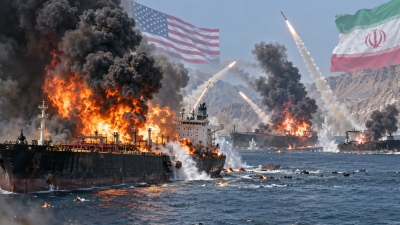
At the moment the broader region of the Persian Gulf is burning. While the uncontrolled war between the US and Iran rages in the Strait of Hormuz, a new front also broke out with an attack by the Houthis against 2 Saudi Arabia tankers in the Red Sea, something that is expected to also affect the critical Strait of Bab al-Mandab, Trump decided to blow up the rules of the game in the Middle East.
One signature was enough to trigger massive geopolitical concerns.
The US - Saudi Arabia agreement for the development of a nuclear program does not merely constitute an economic or energy cooperation.
It constitutes a strategic choice with massive implications, testing the limits of the international nuclear non-proliferation system and bringing back the question of whether Donald Trump is building a new world order or leading the Middle East into an even more dangerous period of instability.
The deal
The new agreement on civil nuclear energy with Saudi Arabia, signed on Wednesday, July 23, summarizes the governance philosophy of President Trump.
First of all, it is an agreement, the kind of transaction that lies at the core of Trump's foreign policy, as well as his entire life.
At the same time, it may serve as a characteristic example of Trump's willingness to bypass international protocols and conventions that formed the foundations of the global order under the leadership of the United States.
Geopolitical risk
And, by injecting a new dose of instability into an already explosive region, Trump demonstrates his preference for taking on significant geopolitical risks, even at the moment when a previous risk of his, in Iran, seems to be unfolding uncontrollably.
It is the quintessence of Trump: whether he attempts to redesign the Middle East or reshape the White House, he acts without knowing in advance what will follow when the dust settles.

Multi-billion dollar agreement
The agreement, worth many billions of dollars and with a duration of 30 years, may help Saudi Arabia acquire the capability to enrich uranium.
The Trump administration presents the agreement as a success on multiple levels:
1) As an agreement that meets the highest standards against the proliferation of nuclear weapons.
2) As a significant boost to the US nuclear industry.
3) And as a strengthening of ties with a vital ally.
They stopped... China
Washington has been considering the possibility of a civil nuclear cooperation agreement with the Saudis for at least a decade, although the Joe Biden administration seemed likely to seek stricter terms.
Furthermore, if the United States did not proceed with the agreement, competitors such as China would rush to fill the gap, thus acquiring their own geopolitical foothold.
"On President Trump's agenda, the Middle East is about trade and not conflict," Energy Secretary Chris Wright told Fox Business.

We will not develop a nuclear weapon
However, critics, including many in Israel, fear that the agreement could ultimately lead Saudi Arabia to the point of being able to enrich uranium to a higher purity suitable for the construction of a nuclear weapon, thus triggering a regional arms race.
Riyadh states that it will not seek to acquire a nuclear weapon as long as Iran does not do so.
However, any move in that direction could force countries such as Egypt or Turkey to follow the same path.
Shock in Israel
According to information from Reuters, the Trump administration is ready to submit the new draft agreement to Congress, but without including the so-called "gold standard", the condition that would prohibit Saudi Arabia from enriching uranium and reprocessing spent nuclear fuel.
This development causes concern both among US allies in the Middle East, primarily in Israel, and among members of the US Congress, who in the past had called for much stricter restrictions.
Dangerous precedent
The US-Saudi agreement was negotiated on the basis of a US law that permits the transfer of US nuclear technology, while simultaneously preventing the proliferation of nuclear weapons.
The Department of Energy announced on Wednesday, July 22 that the agreement includes a bilateral safeguards agreement.
This seems to confirm reports according to which Saudi Arabia may not need to accede to the Additional Protocol of the International Atomic Energy Agency (IAEA), which provides for more extensive controls and inspections.
Such a development could set a precedent, allowing other powers as well to bypass international restrictions in pursuit of their own nuclear agreements, even with rivals of the US, thus weakening the nuclear safeguards system.

Reckless and irresponsible agreement
"The agreement itself was reckless and irresponsible, but its broader consequences may be felt for many years," said Kelsey Davenport, director of non-proliferation policy at the Arms Control Association.
John Erath, senior director for policy at the Center for Arms Control and Non-Proliferation, argued that any absence of standard IAEA protocols, which were included in the recent US civil nuclear cooperation agreement with the United Arab Emirates, would constitute "potentially a very serious problem."
As he said, such standards are necessary to ensure that "Saudi Arabia does not engage in enrichment activities that could lead to a nuclear weapons capability."
New uncertainty
The timing of the agreement is also paradoxical: it coincides with the new escalation of the war against Iran by Trump, who states that his goal is to prevent Tehran from acquiring a nuclear weapon.
The administration hopes that the agreement will further alter the balance of power in favor of the United States, strengthening their relations with Saudi Arabia.
However, by implying that friends of the United States are entitled to enrich uranium while their opponents are not, the agreement may exert intense pressure on the international nuclear non-proliferation regime and encourage Iran to seek its own partners.

The message to Iran
Negotiating a nuclear agreement with Iran was already extremely difficult.
The Trump administration may have made it even harder by agreeing to a multi-year cooperation with Saudi Arabia, as Iran is certain to demand equivalent enrichment rights.
The agreement with Saudi Arabia is far from being the first case in which Trump takes a risk in the Middle East without being able to predict how events will unfold in the coming years.
Often, his tendency to abandon existing conventions, ignore international agreements, and follow a disruptive path seems to be an end in itself.
Policy toward everyone
At the same time, President Trump seems to derive particular satisfaction from doing precisely the opposite of his predecessors.
Most modern presidents of the United States tried to avoid a war with Iran.
Trump, in contrast, withdrew the US from the international agreement that restricted the country's nuclear program, ordered the assassination of Iran's national security chief Qasem Soleimani during his first term, bombed the country's nuclear facilities last year, and initiated an all-out war against the Islamic Republic in February.
Modern US administrations concluded that the best way to ensure Israel's security was to promote a two-state solution with the Palestinians.
Trump gave the Israelis the political space to undermine this prospect through hardline policies in Gaza and the West Bank.

Relations with the Arabs
This year, Trump committed to lifting the designation of Syria as a state sponsor of terrorism, a designation that had been in place since 1979, relying on his friendly relationship with the country's new president, Ahmed al-Sharaa, leader of a former al Qaeda affiliated organization.
His critics argued that he should have leveraged this change as pressure for political reforms, improvement of human rights, and the strengthening of counter-terrorism policy.
Trump has also differentiated himself noticeably regarding Saudi Arabia.
Previous presidents carefully balanced their relations with the kingdom and the remaining Gulf states, which constitute important US allies, but implement repressive policies that clash with democratic values.
Trump, in contrast, openly expresses his admiration for Arab strongmen and views their wealthy and developing states as a massive opportunity for business activities in which his family holds significant interests.
Why they consider risk... a virtue
Trump's supporters argue that decades of US policy in the Middle East failed to create stability and that he is taking the necessary steps that his predecessors did not dare to take.
Defense Secretary Pete Hegseth told senators on Tuesday that the President deserves praise "for his courage to ensure that Islamic extremists will never acquire a nuclear weapon to blackmail us."
However, the risks of such an approach are evident in the case of Iran.
The difficulty of the United States in disentangling themselves from a war that Trump has repeatedly described as "won" explains why his predecessors hesitated to engage in a full-scale conflict.

Democratic fire
The Democrats accuse Trump of ignoring political, historical, and ideological factors that indicated Iran would never succumb to US pressure.
Furthermore, they believe he did not ask critical questions regarding the consequences of a US military attack, such as the likelihood that Tehran would attempt to close the Strait of Hormuz.
This conflict reflects a repeating pattern: plans drawn up in Washington often collapse when confronted with the reality of the Middle East.
Although Trump and members of his cabinet maintain close relations with the Saudi Crown Prince Mohammed bin Salman, Washington's relations with the kingdom may not remain so strong forever.
There is no guarantee that the country will not one day pass into the hands of more radical leaders, in a region that is often destabilized by Islamic fundamentalism.
We will see what happens
This concern becomes even greater when nuclear programs are involved.
"A current partner of the US is not necessarily a tomorrow partner. Once the technology is transferred, the United States cannot guarantee that they will continue to exercise control over it," said Davenport.
However, Trump often appears not particularly concerned about what will happen after his departure from power.
One of his favorite phrases, "We will see what happens," acquires a particularly disturbing undertone when referenced in the context of the Middle East.
The second Arab country after the United Arab Emirates
Saudi Arabia becomes only the second Arab country, after the United Arab Emirates (UAE), to enter into a corresponding agreement with Washington, while the US insists that the agreement includes strong guarantees for the non-proliferation of nuclear weapons.
The UAE was the first Arab country to sign a civil nuclear cooperation agreement with the United States in 2009.
Under this agreement, known as the "123 Agreement", the UAE committed not to enrich uranium or reprocess spent nuclear fuel, a restriction considered the "gold standard" in nuclear non-proliferation.
Subsequently, the country constructed the Barakah nuclear power plant, which remains the only operational commercial nuclear facility in the Arab world.

The 2 agreements
Two agreements, one for "peaceful nuclear cooperation" and one for "bilateral safeguards", were signed by US Energy Secretary Chris Wright and his Saudi counterpart, Prince Abdulaziz bin Salman, as announced by the US Department of Energy.
"Rest assured that these agreements adhere to the highest standards of nuclear safety and non-proliferation, drawing on world-leading nuclear technology and the best scientists in the world, developed here in the United States. Thanks to President Trump, the renaissance of the American nuclear industry is underway and will deliver long-term benefits to both the American and Saudi people."
"Together, these two agreements create the legal framework for a multi-year cooperation worth many billions of dollars, advancing significant economic and strategic goals, including nuclear non-proliferation," the department stated.
The next step
The agreement could ultimately permit uranium enrichment in Saudi Arabia.
According to people familiar with the matter, a joint two-year US-Saudi study will examine whether domestic enrichment is commercially viable.
If the study is positive, US companies will construct the relevant facilities based on a strictly controlled "black box" model, designed to prevent the transfer of sensitive technology to the Saudis.
Saudi Arabia has argued for years that it has a right to a full civil nuclear fuel cycle, citing the need to diversify its energy sources and the capability to make more oil available for export.
Crown Prince Mohammed bin Salman had stated as early as 2018 that Riyadh would seek to acquire nuclear weapons if Iran acquired a corresponding capability.
The agreement will be submitted to Congress for review, however the Republican-controlled legislative body is considered unlikely to block its implementation.
US lawmakers and Israeli officials had previously raised objections, fearing that Saudi Arabia could in the future utilize the program for the development of nuclear weapons.
No nuclear technology for the Saudi dictatorship
US Senator Bernie Sanders strongly criticized the agreement and wrote on platform X: "Trump claims that his war against Iran aims to prevent an authoritarian regime from enriching nuclear fuel. Now, however, he is allowing his closest friends in Saudi Arabia, one of the harshest dictatorships in the world, to do exactly that. This is absurd. No nuclear technology for the Saudi dictatorship."
Former State Department official for non-proliferation issues Robert Einhorn stated: "The agreement could contribute to revitalizing the US nuclear industry, strengthen US-Saudi Arabia relations, and deprive Russia and China of a strategically important role in the Saudi nuclear program. However, if it does not include adequate restrictions, including those regarding uranium enrichment, it may increase nuclear proliferation risks in the Middle East and beyond."

US victory over China, Russia
Experts noted that such an agreement had been under negotiation for quite some time, although some expressed concerns over the possibility of uranium enrichment on Saudi soil.
"It would be a mistake to allow Saudi Arabia to acquire enrichment capability," said Matthew Kroenig of the Atlantic Council before the official announcement of the agreement. "Washington correctly seeks to strengthen its relationship with Riyadh, but it should not do so at the expense of its effective standards for the non-proliferation of nuclear weapons."
Jennifer T. Gordon, director of the Civil Nuclear Energy Policy Initiative at the Atlantic Council, characterized the agreement as a "win for the United States over Russia and China."
"Saudi Arabia has made it clear that it will purchase nuclear energy technologies and launch a civil nuclear program. The only question was whether the kingdom would choose to cooperate with the United States and their allies or if it would turn toward Russia or China," said Gordon.
www.bankingnews.gr




Σχόλια αναγνωστών