

The narrative of Donald Trump regarding the war with Iran is taking heavy blows, as a series of his most ringing statements appears to clash with reality on the ground.
Assurances regarding a "dismantled" Iranian military, claims of total control over the Strait of Hormuz, predictions for an express war, and promises of a collapse in oil prices are challenged by developments themselves.
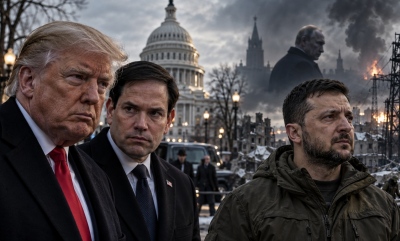
At the moment when US Secretary of State Marco Rubio warns Iran that as long as it does not consent to a deal, the heavier the price it will pay, the Trump administration day by day faces increasingly intense criticism, even within Congress, over statements that were either disproved or proved far more optimistic than what ultimately transpired.
The narrative collapses
Several of the key claims of US President Donald Trump regarding the war with Iran were disproved by developments.
Some of his claims were visibly inaccurate from the very moment they were articulated.
Others were based on actual data from that period, but ceased to hold true as the war continued.
There were also statements predicting what would happen in the near future, which however were never verified.
Indicative, moreover, were the statements of US Defense Secretary Pete Hegseth in Congress, where, when asked what a US victory would look like, he limited himself to saying that Iran must not acquire a nuclear weapon.

Iran and its military capabilities
Donald Trump repeatedly claimed that Iran's military capabilities had been completely destroyed.
In March, he stated that "whatever they had has disappeared, including their leadership."
In April, he reported that "they cannot counterattack."
In May, he claimed that "the Iranian military has been completely eliminated" and that "we have totally destroyed it."
In early July, he further stated that "they have no army left."
However, what happened in practice was completely different.
Despite these statements, Iran continued to launch attacks against American forces, US allies in the region, and commercial vessels, causing deaths and injuries among American military personnel.
Even before these attacks, US intelligence agencies had assessed that Iran still possessed significant military capabilities and was rapidly reorganizing forces hit during the war.
Donald Trump himself, in subsequent statements, periodically admitted that Iran still possessed "certain" missiles and drones, although he insisted it had suffered very heavy losses.

The duration of the war
Initially, Donald Trump claimed that the war would last just a few weeks.
In early March, he had stated that the operation would be completed in about four weeks or even sooner.
In another interview, he reported that he calculated a duration of four to five weeks, adding that "it would not be difficult."
In late March, he said that the mission would be completed in four to six weeks and that operations were progressing faster than originally planned.
At the same time, he repeated several times that the war would end "very quickly."
As in previous US military operations, the conflict proved much more difficult and protracted than originally predicted.
Nearly five months after the start of the war, hostilities continue.
Indeed, on Wednesday, Donald Trump threatened further escalation, stating that the US will destroy one bridge or one power plant in Iran every time Iranian forces attack ships in the Strait of Hormuz.

The Strait of Hormuz
On July 13, Donald Trump wrote on social media that: "The Strait of Hormuz is open and will remain open, with or without Iran," adding that the United States will now be "the Guardian of the Strait of Hormuz."
On the same day, he also stated that "we are taking control of the Strait. They have nothing left."
A few days later he went even further, claiming that "we control the Strait.
Iran controls nothing."
Despite these statements, Iran continues to exercise significant influence in the region of the Strait of Hormuz, even while the US Navy enforces a naval blockade on ships heading toward or from Iranian ports.
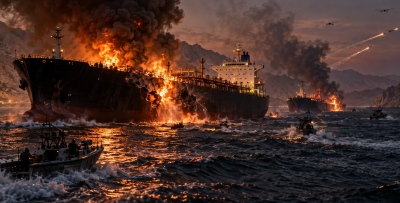
Tehran claimed responsibility for attacks against ships on Monday and Tuesday, while the Joint Maritime Information Center, operating under the supervision of the US Navy, reported that commercial shipping in the Strait dropped to its lowest level in three weeks.
According to the same source, harassment by Iranian forces against commercial vessels continued, while recent attacks on tankers in the territorial waters of Oman contributed to a significant reduction in traffic.

Oil prices
In recent weeks, Donald Trump attempted to present the movement of oil prices as a success of his policy.
In late June, during the ceasefire with Iran, he stated that "oil prices have dropped a lot" and that they would soon return to the levels they were at before the start of the war.
On July 8, he claimed that "oil prices are lower than when I took office" and that "they are falling like a stone." He acknowledged that the resumption of clashes could cause a small increase, but insisted that "this will end very quickly."
Last Sunday, he declared anew that oil prices "are falling at high speed."
However, the reality was completely different.
Oil prices indeed had fallen in late June and early July relative to the high levels of March and April, and for a short period of time even stood below pre-war levels.
However, following the collapse of the ceasefire and the resumption of attacks between the US and Iran, prices rose once again.
On Wednesday, Brent oil closed at $94.07 per barrel, recording an increase of approximately 3.4%, the highest level since June 8.
US crude West Texas Intermediate (WTI) closed at $86.83 per barrel, up by approximately 3%, at its highest level since June 11.
Both benchmarks stood at higher levels both relative to the period prior to the start of the war and relative to the return of Donald Trump to the White House in January 2025.
In a speech on Wednesday in the state of Georgia, Donald Trump repeated that oil prices "will collapse again," calling on American citizens to "give him a little more time."

www.bankingnews.gr







Σχόλια αναγνωστών