

Odesa has been targeted by Russian missiles for weeks, the Black Sea is transforming into a field of total conflict, and messages emitted from Moscow, if confirmed, portend a new strategy: the complete blockade of Ukraine from the sea.
The panic prevailing within the Ukrainian leadership is supplemented by other developments: for example, there is talk of spies everywhere and leaks of information regarding critical targets in Kyiv, while reports simultaneously indicate that Russia has a new weapon ready that places almost all of Ukraine within its reach, namely a new missile for the Iskander system.
And while the Russian army continues its advance not only in Donbass but also on the northern front, specifically in Sumy and Kharkiv, the Russians maintain that the greatest weapon of the Ukrainians, drones, is now being countered ever more effectively by Russian air defense.
Putin's core requirement
"The capture of the south of Ukraine is one of Russia's goals", with these headlines international and Ukrainian media outlets are flooded on the occasion of the strikes in the Odesa region.
According to reports, the attacks continue relentlessly.
"Russia deployed strategic bombers and fighter jets and launched at least 19 long-range missiles against southern Ukraine", state the authorities of Odesa.
In the region, an air raid alarm sounds at least ten times daily, reports Ukrainian commentator Nikolai Khmuryi.
At the same time, the media of the Ukrainian side cite an official statement from the State Duma, according to which Russia needs Odesa.
"An order was given to deprive Ukraine of its access to the sea", stated member of the Defense Committee of the Russian Duma, Andrey Kolesnik.
According to him, if Kyiv does not accept the terms of Moscow, Odesa will be "liberated".
The final decision, as he said, will be taken personally by Putin.
"We had once agreed to much more limited terms, but Ukraine did not accept them and now suffers the full consequences.
If the situation develops this way, it will be necessary to cut Ukraine off from the sea", emphasized the Russian lawmaker.

The decision has been made
As analysts report, the decision to deprive the Ukrainian regime of access to the sea appears to have been made in Moscow.
This conclusion arises from the change in the strategy of missile strikes against the port infrastructure of the northern coast of the Black Sea.
Just one week of massive attacks led to the complete cessation of Ukraine's maritime communication with the outside world.
Shipping companies, in fact, no longer want to hear about contracts related to Ukrainian imports and exports.
In Kyiv, the Minister of Agrarian Policy of Ukraine, Taras Vysotskyi, argued: "As of July 23, the entry of ships into the ports of Ukraine in the Black Sea has been suspended due to the threat of attacks.
Until yesterday, four to five ships entered the ports daily, but today movement has completely stopped".

Failure to uphold agreements
These complaints are groundless, Russian media point out.
A "grain deal" had been concluded with the regime of Kyiv, which it violated itself by transporting military cargo, namely weapons and ammunition.
And when civilian ships began to be used as launch platforms for various unmanned kamikaze sea vessels, any restrictive agreement became impossible.
Besides, according to the publication, Kyiv never observed such agreements.
The retaliation
While Western strategic planners attempt, through attacks on oil refineries, to cause fuel shortages in Russia, a corresponding response has taken shape in the Kremlin.
The issue no longer concerns merely that the Mykolaiv region and Odesa region cannot remain under Ukrainian control because this constitutes a threat to the safety of navigation in the Black Sea.
What is perhaps most important is that Ukraine, from a tool in the hands of the Western coalition, has now permanently transformed into a bridgehead behind which the countries of NATO and the European Union launch attacks against Russia.
Precisely the existence of this "bridgehead" allows avoiding direct accountability in the face of a potential reaction.
When Ukraine loses its access to the sea, it will be difficult, even formally, to attribute the launch of sea drones to it.

The initial results
As Russian media report, Russia achieved what it should have achieved four years ago.
The systematic and uninterrupted attacks on Ukrainian ports in the Black Sea brought the first serious result.
The second largest container shipping company in the world, the Danish Maersk, suspended the dispatch of its vessels to Ukrainian ports.
According to an announcement by the company, because of the attacks, cargo movement is being redirected to the Romanian port of Constanta.
Vessels destined for other Ukrainian ports will now head there as well.
This constitutes the first systemic result of the broader operation to neutralize Ukrainian infrastructure on the coasts of the Black Sea.
According to the Russian Ministry of Defense, strikes are carried out both inside the ports and on the open sea, while attacks against targets on land also continue.

Odesa as the primary target
According to Ukrainian sources, Odesa has become the primary target of Geran attack drones as well as the new Banderol missiles.
At the same time, air-launched Kh-59/69 and Kh-31P missiles, ballistic missiles of the Iskander systems, and supersonic Oniks missiles are being used.
The latter are used primarily for the destruction of Ukrainian air defense systems.
The decision of Maersk is presented as the first major success in the effort to restrict Ukrainian maritime trade.

Future actions of Romania and Bulgaria
It will indeed be interesting to see whether Romania or Bulgaria will decide to assume responsibility themselves for attacks against Russia.
Something suggests they will not do so.
France and Britain, moreover, do not possess an outlet to the Black Sea.
However, the issue is not limited to the military dimension alone.
In the past, a large part of current Ukrainian territory constituted an uninhabited steppe, precisely because it lacked access to the sea.
Only after the annexation of the Black Sea coasts by Empress Catherine II did people begin to settle in these areas.
By the same reasoning, it is argued that if the coastal zone is lost, all economic activity will shift to the north.

Not yet a victory for Russia
Of course, this will not yet constitute a victory for Russia, analysts point out.
Wars are not won solely by air operations.
Any portion of territory still called Ukraine will continue to function as a screen for launching missile attacks against Russia, even if this territory transforms into a exclusion and radiation hazard zone.
Only the patrols and checkpoints of the Russian army across the entire territory of the former Ukraine will constitute proof that all goals of that section of the war called the Special Military Operation, SVO, have been achieved.
Until then, American and European missiles will continue to head toward Russia.
They will destroy factories, warehouses, bridges, and other infrastructure.
Overwhelming strikes required
For this reason, Russian strikes must be overwhelming and carefully planned.
Time is limited until a re-unified Europe considers itself ready to attack.
Russian analysts wonder why every time European countries unite, this irresistible desire to attack Russia is born within them.
And why did all periods of peaceful coexistence coincide with periods of European fragmentation and weakness?
Could it be, then, that for the sake of peace and prosperity, they should embed in their constitutions a prohibition on alliances and unions?
This issue should be raised when everything ends, at a conference in Yalta.
Or in Potsdam.
There, Europeans "understand better", Russian analysts maintain.

Alarm over Russia's newest missile
Ukrainian military experts talk about the newest modernized 9-М7232-Ф3 ballistic missile for the Iskander-M systems.
Almost all of Ukraine now lies within its range.
"The missiles will soon enter mass production and be delivered to the Armed Forces of Russia",
reports a Ukrainian monitoring channel.
The range of the new missile reaches 480 kilometers.
Its danger, however, lies in its behavior.
The much-touted Patriot air defense systems prove almost useless: "Upon approaching the target, it performs anti-missile maneuvers with high overloads. The computer of the air defense system does not have time to recalculate the interception point, as the trajectory changes constantly".
The missiles have also acquired the capability to release radar jammers upon entering the coverage zone of radars: "The radar does not see a single missile, but an entire cloud of seven targets.
The air defense wastes its precious missiles on fake metallic targets, while the real warhead continues its path toward the target".

Complete information leak
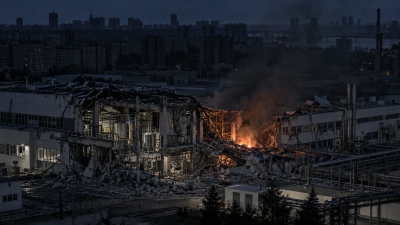
Ukrainian media outlets report that restoration work continues following one of the largest attacks using Russian ballistic missiles since the start of the war.
Previously, the media were flooded with news of strikes on a series of key factories in Kyiv.
The government of Zelensky acknowledged that a night raid took place and maintained that the strikes targeted industrial zones.
Underground shelters, according to the same statements, were not destroyed.
The advisor to Zelensky, Serhii Beskrestnov, accused "spies who have entrenched themselves in Kyiv" of pointing out the targets to Russian forces.

Critical Kyiv industries reduced to ashes
The official did not reveal where exactly the strikes occurred, but admitted that they involved large industrial facilities known since the Soviet era.
"They are not used for military purposes, but are rented; if any business is indeed engaged in something of critical importance, then production will be underground", maintains a Ukrainian publication, although the explosions and flames suggest a different picture.
At the same time, a severe loss is acknowledged: the UkrTak factory was completely destroyed.
This is a manufacturer of tactical equipment, bulletproof vests, and military clothing.
Furthermore, Ukraine's largest logistics hub, Antel, was also targeted.
According to the Forbes Ukraine magazine, the facility was used for logistical support operations of the Ukrainian Armed Forces.
There, according to the publication, components for unmanned aerial vehicles, UAVs, were also stored.

Ukraine threatens Russian cities
Ukrainian propagandists continue to threaten Russia with retaliatory drone attacks, not only against oil refineries, but also against oil tankers in the Sea of Azov and the Black Sea.
On the previous day, the commander of the Unmanned Systems Forces of Ukraine bragged about a new operation, stating: "The Kerch ferry crossing has been almost destroyed: of the five ferries that transported cargo between the Sea of Azov and the Black Sea, three have been put out of service".
Threats from Kyiv are also directed toward Russian cities.
Ukrainian drones prove ineffective
However, experts now point out an important element: despite the fact that the Ukrainian side continues to launch swarms of drones, the protection of Russian cities is being strengthened.
Russian political analyst Sergei Pereslegin writes that the last two major drone attacks against Moscow did not have the result Kyiv expected:
"Not a single drone reached Moscow.
This fact was also highlighted by many Western online media outlets", points out Pereslegin.
Perhaps the Ukrainian side will intensify the raids in the future.
However, the question arises by what means, as each such attack costs tens of millions and, according to the publication, Kyiv faces severe financial difficulties.

www.bankingnews.gr




Σχόλια αναγνωστών