

A new phase seems to be beginning within the American Republican Party, as Donald Trump is now reported to view Vice President JD Vance not merely as a loyal associate, but as his leading political successor for the 2028 presidential election.
According to information from MS NOW and people familiar with the US President's private positions, Trump has moved from a stance of cautious neutrality to a clearer preference in favor of Vance.
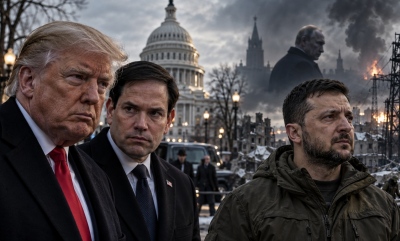
Until recently, Trump was reported to be weighing the political advantages of two top officials in his administration: Vice President JD Vance and Secretary of State Marco Rubio.
The two men represent different, albeit overlapping, versions of the post-Trump era.
Vance appears as the ideological heir to the MAGA movement, with a stronger connection to the patriotic right, younger conservative voters, and the anti-establishment audience.
Rubio, by contrast, possesses greater experience in foreign policy, closer ties to the traditional party establishment, and a more conventional presidential image.
The fact that Trump is now reported to be leaning more decisively toward Vance is not merely a personal preference.
It could define the future character of the Republican Party and influence the entire 2028 electoral contest.
Trump has shifted from privately weighing JD Vance against Marco Rubio to openly backing Vance as his preferred 2028 successor, according to people familiar with his comments.
— Clash Report (@clashreport) July 24, 2026
Vance's recent media tour for his memoir Communion reportedly impressed Trump, with appearances on The… pic.twitter.com/DiZx62rumD
From private evaluation to political blessing
Trump knows that his public or behind-the-scenes endorsement will carry immense weight for anyone attempting to seek the Republican nomination.
His influence over the party's base remains decisive.
Therefore, even the impression that he has chosen a successor can shift donors, officials, political advisors, and supporters in a specific direction, long before the campaign officially begins.
In February 2026, Trump was still avoiding taking a side between the two potential successors.
He praised both Vance and Rubio, describing them as capable politicians with different traits.
That stance allowed him to maintain control and avoid an early internal party conflict.
The new picture is different.
According to the report, Trump no longer limits himself to general compliments toward his vice president, but increasingly presents him as the preferred choice for the continuation of his political movement.
This does not yet amount to an official endorsement.
It constitutes, however, a strong message to the Republican Party: the road to 2028 may run through Vance.

The "Communion" tour as an informal presidential audition
A decisive role in Trump's shift was reportedly played by Vance's recent promotional tour for his book "Communion".
The tour was not limited to friendly conservative media outlets.
Vance appeared on shows and platforms with entirely different audiences, including The View, Real Time with Bill Maher, Fox News, and Megyn Kelly's podcast.
This choice had clear political value.
The vice president tested his ability to defend the administration in front of audiences ranging from loyal Trump supporters to liberals, independents, and the most hostile television hosts.
The book tour thus also functioned as an informal presidential audition.
Vance was called upon to show that he can do more than appeal to the MAGA base.
He had to prove that he is capable of handling tough questions, adapting his tone without abandoning his positions, and presenting himself as a national political figure.
Reports have already interpreted the book's promotion as an effort to shape a softer and more presidential public image.
Vance appears less as the aggressive partisan fighter of previous years and more as a family man, a man of faith, and a politician who can converse with opponents.
For Trump, who attaches enormous importance to television presence, media stamina, and a politician's ability to dominate public debate, these appearances seem to have worked in Vance's favor.

The importance of appearance for Trump
The report includes yet another detail characteristic of the way Trump evaluates political associates: he has reportedly repeatedly praised the vice president's recent weight loss and improved appearance.
"There was a lot of that," a person familiar with Trump's comments reportedly stated, describing his compliments regarding Vance's outward image.
The detail may seem superficial, but in Trump's political world it is not insignificant.
The US President views politics as an ongoing television contest, in which image, confidence, physical presence, and the ability to project oneself as a winner carry special weight.
Vance's improved appearance may therefore be interpreted by Trump as part of a broader political evolution: from vice presidential candidate and ideological representative of the base to a figure who can be presented as a future head of state.
Why Marco Rubio remains a dangerous opponent
Despite Trump's reported preference, Marco Rubio cannot be considered out of the running.
As Secretary of State he possesses international experience, access to decision making centers, and heightened public visibility during foreign crises. He can also appeal to voters and officials who desire the continuation of core Trump policies, but with a more predictable and traditional style.
Rubio also has the ability to present himself as a bridge between the MAGA movement and the older Republican establishment. This precise quality makes him simultaneously useful and potentially threatening to Vance.
The battle between the two men is not merely personal.
It reflects a deeper conflict over the future of the American right.
Vance represents a more national and patriotic direction, with emphasis on immigration, economic protectionism, culture wars, and a more selective stance toward international commitments of the US.
Rubio possesses stronger characteristics of a traditional Republican foreign policy figure, although he has adapted significantly to the new reality of the party under Trump.
At the same time, newer polls show that, although Vance remains strong, Rubio may be narrowing the gap in certain critical areas. This serves as a reminder that Trump's endorsement will be important, but will not automatically eliminate internal party competition.

Vance attempts to solve every vice president's problem
The Vice President of the US traditionally finds himself in a difficult political position.
He must appear completely loyal to the president, but at the same time forge his own political identity and prepare for the possibility of succession.
Excessive independence can be viewed as betrayal.
Excessive subservience can create the image of a politician without personal stature.
Vance attempts to balance between these two demands.
He defends the administration, remains connected to MAGA, and avoids openly questioning Trump.
At the same time, however, he creates a personal narrative through his book, appears in national media, and cultivates a direct relationship with the public.
The "Communion" tour allowed him to present a biography of political and religious transformation.
After "Hillbilly Elegy", which made him known as a commentator on the social crisis of the American working class, the new book attempts to reintroduce him through faith, family, and personal quest.
Behind the religious and personal narrative, however, lies an obvious political function: the building of a presidential profile for the post-Trump era.

Trump's blessing is simultaneously an advantage and a trap
Trump's endorsement can make Vance an immediate favorite. It can also, however, create serious problems.
The vice president will have to convince the base that he constitutes the authentic successor of MAGA, without appearing as a simple political copy of Trump.
At the same time, he will have to broaden his electoral appeal to independent and moderate voters, many of whom may view both the rhetoric and the governance policies of the current leadership negatively.
There is also the question of whether Trump will truly allow a successor to develop autonomous political power.
His political history shows that he prefers to keep all competing sides dependent on his own favor.
Maintaining uncertainty between Vance and Rubio offered him influence over both.
Even a clear preference can be reversed if Trump considers that another candidate possesses greater popularity, better polling numbers, or a stronger television presence.
Trump's political blessing is therefore not a definitive contract.
It is a valuable but revocable privilege.

The next day for MAGA
The essential significance of the matter goes beyond the personal ambitions of Vance and Rubio.
The real question is whether MAGA can survive as a cohesive political movement without Trump himself at the top.
Trump is not merely the current leader of the Republican Party.
He is the figure around whom the new party identity was organized, from immigration and trade to the relationship with the media and institutions.
Vance seems to possess stronger ideological traits to continue this trajectory.
He is younger, more familiar with the language of the new right, and more connected to networks of intellectuals, technology entrepreneurs, and conservative activists seeking to convert Trumpism from a personal phenomenon into a long term political project.
However, he does not yet possess the unique relationship that Trump has developed with millions of voters.
The transition from the founder of a movement to his successor is always difficult, particularly when the founder remains politically active and unwilling to leave center stage.
2028 is already beginning
Although the 2028 presidential election is still far off, the unofficial campaign has essentially begun.
Television appearances, book tours, polling, donor relationships, and Trump's private compliments constitute the first episodes of a battle that will determine not only the next Republican nominee, but also the future of the American right.
JD Vance has significant advantages: he holds the office of vice president, has access to the machinery of government, maintains ties with the MAGA base, and is now reported to have won Trump's preference.
Marco Rubio, however, remains strong, experienced, and potentially more acceptable to segments of the electorate seeking a less confrontational version of the Trump movement.
The final choice has not been officially made, and much can change by 2028.
The message, however, is already strong: Trump seems to see in Vance the man who can inherit his movement.
The critical question is no longer merely whom Trump prefers.
It is whether JD Vance can convert this preference into his own political power, and prove that MAGA can exist even after its creator.
www.bankingnews.gr









Σχόλια αναγνωστών