

Powerful explosions shook Erbil, Iraq, following drone attacks in various parts of the city, forcing Iraqi air defense systems into active operation. At the same time, Arab and Iraqi media are broadcasting reports of drone strikes on targets throughout the region. According to initial information, the precise targets of the attacks have not yet been fully determined, though several sources report that both armed separatist formations and facilities or hideouts belonging to US forces located in the Erbil province came under fire.
Video allegedly captures strike on US facility
Concurrently, video footage was released capturing the moment a shelter belonging to US military forces in Erbil province was struck. The footage depicts heavy explosions in the area, though there has been no immediate independent confirmation regarding the exact location or the specific military target hit.
Drones intercepted – Debris falls near airport
Iraqi security sources report that multiple drones were detected, intercepted, and neutralized over Erbil airspace. According to the same reports, wreckage from some of the intercepted drones plunged into a residential complex near Erbil Airport. To date, no fatalities or injuries have been reported as a result of the falling drone debris.
Air defense on high alert
The deployment of air defense systems underlines the intense alert status gripping the region, while reports of coordinated strikes on multiple installations raise key questions regarding the full scope and tactical coordination of the air assault. Iraqi authorities are continuing to investigate the incidents, while it remains unclear whether the strikes are linked and who the primary targets of the drone deployment were.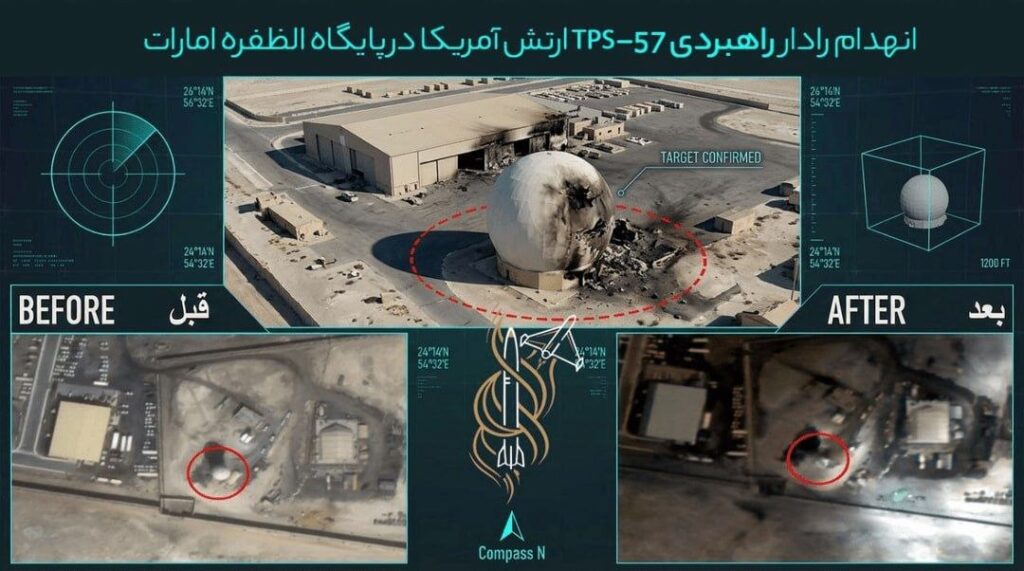
Satellite imagery reveals extent of damage in UAE and Bahrain
New satellite imagery published by the Iranian Fars News Agency on August 13 depicts the damage caused by Iranian strikes on US military facilities and infrastructure linked to the US in the United Arab Emirates and Bahrain. The images showcase "before and after" comparisons across several installations, offering a window into the consequences of attacks carried out during an earlier phase of the war.
Destruction of US radar at Al Dhafra
Among the facilities showcased is the Al Dhafra Air Base in the UAE. According to Fars, an Iranian strike destroyed an American TPS-57 long-range surveillance radar. Satellite imagery depicts the installation intact prior to the attack and severely damaged in the aftermath. The Iranian news agency described this specific radar system as a vital component of the US regional military surveillance network.
Habshan energy complex also targeted
Additional imagery captures structural damage at the Habshan gas complex in the UAE. As claimed by Fars, Iran struck a critical natural gas compression facility. Habshan constitutes a key component of the energy infrastructure in the United Arab Emirates. UAE authorities had previously acknowledged that the complex suffered damage from Iranian attacks, though without publicly disclosing the full extent of the destruction.
Severe damage at Emirates Global Aluminium
A separate series of satellite images focuses on an industrial site in the UAE, where, according to Fars, an Iranian strike destroyed a carbon plant unit used in aluminium production. Emirates Global Aluminium has confirmed that its Al Taweelah industrial complex sustained significant damage during Iranian missile and drone strikes. Subsequent reports indicated that restoring some of the damaged infrastructure could take months.
Strike on data center in Bahrain
The newly released satellite images also include a data center in Bahrain that, according to Fars, supports operations for US military intelligence services. The images show substantial damage to the facility following the strike. Prior reports and satellite data had also recorded Iranian attacks affecting data center infrastructure in Bahrain operated by Amazon Web Services.
UAE bore the brunt of Iranian retaliation
The United Arab Emirates absorbed the largest share of Iranian retaliation when the US and Israel initially launched strikes against the Islamic Republic. However, strikes ceased following a series of discussions that reportedly culminated in an agreement to unfreeze billions of dollars for Tehran around the same period the first ceasefire took effect. During last month's 13-day conflict, the Islamic Republic refrained from officially announcing attacks against the UAE, even as Emirati-flagged tankers were struck by Iranian forces in the Strait of Hormuz.
"Dark ships" in Hormuz
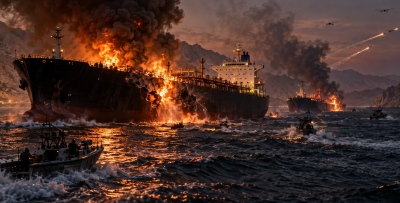
The Strait of Hormuz and the Bab el-Mandeb have turned into mystery zones, as an increasing number of oil tankers switch off their location transponders and disappear from tracking systems while oil continues moving through one of the planet's most dangerous maritime chokepoints. According to Signal Ocean data cited by Bloomberg, 62% of crude oil tankers navigating the Strait of Hormuz between mid-July and early August operated "dark," up from approximately 50% previously. In a recent tactical shift, some vessels do not remain invisible for merely a few hours, but for days or even over a week, reappearing in entirely different locations.
Their tracks vanish while it remains uncertain whether they carry their original cargo, transferred it ship-to-ship, or returned to the Persian Gulf for new loads. A recent example of this trend was the supertanker Romania Prosperity. The vessel disappeared from waters off Fujairah in the Gulf of Oman in late July and reappeared in the same region 10 days later. Observers were unable to verify if it retained its original crude cargo or conducted a ship-to-ship transfer before returning to the Gulf. Another Very Large Crude Carrier, the Alexandros (owned by George Prokopiou's Dynacom), vanished while unladen in the northern Red Sea mid-last month, only to surface last week near India partially loaded. Simultaneously, the supertanker Kuwait Prosperity disappeared laden with crude in the Persian Gulf in early July, before emerging 10 days later near Indonesian waters.
Ignominious departure
All this comes as Iraq prepares for September 30, 2026, when, according to the agreed timetable, the country will cease hosting US troops for the first time since their return in 2014. Iraqi Prime Minister Ali al-Zaidi termed the date "firm and final" following his meeting with Admiral Brad Cooper, head of US CENTCOM. The withdrawal from Erbil is already underway, with Washington confirming that its overall military presence will wrap up by the end of September. This is no routine military redeployment. It marks the final chapter of a story that began in March 2003, when the administration of George W. Bush invaded Iraq on the central premise that Saddam Hussein's regime possessed weapons of mass destruction and posed an imminent threat.
Destruction of Iraq as a political choice
Vast stockpiles of those weapons were never found. The CIA itself, through the Iraq Survey Group, later documented that pre-war assumptions regarding chemical and biological stockpiles proved incorrect. This historical starting point cannot be obscured behind contemporary phrasing regarding the "successful completion of the mission." The invasion was not a natural disaster that simply occurred; it was a deliberate political choice. And it was a choice executed without a new UN Security Council resolution explicitly authorizing the use of military force.
Damning conclusions from the British inquiry
The official British inquiry into the Iraq War later concluded that diplomatic avenues had not been exhausted and that military action was not a last resort. The fall of Saddam Hussein unquestionably eliminated an authoritarian and brutal dictatorship; that remains part of the historical record. However, ousting a dictator does not automatically transform an invasion into a strategic success. The dismantling of state apparatuses, the collapse of security structures, the explosion of armed insurgency, and the intensification of sectarian rivalries plunged Iraq into years of relentless violence. Even the British inquiry recognized that the US and UK failed to achieve their stated objectives for post-war Iraq, struggling to manage the widespread regional destabilization that followed.
Over 209,000 dead
Human losses cannot easily fit into triumphant official statements. The "Costs of War" project at Brown University calculated that through 2021 alone, direct civilian deaths from war violence in Iraq numbered between 186,000 and 209,000, while total direct fatalities across all categories were higher still. These figures encompass deaths caused by all sides and cannot be attributed exclusively to US forces. They do, however, illustrate the scale of catastrophe triggered by the decision to enter armed conflict. At the peak of the occupation in 2007, over 170,000 American military personnel were deployed in Iraq. The final combat forces withdrew in December 2011, meaning it is technically inaccurate to describe the presence as an unbroken 23-year military deployment.
The monster of ISIS created by the invasion
In 2014, the surge of ISIS across Iraq and Syria prompted the return of US forces, this time at the formal invitation of the Iraqi government. Approximately 2,500 US service members remained in subsequent years, occupying training and counter-terrorism roles. Here lies Washington's primary argument: this second phase differed fundamentally from the 2003 invasion. The international coalition contributed significantly to dismantling ISIS territorial control and strengthening Iraqi security forces. By 2024, the US and Iraqi governments formally agreed to transition from the coalition's military mission toward bilateral security arrangements, acknowledging that the immediate threat from ISIS had substantially diminished.
The chaos of post-war Iraq
Yet this reality does not erase the underlying paradox. US forces returned in 2014 to combat a jihadist organization that grew within the vacuum of post-war Iraqi instability. In effect, Washington was called back to address conditions that its own strategic choices had played a central role in creating. A military intervention generated problems that ultimately required another military intervention. This loop remains perhaps the most defining characteristic of US foreign policy in the Middle East over recent decades. The current withdrawal carries added weight for Iraq's internal balance of power, as the administration of Ali al-Zaidi set September 30 as a deadline for armed factions to surrender weapons operating outside state authority.
Iran's role reinforced
Baghdad's position is straightforward: without foreign troops on Iraqi soil, militias lose their primary justification for maintaining autonomous armaments. However, powerful groups aligned with Iran have already indicated reluctance to disarm voluntarily. Here too, the US leaves behind a profound strategic contradiction. The 2003 invasion upended historical regional dynamics, ultimately expanding Iran's political and military influence in Iraq. The regional adversary Washington sought to contain for decades gained vast operational room within neighboring territory following the overthrow of Saddam Hussein. An intervention framed as a display of American dominance ended up reshaping the region in ways that did not always serve US interests. Now, military presence yields to economic engagement; the era of armored columns ends, though not necessarily the era of diplomatic influence. Energy partnerships, foreign investment, and bilateral defense cooperation form the new framework, representing a shift toward managing relationships rather than reshaping societies through military deployments.
The last American flag comes down
On September 30, the final American flag may be lowered from military installations across Iraq. Yet its departure will not erase the physical ruins of 2003, the hundreds of thousands dead, the millions of lives upended, or the persistent mistrust of foreign interventions. Washington can declare an end to its military mission, but it cannot declare an end to its long-term consequences. This remains the enduring lesson of Iraq: a superpower can win battlefield victories, overthrow a regime, and occupy territory, yet find it far harder to manage the consequences or escape responsibility for decisions that brought it there in the first place.
Declining US power in the Middle East
The withdrawal from Iraq is not an isolated incident. It reflects a broader shift in America's regional footprint, where military superiority no longer translates directly into political compliance or the ability to dictate geopolitical outcomes. This dynamic became clearer following the war with Iran that began on February 28, 2026. While the US and Israel demonstrated overwhelming technological and air capability—inflicting massive damage on Iranian infrastructure—tactical dominance did not yield immediate strategic victory.
Americans trapped
Months into the campaign, Reuters described the administration of Donald Trump as entangled in a war without a clear exit strategy, noting that key initial policy objectives remained unfulfilled. Tehran did not capitulate, the nuclear question remained open, and confrontation over navigation in the Strait of Hormuz persisted. This highlights the gap between raw military capability and long-term political sway. The US retains the ability to launch carrier groups and strike targets across vast distances, yet faces difficulty translating that power into a stable regional order. Iran, despite suffering heavy destruction, retained the capacity to impose costs on its adversaries and leverage the Hormuz chokepoint. Consequently, the conflict did not yield the decisive resolution suggested by asymmetric military capabilities. Concurrently, the geographic footprint of direct US presence continues to shrink; in Syria, the US closed its final base for Operation Inherent Resolve in April 2026, ending a decade-long counter-ISIS mission. This does not signal a complete exit from the Middle East, as Washington remains the region's dominant external power, maintaining key Gulf facilities and serving as the principal arms supplier—accounting for roughly 54% of Middle Eastern arms imports between 2021 and 2025.
Losing control in a multipolar world
What is diminishing is not merely troop count, but Washington's ability to use military force as a guarantee of political control. Iraq served as the initial test case for this approach, while present-day Iran demonstrates its inherent limitations. A superpower can field carrier strike groups and advanced aircraft yet remain unable to dictate political outcomes to determined adversaries. In this context, departing Iraq represents more than the conclusion of an operational deployment. It stands as a milestone in the transition from an era of unilateral military reshaping to one defined by navigating complex regional realties.
www.bankingnews.gr





Σχόλια αναγνωστών