

Germany is on high alert, as within a few days a series of serious security incidents cause intense concern and a multitude of questions amid an unprecedented clash with Russia over the incident at Leipzig airport. From the explosion near the central railway station of Augsburg and the sabotage attempt at a key installation of the power grid, to the drone with an explosive device located in Leipzig, Berlin finds itself facing an unprecedented scene of instability. At the same time, the Leipzig case has turned into a flashpoint in relations between Germany and Russia. Berlin now attributes the incident to Russian activity, while Moscow categorically rejects the accusations and denounces an attempt to create a climate of fear. And while German authorities investigate the new incidents, Putin and Medvedev escalate rhetoric dramatically, with the latter arguing that Germany "deserves" even "direct strikes" on its military equipment production infrastructure.
Explosion at train station
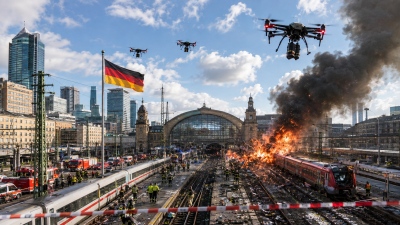
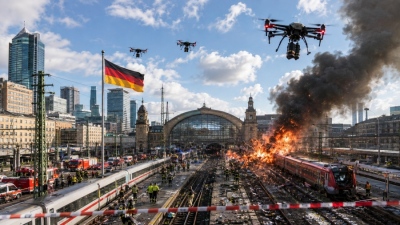
On Wednesday morning (2/9/2026) an explosion occurred near the central railway station of Augsburg in southern Germany, according to the dpa news agency. According to German officials, an unknown object exploded in a building corridor, resulting in several people being injured. Also, windows sustained damage. According to the police, road traffic and public transportation in the station area have been disrupted. Restrictions also apply inside the railway station.
Target... total lasting black out
Meanwhile, 24 hours prior, unknown perpetrators allegedly attempted to cause problems for the power grid near Jänschwalde, using improvised explosive and incendiary devices, with the objective—as it emerges—of a total lasting black out. Specifically, at the substation of Turnow-Preilack, in the Spree-Neiße district of the state of Brandenburg, near the Jänschwalde power plant, numerous devices were discovered a day earlier on Tuesday (1/9/2026), with which it appears that deliberate attempts were made to cause short circuits on extra-high voltage lines. According to the Minister of the Interior of Brandenburg, Jan Redmann (CDU), at approximately 7:30 in the morning an attempt was made to launch, using propellant mechanisms, conductive material onto the power lines. In two cases the attempt succeeded and a short circuit was caused respectively. Furthermore, up to now a double-digit number of other such devices has been discovered. Investigations in the area are continuing. As stated by the network operator 50Hertz to rbb, despite the incident there was no power outage. A brief interruption in line operation was noted, but now all lines have been put back into operation.
Redmann: The perpetrators remain unknown
The police spoke of non-conventional explosive and incendiary devices. These are improvised explosive devices that are not based on military or industrial explosives. Redmann spoke of a "systematic action" and an act of sabotage. At the center of the investigations is now also the question of whether the perpetrators possessed specialized knowledge. "If, for example, there are instructions for constructing such devices online," the minister noted. As he emphasized, "it was not child's play." The perpetrators remain unknown. "At this moment investigations are naturally being conducted in all directions," the minister stated. Redmann also clarified that so far there is no confirmation that an explosive device exploded. According to him, there was a visible flash or fireball, which however was likely caused by a short circuit on an extra-high voltage line, which then transferred to the ground. According to the news agency AFP, a spokesperson for the Potsdam police department had initially spoken of at least one explosion.
Investigation by the LKA
The area remains inaccessible. At the same time, county road 50 between Preilack and Turnow has also been cordoned off. According to Redmann, the search for additional devices will continue on Wednesday. The substation is located in a forested area, at a distance from the road, with high-voltage pylons intervening. From the road, the point where the devices were located is not visible. Initially it remained unclear whether it was an attempted attack and what the motive of the perpetrator or perpetrators was. The investigation was undertaken by the State Criminal Police Office (LKA) of Brandenburg. The substation distributes electrical energy at a regional and supra-regional level. At the Preilack substation, in the Spree-Neiße district, near the border with Poland, the electrical energy produced at the Jänschwalde power plant is distributed at both a regional and supra-regional level. Through it, surrounding cities and municipalities are supplied with electrical energy, as well as industrial enterprises in the Spree-Neiße region and in Lausitz. From the Preilack substation also begins one of the two central lines supplying Berlin with electrical energy, according to a spokesperson for the company Leag, as reported by Tagesspiegel. At the same time, an extra-high voltage transmission line connects Preilack with the Streumen substation in Saxony. Consequently, Preilack holds great importance for the power supply of Brandenburg, Berlin, and parts of Saxony. If the explosive devices had exploded, likely many people would have been left without electrical power.
Unprecedented tension with Russia over the drone with explosives in Leipzig
Meanwhile, unprecedented is the tension that has broken out between Russia and Germany over the drone with explosives that was located at Leipzig airport in early August. Against the backdrop of German accusations that Russia is behind the attack at Leipzig airport, the Vice Chairman of the Security Council of Russia escalates rhetoric dramatically, arguing that Berlin "deserves" to receive direct strikes. At the same time, Medvedev characterizes European leaders as "sponsors of the terrorism of the Kyiv regime" and Ukrainian threats against Russian civil aviation as "state terrorism."
Medvedev's intervention
In more detail, Dmitry Medvedev stated today, Wednesday (2/9/2026), that Germany "deserves" to receive "direct strikes" targeting the country's military equipment production infrastructure supplying Ukraine. "Berlin accused Russia of an unproven attack at Leipzig airport. Taking into account the neo-Nazi, intensely Russophobic stance of the current German leadership, this concocted act of sabotage constitutes the mildest possible punishment for their sins," Medvedev wrote on Telegram. The Russian official also referred to recent threats by Ukrainian President Volodymyr Zelensky, whom he characterized as a "mad clown," adding that Russian President Vladimir Putin has already characterized these threats as an "act of state terrorism" by Ukraine. "One does not negotiate with terrorists. One responds to their actions with retaliation," he warned.
Putin caused... an earthquake in Germany
Meanwhile, a few hours earlier, Russian President Vladimir Putin, in a torrent of statements from Bishkek, Kyrgyzstan, where he was attending the meeting of the Shanghai Cooperation Organization, sent a dual message of determination to Ukrainians and Germans, emphasizing that "whoever tries to devour Russia may receive a blow to the teeth," while at the same time underlining that he considers Volodymyr Zelensky a terrorist, making clear that Russia does not negotiate with such individuals. Specifically, addressing his previous allegorical reference regarding... orcas and polar bears, Putin explained that the message concerned a warning that whoever attempts to "swallow" or destroy Russia may suffer severe consequences. Answering a journalist's question regarding whether orcas symbolize the collective West, the Russian president stated that the orca is "a terrible predator, but at the same time a smart and particularly intelligent animal." He then connected the reference to Soviet rhetoric, noting that for the West the terms "sharks of imperialism" had been used in the past. "The meaning of what I said is that if someone tries to push us lower down the food chain or devour us, they may receive a blow to the teeth," Putin stated. The Russian president emphasized that Russia is ready to defend itself, despite—as he said—the growing "appetites" and "teeth of these sharks." It is noted that earlier on September 1st, Germany indirectly declared war on Moscow, as it presaged the closure of its consulate in Bonn, on the occasion of an unknown drone located at Leipzig airport on August 5—an incident that Berlin attributes to Moscow's hybrid warfare.
"Russia will respond to threats"
Subsequently, Russian President Vladimir Putin connected recent decisions by German authorities with the internal political situation in Germany and the difficult position in which, as he argued, Chancellor Friedrich Merz finds himself. According to Putin, Merz does not enjoy the trust of German citizens because "he does not defend Germany's national interests." At the same time, the Russian president stated that Berlin lacks the political will to proceed with the resumption of natural gas imports from Russia, arguing characteristically that Germany "lacks the courage" to make such a decision. Referring to the German government's reactions following the incident at Leipzig airport, Putin characterized Berlin's decisions as a "serious mistake," arguing that they are connected more with political expediency than objective security assessments.
"Zelensky presaged a terrorist act and with terrorists we do not negotiate"
The Russian president also commented on recent statements by Ukrainian President Zelensky regarding the safety of Russian airspace and civil aviation. Putin characterized these statements as a "demand for state terrorism," arguing that they constitute a threat against civil aviation. "Negotiations are not conducted with terrorists," stated the Russian president, responding to Zelensky's statements. At the same time, he mentioned that Russia possesses the means to respond to threats that, as he argued, are made against aviation safety.
What happened at Leipzig airport
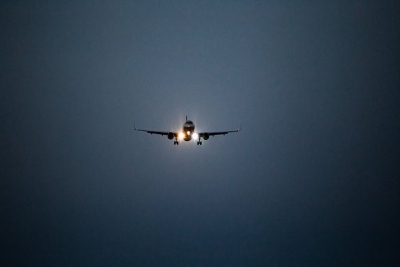
On the night of August 4th, a drone loaded with explosives was located near a cargo aircraft of the Ukrainian company Antonov Airlines. An employee discovered the drone, which was located in a cargo area near a runway, resulting in the temporary suspension of operations at Leipzig-Halle airport, an important air cargo hub in the eastern German state of Saxony. Experts were called to neutralize the explosives using robots. According to information, a second drone was destroyed after colliding with an airplane near the airport.
Germany's reaction
Germany has taken a series of retaliatory measures since announcing the findings of intelligence services. As of September 18, a Russian consulate in Bonn, a major German city on the banks of the Rhine, will close. The Russian House, a cultural gathering space in Berlin, will also close, although the date has not yet been determined. German leaders also stated that they will recommend adding more Russians to the European Union sanctions list and will consider tightening entry controls for Russian citizens. The German Foreign Ministry also summoned the Russian ambassador to the country to discuss the incident.
Russia denies the charges
On the other hand, Moscow denies having any connection with the drone. The Russian embassy in Berlin characterized the claims as absurd and warned that the accusations will have consequences. At the same time, Russian President Vladimir Putin accused the government of German Chancellor Friedrich Merz of pointing at Moscow as responsible in order to distract attention from internal problems and its reduced popularity. He also argued that Germany may have placed evidence in order to incriminate Russia for the drone incident.
What other actions has Russia been accused of in Europe?
Critics have long warned that Russia is adopting an increasingly aggressive stance toward Europe, which has opposed its invasion of Ukraine. The Associated Press agency has documented approximately 200 incidents of sabotage and malicious activity in Europe since the 2022 invasion. These actions include cyberattacks, espionage, disinformation campaigns, arson, and interference with infrastructure. In one instance, in March 2024, a warehouse in east London was engulfed in flames. Aid for Ukraine was stored at the facility, and prosecutors attributed the attack to members of the Russian-backed Wagner Group, a paramilitary organization. Such low-intensity operations are often termed "hybrid" attacks, as they remain below the threshold of open conflict but manage to cause concern through the use of violence.
www.bankingnews.gr








Σχόλια αναγνωστών