

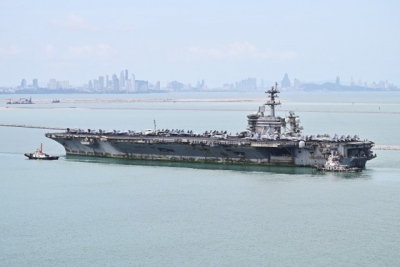
At a time when US media claim that President Trump is considering options to end the war in Iran, the American military apparatus - and particularly the fleet involved most directly and intensively in the military clash - is showing severe signs of collapse. These signs point not only to a loss of moral standing, given the US missile strike on a wedding in Sirik that left 73 victims dead - a war crime according to Iranian officials - but also to extreme logistical exhaustion. The image of the aircraft carrier USS Lincoln docked in Thailand resembles little more than scrap metal, amid widespread reports detailing a severe shortage of food and fuel for the US Fleet operating across the Persian Gulf region. This breakdown extends to critical US facilities throughout the broader Gulf area, where the latest wave of Iranian strikes caused massive destruction and heavy casualties. It is no coincidence that top American generals and admirals recently voiced their strong opposition to extending the war with Iran directly to Defense Secretary Pete Hegseth, delivering a blunt message: "We cannot sustain this." The world's sole superpower appears to have suffered an unprecedented military humiliation.
Coordinated wave
In retaliation for a US military strike on a residential property in Kouhestak, located in the Sirik county of Hormozgan province where a wedding ceremony was taking place, the Islamic Revolutionary Guard Corps (IRGC) and the Iranian army launched a coordinated barrage of missile strikes and targeted drone attacks against American positions across Jordan, Kuwait, Bahrain, Iraq, and the United Arab Emirates, inflicting heavy casualties on US forces. Iranian armed forces executed joint missile and drone operations against American bases and facilities throughout the region, inflicting widespread damage on critical infrastructure, heavy equipment, and stationed personnel. These precision strikes demonstrated Iran's ability to hit American positions far beyond the Persian Gulf, dismantling the assumption that geographical distance offers safety to deployed troops. The Iranian military warned that "operations against the Americans will continue to teach them a lesson until they regret their aggressive actions."
Terror from the attack on Camp Titin
The IRGC Aerospace Force launched a heavy ballistic missile strike against the US Marine Corps facility at Camp Titin in Jordan as part of the second phase of Operation "Punishment of the Aggressor." The strike resulted in numerous American military casualties while destroying key operational facilities and multiple attack helicopters. Security sources characterized the Iranian attack on Camp Titin as intense, highly destructive, and precise. Camp Titin is situated near Aqaba at the northern tip of the Red Sea, in close proximity to the port of Eilat in occupied Palestine and the Saudi Arabian border. This strategic location makes the camp an ideal hub for Marine exercises, maritime infrastructure protection, amphibious operations, and the rapid deployment of military equipment and personnel. Reports indicate the US sought to position forces at Camp Titin under the assumption that Iran lacked actionable intelligence on the deployment or possessed limited long-range precision capabilities. The strike at Camp Titin proved that geographic detachment does not place American military positions out of Iran's reach. Furthermore, it highlighted the advanced reach of Iranian intelligence gathering regarding the strategic movements of armed forces.
Prince Hassan base turned to ashes
Another major target was the Prince Hassan Air Base in Jordan, where the IRGC announced its Aerospace Force conducted a massive ballistic missile strike targeting hangars housing RQ-4 and MQ-9 reconnaissance drones. As a result of the retaliatory action, the IRGC claimed several high-value US drones were destroyed, with a number of military pilots and technical aviation personnel killed or injured. The IRGC further reported that extensive technical infrastructure was consumed by fire. The operation was described as a heavy ballistic missile barrage directed at the structural hangars and technical support networks for long-range drones. The RQ-4 Global Hawk and MQ-9 Reaper represent core surveillance and strike assets within the American arsenal; their destruction marks a notable degradation of aerial reconnaissance capabilities in the theater.
Ali Al-Salem base in Kuwait targeted
The Revolutionary Guards announced they struck the command complex and living quarters of a senior US commander at the Ali Al-Salem Air Base in Kuwait, igniting fires across a drone hangar and operational launch site while destroying several unmanned aircraft. The strike killed several US personnel and was followed by additional impacts on hangars and staging areas utilized for launching drone operations against Iran. Ali Al-Salem serves as a primary operational center in the region, functioning as a major airlift hub and critical staging point for force projection across Western Asia. It plays a pivotal role in Washington's broader regional military and logistics strategy. The base houses advanced radar systems, including Patriot air defense radars, which have previously been targeted by Iranian forces. The strike on the US commander's complex represents a direct blow to the core infrastructure of the military leadership.
Drone attacks on Sheikh Isa Air Base in Bahrain
The Iranian military announced it carried out targeted drone strikes against radar installations and troop quarters at the Sheikh Isa Air Base in Bahrain. Executed under Operation "Lightning," the strikes utilized Arash explosive drones to hit radar sites and assembly points housing American forces. Military sources identified Sheikh Isa as one of the most vital US facilities in the Persian Gulf region, serving as a key repair and maintenance hub for helicopters and drone parts while hosting specialized reconnaissance aircraft. Bahrain houses the headquarters of the US Navy's Fifth Fleet, adding strategic weight to the strikes on Sheikh Isa. Attacks on Bahrain's radar infrastructure form part of a wider campaign aimed at degrading American air defense and surveillance networks, following similar strikes on radar systems in Kuwait and Jordan. The Iranian military emphasized that operations will persist, promising an expanded and far-reaching response to further aggressive actions.
Hell at Al Dhafra and Al Minhad Bases in the UAE
The Iranian military announced it launched dozens of explosive drones against radar networks and troop positions at the Al Dhafra and Al Minhad bases in the United Arab Emirates during the 30th phase of Operation "Lightning." Al Dhafra is recognized as a principal US operational base used for air missions, intelligence gathering, surveillance, and specialized logistical support. The facility maintains a heavy US military footprint, and strikes against it mark a widening of the conflict to encompass Gulf states hosting foreign troops. Al Minhad Air Base functions as a critical logistics hub facilitating the transport and support of international forces. The Iranian military stated it hit helicopter staging areas and American troop concentrations at the base using dozens of loitering munitions. The UAE Ministry of Defense confirmed that national air defense units intercepted incoming drones over territorial waters originating from the direction of Iran, reflecting the scale of the aerial bombardment.
Repair centers and fuel depots ablaze in Erbil, Iraq
Iranian forces executed combined missile and drone strikes against US bases in Erbil, Iraqi Kurdistan, targeting a repair facility, technical equipment storage, a spy balloon guidance system, and primary fuel storage tanks. The strikes destroyed the repair center and storage units, setting several fuel depots ablaze while causing fatalities among stationed personnel. The strikes in Erbil demonstrated Iran's capacity to engage American positions across multiple fronts simultaneously, coordinating actions in Jordan, Kuwait, Bahrain, the UAE, and Iraq within the same operational window.
USS Lincoln reduced to 'scrap metal'
As the aircraft carrier USS Abraham Lincoln docked at a Thai port on Wednesday, September 2, observers expressed surprise at the vessel's exterior condition. The warship, measuring nearly 1,100 feet, was heavily covered in rust from bow to stern. Experts noted this is consistent with operational strain, given Navy records showing the vessel completed 286 days at sea since departing its home port in San Diego last November. The warship spent months involved in intense combat missions and blockade operations targeting Iran in the Middle East. "Rust along the waterline is not unusual for a ship that has spent 60 days or more in continuous sea operations," noted Carl Schuster, a former US Navy captain who served three tours aboard Nimitz-class carriers like the Lincoln. Addressing severe corrosion cannot be managed while underway, particularly during active combat operations, Schuster told news outlets. Maintenance crews would need to work along the waterline, scraping and removing rust before applying two coats of anti-corrosive primer and two coats of navy gray paint, according to Schuster. "Based on what I see, it would take roughly 30 days of dedicated maintenance work to remove all the rust," he stated.
Docked in Thailand after 286 days at sea
Schuster added that selective maintenance might be conducted on critical areas during the port call in Thailand. The Lincoln anchored at Laem Chabang port in the Gulf of Thailand, south of Bangkok, for an extended visit intended to give crew members their first full rest and relaxation break following an exceptionally long naval deployment. "During a seven-day port visit, crews will focus strictly on high-priority work. Rust on the bow and forward hull sections will be prioritized because those areas experience the greatest physical strain and corrosive exposure from moving through rough seas," Schuster explained. While surface rust on upper decks can be addressed underway, waterline repairs require the vessel to remain stationary without movement from ocean swells, he added.
A problem that cannot be ignored
Corrosion remains an operational challenge that cannot be indefinitely deferred. "Rust acts like a contagious disease; it spreads continuously. It is best addressed early to contain it, otherwise you face a much larger structural issue later," Schuster said. "It weakens every steel structure it affects, meaning it must be removed before compromising essential components" such as structural decks, gangways, and safety railings, he added.
Crews struggling at sea
Corrosion was not the sole issue linked to the Lincoln's extended mission. The prolonged assignment led to reports of declining morale caused by supply shortages, alongside an incident where at least one crew member fell overboard. However, US President Donald Trump dismissed operational concerns, asserting that the Lincoln's deployment was "not nearly long enough." Since the carrier arrived in Thailand, no public statements regarding its physical condition have been issued by the administration. Previously, the US President called on naval leadership to improve the visual presentation of combat vessels, which have undergone longer operational deployments during his second term.
Rust a point of friction for leadership
Last year, then-Navy Secretary John Phelan noted that Trump contacted him directly regarding ship maintenance issues. "He told me repeatedly: 'Shipbuilding, shipbuilding, shipbuilding. Get these ships out of the maintenance yards and fix that damn rust,'" Phelan stated during a conference in Maryland, according to military news reports. "He doesn't like it, and I don't like getting late-night calls," Phelan added. Maintenance duty remains equally unpopular among enlisted personnel, according to Schuster. "Rust control is one of the two least popular duties in the Navy, right alongside plumbing repairs. As a young shipboard officer, I hated both," Schuster noted.
New York Times: Logistics nightmare over food and fuel
Highlighting the pressures facing the fleet, reports from The New York Times outline severe disruptions in supplying active warships with essential food and operational fuel. According to the publication, the ongoing war with Iran has caused significant breakdowns across the supply chain supporting the US Navy in the region. Iranian strikes have effectively reshaped the naval logistics framework across the Middle East. To sustain continuous operations, warships require vast amounts of supplies and fuel. The regional fleet requires enough provisions weekly to prepare over 420,000 meals, alongside roughly 8 million gallons of marine fuel.
Logistics hubs forced out of operation
The New York Times further reports that Iranian attacks knocked out a primary US Navy logistics hub operating in Bahrain. Concurrently, persistent missile and drone threats have restricted access to several regional ports and facilities vital for refueling and supporting operational units. The inability to utilize primary shore bases has forced the Navy to execute underway replenishment at sea roughly every five to six days. Transferring fuel, provisions, and heavy cargo between moving vessels remains a complex, high-risk maritime operation.
Unsustainable strain
Prolonging these emergency supply procedures presents long-term operational challenges. If regional supply lines remain disrupted, support vessels may be forced to reroute toward Singapore—a distance of approximately 3,700 miles requiring transit through the congested Strait of Malacca. Alternatively, supply vessels could be redirected toward the island of Diego Garcia in the Indian Ocean. Supply vessels are currently forced to travel roughly 2,200 miles to deliver critical fuel and cargo to warships operating in the Gulf of Oman and the Arabian Sea. These conditions indicate that Iranian military actions extend beyond direct tactical engagements with warships and bases, placing sustained pressure on the wider supply chain supporting American forces across the theater.
www.bankingnews.gr










Σχόλια αναγνωστών