

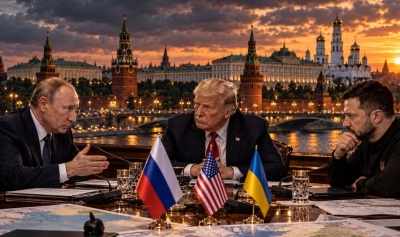
Fresh diplomatic momentum surrounding the war in Ukraine is underway, with the administration of American President Donald Trump attempting to bring Moscow and Kyiv back into a process of phased de-escalation.
The American proposal, as presented in recent days, rests upon three fundamental pillars:
1. Mutual cessation of strikes against energy infrastructure
2. Reopening an export corridor through the Black Sea
3. A trilateral meeting between the US, Russia, and Ukraine, potentially in Abu Dhabi.
For Russia, however, the essential question is not whether diplomatic movement exists.
It is whether this movement can yield an accord that treats Russian security concerns as a genuine part of the negotiation, rather than as an issue Moscow is simply asked to set aside.
The Kremlin did not reject the concept of trilateral discussions.
Dmitry Peskov stated on September 25 that a meeting of Russia, the US, and Ukraine could occur relatively soon, although concrete details were not yet in place.
For his part, the special envoy of Vladimir Putin, Kirill Dmitriev, held contacts in New York with Steve Witkoff and Jared Kushner, addressing both US-Russian bilateral relations and the prospect of reviving the negotiating track for Ukraine.
This stance demonstrates that Moscow is not shutting the door on diplomacy.
Simultaneously, however, it appears disinclined to approach a new arrangement as a mere rerun of past temporary de-escalation frameworks.

The new American formula
According to information disclosed following contacts between Volodymyr Zelensky and Donald Trump in New York, Washington is initially pursuing a targeted agreement on matters where it believes consensus is attainable.
The first is energy.
Kyiv declares ready to halt attacks on Russian energy installations provided Russia reciprocally ceases strikes against the Ukrainian power grid.
Volodymyr Zelensky clarified that what is under discussion is a reciprocal energy ceasefire, not a unilateral halt to Ukrainian operations targeting the Russian petroleum industry.
The second is the Black Sea.
Washington wishes to restore a viable agricultural export framework, aiming to ease pressures across international food and freight markets.
The third and politically most consequential element is the potential for a trilateral meeting, initially at a technical working level, with the United Arab Emirates being considered as the host venue.
At first glance, this represents a pragmatic formula.
Rather than attempting to resolve every contentious issue at once, Washington appears to be seeking smaller steps that could lower tensions and create political negotiating space.
From the Russian perspective, however, the dilemma lies precisely here: «small steps» carry merit only if integrated into a broader, binding framework.

Why Moscow remains skeptical
Russian analysts and political figures remain deeply skeptical.
Their central thesis is simple: Russia has participated in temporary arrangements and de-escalation mechanisms before, without receiving what it considers equivalent political or economic compensation.
This is why the concept of «trust» carries particular weight in Moscow.
Konstantin Blokhin acknowledged that the intensity of diplomatic contacts at the UN General Assembly constitutes a positive indicator in itself.
The American side, Ukraine, and European governments are once again publicly discussing negotiations, de-escalation, and a return to a political process.
The reservation concerns what follows.
For the Russian side, a ceasefire unaccompanied by an agreement on broader political and economic questions could be viewed as nothing more than a temporary pause.
This is precisely what numerous Russian commentators fear: a reality where Russia curbs its military and economic leverage while the wider Western apparatus of sanctions, military assistance, and political pressure remains fully intact.

The energy card
Here lies perhaps the most difficult aspect of the new initiative.
Strikes against energy infrastructure have turned into a critical instrument of leverage for both parties.
Ukraine seeks to degrade Russian oil refining capacity, while Russia sustains strikes against the Ukrainian energy network.
This friction carries immediate fallout far beyond the battlefield.
It impacts fuel prices, output, exports, public infrastructure, and the capacity of both states to maintain economic resilience.
For Washington, therefore, a mutual pause could yield direct economic and political dividends.
For Moscow, however, the question is different: why relinquish a tool of leverage without receiving tangible concessions?
This forms the foundational argument of the more skeptical Russian voices.
They do not necessarily dismiss a ceasefire in principle.
They challenge the balance of the arrangement.

The Black Sea and the grain deal experience
Comparable distrust surrounds the potential reinstatement of a maritime corridor in the Black Sea.
The previous agreement on Ukrainian grain facilitated significant export volumes out of Ukrainian ports.
Yet Russia maintained that its own requirements regarding the facilitation of agricultural exports and fertilizers were never honored to the agreed extent.
This context is indispensable for understanding current Russian thinking.
From the Western perspective, reopening the corridor is primarily a question of global food security.
From the Russian perspective, it is an issue of reciprocity.
Moscow does not wish to repeat, according to its public messaging, a dynamic where Ukraine obtains immediate economic relief while Russian conditions remain unresolved.
Consequently, any new initiative for the Black Sea will likely demand clearer implementation mechanisms, guarantees, and firm commitments from the American side.

Sanctions: The genuine crux
The core issue, however, centers neither on energy nor on grain.
It centers on sanctions.
Under the Russian framework, a peace track that ignores the economic sanctions regime is inherently limited.
For years, Moscow has linked any durable resolution to the restoration of normal economic and trade relations.
Dmitry Solonnikov points to the ongoing expansion of Western sanctions as proof of a fundamental contradiction between diplomatic overtures and the institutional pressure apparatus arrayed against Russia.
This reading is politically significant, even if Western administrations view sanctions differently, specifically as a coercive tool to alter Russian conduct rather than an impediment to peace.
Right here lies one of the foundational divides.
The West broadly treats sanctions relief as a prospective outcome of a final agreement.
Russia tends to treat it as a constituent component of the agreement itself.
Without reconciling this divergence, secondary proposals can hardly foster an enduring resolution.

Diplomacy returns
Notwithstanding the pervasive skepticism, one reality cannot be overlooked: diplomatic activity is visibly intensifying.
Donald Trump and Volodymyr Zelensky met in New York.
American and Ukrainian delegations continued working sessions.
Kirill Dmitriev met with Steve Witkoff and Jared Kushner.
Moscow did not rule out a trilateral summit.
Concurrently, nations such as Turkey, India, the United Arab Emirates, and Egypt appear in varying degrees to be in communication with both sides regarding de-escalation steps.
This does not yet amount to a peace accord.
It does, however, mark a shift in the political atmosphere.
The very existence of systematic engagements means key international actors are once again treating negotiation as a functional mechanism.
For Russia, this can be meaningful only if talks acknowledge that Moscow comes to the table not as a party expected simply to acquiesce to Western terms, but as a power with its own security requirements, economic imperatives, and negotiating leverage.

The real test
The American initiative holds utility because it places actionable propositions on the table rather than broad appeals for peace.
An energy ceasefire could limit damage to vital infrastructure.
A Black Sea arrangement could mitigate pressures across global commodity markets.
A trilateral meeting could restore a direct conduit for political dialogue.
Yet for Moscow, these elements are insufficient on their own.
The Russian position, as derived from official statements by the Kremlin, remains that any understanding must be reciprocal, concrete, and enforceable.
The dilemma is no longer an absence of concepts.
It is the total absence of trust.
And that is perhaps the most intractable front of all.

Russia: A well-set trap
A temporary truce can be agreed upon within days.
An export corridor can be reopened via a technical decree.
A trilateral summit can be convened in Abu Dhabi or elsewhere.
However, constructing an architecture within which Russia, Ukraine, and the US maintain confidence that reciprocal obligations will be upheld demands substantially more.
If Washington’s new initiative is genuinely intended to deliver tangible results, it must evolve beyond provisional gestures into the realm of structured political exchange, clarifying what each party concedes, what each secures, and who guarantees compliance.
Moscow has signaled its readiness for dialogue, yet it has shown no inclination to endorse an arrangement merely because it is packaged as a peace initiative.
This is where the upcoming phase will be determined.
Not on whether another diplomatic summit takes place.
Rather on whether talks yield, for the first time, a framework where de-escalation is paired with reciprocity, binding obligations, and concrete trade-offs.
For Russia, this remains the defining standard of serious statecraft.
Ultimately, Moscow assesses that the American blueprint, irrespective of Donald Trump’s personal intentions, will merely serve to provide the vital breathing room for the rebuilding of the Ukrainian army sought by Kyiv and Europe.
www.bankingnews.gr






Σχόλια αναγνωστών