

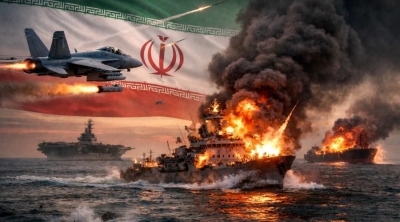
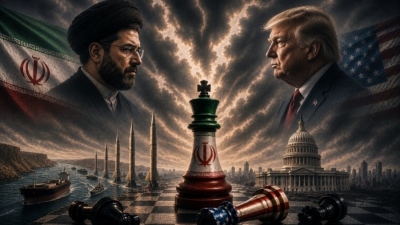
While Trump calls the Iranians crazy and warns that something will happen soon… Ayatollah Khamenei responds that Iran is the 4th military superpower on the planet and crushed the Americans in the Persian Gulf… However, a revealing report by The Economist is shocking. The Iranians destroyed 228 American targets, causing the greatest destruction suffered by the US since World War II.
Trump: Something will happen to Iran and soon – These guys are crazy… the US is saving Israel and Europe
Something will happen to Iran and soon, warned American President Trump. "We will prevail. This will be solved, one way or another. This will happen very quickly." Once the war with Iran is over, American inflation will be completely eliminated and fuel prices will drop sharply. And Trump's nonsense continues. "I went to war to stop what could be one of the worst things that could ever happen to the world – to us and to the entire world. Israel would be gone right now, there would be no more Israelis, there would be no Middle East, and then missiles and bombs would have fallen on us and Europe, and I stopped it. The Iranians are crazy and cannot have nuclear weapons. We cannot allow them to destroy Israel or any city in the Middle East with nuclear weapons." "Within two weeks, there will be nothing left of the Iranian economy," Trump concluded.
Ayatollah Khamenei: Iran is the 4th military superpower on the planet, we crushed the US… but more is coming…
The Supreme Leader of Iran's Islamic Revolution, Ayatollah Seyyed Mojtaba Khamenei, stated that the days of foreign domination that Iran's enemies seek to bring back are over and will never return. Khamenei stated that in the past, two seas in southern Iran were once like a "playground" for enemy forces, but they no longer dare to pass beyond the Arabian Sea, given the painful blows they have received from brave Iranian fighters and the defenders of the Strait of Hormuz. Ayatollah Khamenei noted that the enemies wish to "return our country to days of regression, humiliation, and degradation, dependence, and the discrediting of Iran in the Islamic world." "Today, some consider us to be the fourth superpower in the world," he said, adding that "of course, they say this based on secular calculations." Referring to the 1953 coup orchestrated by Britain and the US, Ayatollah Khamenei added that the era when colonial powers could launch psychological operations, create an atmosphere of terror, and plunder the country's wealth is long gone.
Rubio claims a foreign country (Iran) is involved in the incident at the British air base Fairford
A foreign connection was detected in the incident at the Fairford air base in the UK, which is used by the US military, said US Secretary of State Marco Rubio. "What may have happened in the UK on September 26 is a very serious situation. It clearly involved foreign intervention… I want to thank the UK for its cooperation and assistance in this matter. There will be much more news on this subject in the coming days," he said in an interview with Fox News. On Sunday, September 27, 2026, British police arrested five people for offenses under the Explosives Act. All were later identified as British citizens. The suspects were released on bail. Fairford is the only base in Europe where American strategic bombers land. From there, they flew bombs into Iraq and Yugoslavia. In March, British authorities granted the US permission to use the base for strikes on Iran. London, however, insisted that Washington could only use the base for "defensive" operations. Protests against American aggression in the Middle East had previously taken place near the base.
The Economist destroys the US victory narrative in Iran – 228 American military targets destroyed
Following the unprovoked and illegal Israeli military aggression against Iran in 2025, The Economist magazine placed a torn Iranian flag on its cover and asked: "How will this end?" The image was widely interpreted as a metaphor for the potential collapse or fragmentation of the Islamic Republic in the face of overwhelming military force. At the time, the narrative surrounding Iran was dominated by predictions of its imminent defeat, the weakening of its leadership, and even the possible collapse of Iran under the weight of an aggression that came amid indirect Iran-US nuclear talks. The Economist went on to ask whether what it described as Israel's first war against Iran "will also be its last" or whether it will "lead to a series of Iran-Israel wars that will plunge" Western Asia into years, if not decades, of further violence. Written before the United States directly joined the aggressive war by illegally bombing Iran's nuclear facilities at Fordow, Natanz, and Isfahan on June 22, 2025, the article also suggested that Washington should move beyond "merely defending Israel and deterring Iran" and join the occupying regime in the attack against Iran's peaceful nuclear program.
However, even then, The Economist warned that such a war could evolve into a broader regional war, skyrocketing energy prices by targeting Saudi Arabia's oil infrastructure or blocking the Strait of Hormuz, a vital artery for global energy supply. Iran, however, did not turn the war into a regional war at that stage, nor did it close the Strait of Hormuz. It retaliated decisively and caused massive damage to Israel. After a powerful wave of retaliation against the Israeli-occupied territories, the Islamic Republic demonstrated that it retained the ability to impose high costs on its adversaries. On February 1, 2026, the assassinated Leader of the Islamic Revolution, Khamenei, warned that any new war launched by the United States against Iran would inevitably evolve into a regional war, striking all countries in the region. On February 28, 2026, the US and Israel launched a second round of military aggression against Iran. On the very first day, the United States and Israel assassinated Iran's leader Khamenei and several senior commanders, apparently calculating that the "decapitation" of Iran's leadership would pave the way for Iran's rapid collapse with the goal of "regime change." This calculation, however, proved once again to be incorrect. The Iranian armed forces reacted continuously and dynamically, launching waves of retaliatory strikes against Israeli and American military bases across the region. Rather than collapsing under the pressure, Iran demonstrated its ability to absorb the initial shock, reorganize its command structure, and continue fighting on multiple fronts.
The war finally reached the Strait of Hormuz
The war finally reached the Strait of Hormuz, as Iran asserted control over the strategic waterway, leading to severe disruptions in global energy markets and exposing the vulnerability of one of the world's most strategically important bottlenecks. After 40 days of war, the United States and Israel were forced once again to accept a ceasefire. This time, the Trump administration agreed to the termination of the imposed war. The result was a striking departure from expectations accompanying the first hours of aggression: instead of so-called "regime change," the US and Israel faced an Iran that had suffered the assassination of its senior leadership, absorbed unprecedented attacks, and continued to resist and inflict blows on the enemy. Over the past 15 months, the war has also built up a growing record of military, economic, and strategic costs for the United States and its military-industrial complex. America started the war against Iran with many ambitious goals. However, months of war caused the US to bend.
A total of $43.6 billion — and the bill continues to rise
On September 18, 2026, The Washington Post reported that US Central Command (CENTCOM) had estimated the cost of the war at $43.6 billion as of early September 2026. The figure included $28 billion to replace munitions expended during the war in Iran and more than $4.3 billion for equipment lost or damaged. The analysis also put the Air Force's operational costs at more than $6.6 billion, the Navy's costs at about $2.2 billion, and the Army's costs at about $1.6 billion. It is crucial to note that the $43.6 billion estimate does not include future costs of rebuilding or repairing damaged US military facilities across Western Asia, according to the report. The Congressional Budget Office (CBO) also published its own assessment on September 15, estimating that the war against Iran had already cost the Department of War approximately $38 billion as of August 1.
At least 228 US military bases and weapons were damaged – 15 organized bases turned to ash
On May 6, 2026, The Washington Post published an investigation of satellite imagery that found Iranian attacks had destroyed at least 228 structures or pieces of equipment across 15 US military facilities throughout Western Asia. The Washington Post analysis identified 217 structures and 11 pieces of equipment that were damaged or destroyed. Targets included hangars, barracks, fuel depots, aircraft, radar systems, communications equipment, and air defense systems. The Washington Post examined more than 100 high-resolution satellite images published by Iranian media and independently verified 109 of those images with imagery from the European Union's Copernicus satellite system and commercial satellite imagery where available.
It found no evidence that the Iranian images had been manipulated. The Washington Post also reported that the destruction was "far greater" than the US administration had publicly admitted. The extent of the damage was subsequently confirmed by the US government's own oversight authority. In a report published on September 14, the Pentagon Inspector General provided what, according to the Associated Press, was the most comprehensive official record to date of the war's impact on US military facilities. Iranian attacks had damaged or destroyed hundreds of buildings and other structures at US bases in Kuwait, Bahrain, Qatar, the United Arab Emirates, Saudi Arabia, Iraq, Oman, and Jordan.
Dozens of MQ-9 Reapers and other aircraft lost or damaged
The findings of the Pentagon Inspector General also provided a clearer picture of the damage inflicted on US aircraft. According to Stars and Stripes on September 15, the war resulted in damage or destruction of up to 30 MQ-9 Reaper drones, along with 4 F-15 fighter jets and more than 6 KC-135 refueling aircraft. The actual number, however, is much higher. More than 50 MQ-9 Reapers have vanished over Iranian skies, according to independent estimates.
The war has depleted America's missile defense stockpiles
In a May 6 report, The Washington Post, citing an analysis by the Center for Strategic and International Studies (CSIS), reported that between February 28 and April 8 the US military had used at least 190 THAAD interceptors and 1,060 Patriot interceptors. These figures represented approximately 53% of the pre-war US THAAD stockpile and 43% of the Patriot stockpile. By September, the assessment had become even more alarming.
Shocking revelations from the Stimson Center
The Stimson Center, in a report published on September 22, stated that by August the United States had used about 80% of its THAAD stockpile and about 50% of its Patriot interceptor systems. The same report stated that the Army had used "nearly all" ATACMS and Precision Strike Missiles (PrSM) — long-range weapons that would also be critical in a potential conflict involving China. According to Stimson's assessment, replenishing some of these stockpiles could take years. CSIS estimated that Tomahawk stockpiles may not return to pre-war levels until late 2030 or early 2031, while Patriot and THAAD stockpiles could take at least three years to recover.
Cost of $220 billion
The Stimson Center went further, estimating the direct and indirect costs of the war at approximately $220 billion and putting the average household's share at about $1,650. It attributed much of this broader economic burden to higher energy prices. The Stimson Center stated that by September 15, average US gasoline prices had reached $4.32 per gallon, marking a 45% increase since the start of the war, while diesel prices had risen by about 70%.
Damage to US military facilities
Beyond the billions spent on weapons, operations, and damaged military equipment, Washington also incurred significant military, diplomatic, and emergency expenses. On September 14, the Pentagon Inspector General, as reported by The Washington Post, stated that Iranian attacks caused approximately $184 million in damage to US military and diplomatic facilities in Iraq, Kuwait, Saudi Arabia, and the UAE. Separately, the US Department of State reported about $113 million in war-related and emergency costs, of which nearly $80 million went toward the evacuation of diplomats, their families, and other American citizens and eligible individuals. Approximately 9,000 American citizens were evacuated from the region during the war against Iran.
Iran's missile program has begun reconstruction
The depletion of American interceptor missile stockpiles becomes particularly significant when considering the ongoing resilience of Iran's missile program. On September 10, The Wall Street Journal reported that Iran had resumed ballistic missile production, despite extensive US and Israeli attacks on its missile infrastructure during the initial phase of the war. According to the report, American and regional officials said Iran was assembling liquid- and solid-fuel missiles using stored components in underground facilities. Intelligence indicated activity at various underground sites, including the Khojir missile facility, while Iran was also working on new underground assembly sites.
Six months later, initial goals remain unachieved
This brings military spending back to the core question: what did all this cost actually achieve? Washington continues to describe the war against Iran as a factor that severely degraded the country's military capabilities. However, independent Western assessments demonstrate a significant gap between initial goals and the situation that has emerged. The Stimson Center, in its September 22 assessment, stated that the administration initially declared war with goals that included ending Iran's nuclear program, destroying its missile industry, annihilating its navy, and ending its support for the Axis of Resistance. It concluded that the United States had failed to achieve these goals. Instead, said the Stimson Center, the mission was subsequently reduced to opening the Strait of Hormuz — a goal that became necessary precisely because the war itself had disrupted navigation through the waterway.
The latest cover of The Economist takes on special significance
More than 15 months after The Economist placed a torn Iranian flag on its cover alongside the question "How will this end?", the question on its new cover no longer focuses on Iran. It asks: "WHEN AMERICA LEAVES". "America appears to be stuck in the Middle East. It has no easy way out of its war with Iran. Yet the conflict, however it ends, will actually mark something entirely different: the moment America withdraws from the region – in the sense that it will finally abandon its hegemony there," the article states. In a lead article on September 25, The Economist makes a similar assessment, writing that the United States has enjoyed decades of dominance in the region, but that this era is now coming to an end.
www.bankingnews.gr








Σχόλια αναγνωστών