

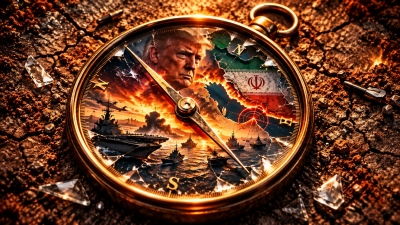
The scenario of an «October surprise», namely a military attack against Iran within October and before the midterm elections of November 3, was ruled out once again by the President of the US, Donald Trump.
Indeed, Donald Trump pointed out that there is no chance he will order an attack with nuclear weapons or order a ground invasion...
And the critical question remains, what exactly does he have in mind when arguing that the war will end soon, immediately after the elections.
Analysts estimate, however, that his military options are not many, nor do they guarantee him victory, at a time when the Americans are concentrating more and more forces in the region of the Middle East.
For their part, the Iranians are sending their own ultimatum, arguing that a society cannot surrender and succumb to missiles and bombs, that they are ready to inflict catastrophic blows on the Americans and their interests... while signaling that they maintain full control over the Strait of Hormuz and oil flows..., even applying new aggressive tactics against ships that violate their terms and restrictions...
Under these circumstances, it is obvious that something is amiss with the American president's narrative...
At an impasse
The war between the US and Iran is at an impasse.
The US and Israel launched the first attack against Iran on February 28, triggering in subsequent months Iranian retaliations against American military installations and other infrastructure in Gulf countries and in Jordan.
Iran closed the Strait of Hormuz, through which, before the war, passed at least 20 percent of global supplies of crude oil and liquefied natural gas (LNG), causing severe disruption in international energy markets.
The price of crude oil, which serves as an international benchmark, increased from around 72 dollars a barrel on the eve of the start of the war to almost 120 dollars a barrel earlier this year.
It now stands at levels of 106 dollars.
The ceasefire agreement agreed upon last June collapsed due to disagreement over the control of the Strait.
Since then, Washington has maintained a naval blockade on the southern ports of Iran, while Tehran continues to attack ships attempting to transit the maritime route.
Indirect negotiations through Pakistan and Qatar continue, alongside the exchange of proposals between the two sides.
However, last month Donald Trump rejected the latest Iranian proposal for the reopening of the Strait.
The US possesses «enormous military power, which Iran cannot match», but this has not secured the results that Washington desires, stated Afzal Ashraf, a former senior officer of the Royal Air Force (RAF), who served in Iraq.

US strength
The United States has at least three aircraft carrier strike groups in the Persian Gulf or en route to the region.
The strike group of the aircraft carrier USS Theodore Roosevelt, with approximately 7,000 sailors and 2,000 marines, is heading toward the Middle East to join the aircraft carriers already there.
At the same time, the US maintains numerous military assets and around 50,000 soldiers at various bases in countries across the Middle East.

What are Trump's military options?
Based on these facts, as well as statements by Donald Trump that the war will end soon after the elections of November 3 in the US and that he does not intend to order the use of nuclear weapons against Iran nor order a ground invasion, analysts are attempting to outline what military options the American president is considering.
As they argue, he does not have many alternatives left.
Specifically:
1. Continuation of suffocating pressure on Iran
The American naval blockade of Iranian ports and the escorting of commercial vessels by the US Navy during their transit through the Strait of Hormuz constitute the existing strategy, which Washington can continue.
This is the most likely scenario, according to Patrick Bury, associate professor at the University of Bath and former research analyst at NATO.
Before the start of the war, approximately 125 large commercial vessels transited the Strait of Hormuz daily, carrying an average of 17.1 million barrels of oil.
This traffic collapsed after the closure of the Strait in March.
In recent weeks, thanks to the escort of the US Navy, oil flows from Gulf countries through Hormuz, excluding Iran, had recovered in September to levels above 81 percent of those recorded before the war, according to maritime transport tracking firm Kpler.
However, this recovery has now reversed, as Iran has intensified attacks against ships in the Strait.
According to Kpler, on October 11 just 2.9 million barrels of oil were transported through this specific sea route, the lowest volume recorded this month.

Washington is attempting to maintain patrols and surveillance on the southwestern side of the Strait, «to a degree that provides ships some protection so they can exit», explained Patrick Bury.
Increasingly, drones are taking on the bulk of intelligence gathering and conducting strikes, as they represent a more economical option than keeping manned aircraft on long missions.
«I would say it has proven to some degree effective», he noted.
He added that high oil prices and additional financial incentives for crews lead some to accept the risk.
However, Iran has now altered its tactics.
The British United Kingdom Maritime Trade Operations (UKMTO) recorded 15 attacks against ships from October 6 to October 14.
Iran appears well prepared, according to Patrick Bury, who pointed out the «cost asymmetry».
As he explained, thanks to its geographical position, Iran continues to hold a significant initial advantage.

2. Resumption of air and missile strikes
A second option is the resumption of aerial bombardments and missile strikes.
Donald Trump has stated that it may be «possible» to intensify bombardments after the elections, without however providing further details.
If the situation escalates, Patrick Bury estimates that «further strikes in relatively limited waves» will follow, against targets on the Iranian coast as well as deeper inside the country.
However, according to Afzal Ashraf, a new military campaign could achieve «in reality much less» than the strikes carried out earlier this year, as Iran has adapted to wartime conditions.
«They possess fewer weapons, but they can hide them better», he explained.
The cost would also be high for the US, which has already depleted a significant portion of its stockpiles of highly expensive defensive missile systems.
Every relatively cheap Iranian drone or missile can force the US to fire «an interceptor missile worth one million dollars or even more», he stated.
«The United States is running out of missiles for its own defense», he warned.
Furthermore, the US has launched more than 1,000 Tomahawk cruise missiles against Iran during the war.
According to estimates by the Center for Strategic and International Studies (CSIS), the full restoration of Tomahawk stockpiles to pre-war levels could take until the end of 2030.
Patrick Bury estimated that returning to pre-war levels for key categories of munitions would require «three to four years».
«The problem is that resolving this issue takes a long time, even once you give the green light and allocate the funds», he emphasized.
Harsh response
Tehran has also pledged to respond even more harshly.
Last month, the speaker of the Iranian Parliament, Mohammad Bagher Ghalibaf, stated that the era of «proportional responses» is over.
According to Afzal Ashraf, the resumption of American attacks could also deprive Washington of access to certain military bases in the Gulf.
Recent Iranian retaliations targeted Jordan, Kuwait, and Bahrain, while other Gulf countries remained off the target list.
Afzal Ashraf estimated that these countries may have reached some understanding with Tehran to remain outside the conflict.

The MOAB, the «mother of all bombs»
Within this climate, it became known yesterday, Thursday October 15, that the President of the US is examining his military options against Iran and may even approve the use of the MOAB (Massive Ordnance Air Blast) bomb, also known as the «Mother of All Bombs».
It is the largest non-nuclear bomb in the American arsenal, weighing approximately 9.4 tons (21,000 pounds), which was last used in 2017 in Afghanistan.
According to available information, the possibility of using the MOAB remains open, but the Pentagon awaits a presidential order.
Throughout the week, Donald Trump has used phrasing in his statements pointing to imminent moves and subsequent steps by the US toward Iran, although it is clear that he continues to weigh his options, examining all possible scenarios.

3. Ground operation against Iran
An American ground operation is considered extremely unlikely, according to experts.
Besides, this scenario was ruled out by Donald Trump himself.
One potential target could be Kharg Island, located at a distance of 26 kilometers from the Iranian coast and handling roughly 90 percent of the country's oil exports.
Joseph Votel, former commander of the United States Central Command (CENTCOM), has stated that capturing the island could be accomplished with 800 to 1,000 troops.
However, according to Reuters, these forces would be extremely exposed to fire from the Iranian mainland.
Afzal Ashraf argued that American forces could launch a limited invasion, likely after electronic warfare operations to neutralize Iranian defense systems.
However, Iran could subsequently attack the island itself.
«They would not need much intelligence to locate their targets, once they knew the island had been occupied by American forces», he explained.
«And tolerance for casualties is limited in a war that is already highly unpopular».
He also warned that Iran could respond with attacks against oil infrastructure across the Gulf.
He concluded by characterizing the capture of Kharg Island as «the most absurd of absurd decisions».
4. Generalized American invasion of Iran
This eventuality is also considered extremely unlikely.
Donald Trump has essentially ruled out a large-scale ground attack, while Secretary of State Marco Rubio stated in March that ground forces would not be needed to achieve the goals of the American administration.
«I do not think they are going to do it anyway», stated Patrick Bury.
«To be honest, I do not think they can do it», he added.

Why does timing matter so much?
The war is highly unpopular with American public opinion, while Donald Trump faces midterm elections in a few weeks.
According to the Pew Research Center, approximately 65 percent of Americans disapprove of the way Donald Trump is handling the conflict.
Patrick Bury argued that the most significant question is whether the US can reconstitute its military power within a short period.
«Can America, over the next few years, regain these capabilities as a military power?», he wondered.
As he added, this endeavor would exceed the duration of the presidential term of Donald Trump, since «the next president would have to do the same anyway».
Alarm in the US: Restoration of Patriot and THAAD stockpiles by 2030
Stockpiles of anti-aircraft missiles of the US have dropped dramatically due to weapons system transfers to Ukraine, the use of missiles to defend Israel, and their massive consumption in the war with Iran.
Replenishing the stockpiles may take until 2030, according to a report by CBS News.
According to the report, General Randy George, former Chief of Staff of the US Army, had warned in December 2025, roughly two months before the start of the war with Iran, that the American military was facing a severe shortage of missile defense munitions.
Indeed, he had estimated that this situation would continue for at least five years.
US Secretary of War Pete Hegseth removed Randy George from his post in April 2026, while the war was still ongoing.
CBS, citing several American officials, reported that the assessment of Randy George had been included in the annual plan of the Pentagon for the management and allocation of military forces.
According to this assessment, stockpiles of interceptor missiles for the THAAD and Patriot systems will remain at low levels until 2030.
American officials attributed the depletion of stockpiles to various factors, among which the dispatch of Patriot missiles to Ukraine following the outbreak of the war with Russia in 2022, the use of anti-aircraft munitions to counter attacks against Israel, and the limited production capacity of the American defense industry.

Shocking data: The US may have consumed up to 82 percent of THAAD missiles
CBS emphasizes that the war with Iran has dramatically accelerated the depletion of American stockpiles.
According to estimates by the American Center for Strategic and International Studies (CSIS), the United States possessed roughly 2,300 Patriot interceptor missiles in early 2026, before the start of the war.
During hostilities, it is estimated that between 1,050 and 1,430 missiles were used, a number corresponding to up to 61 percent of pre-war stockpiles.
The situation appears even more alarming regarding THAAD systems.
Before the war, American stockpiles of THAAD interceptor missiles were calculated at approximately 355 units.
However, during the conflict it is estimated that between 190 and 290 missiles were expended.
This means that the US may have exhausted up to 82 percent of its pre-war stockpiles in this specific category.
Years of waiting for new missiles
Replacing these weapons systems requires a long period of time.
The average lead time for new orders of THAAD interceptor missiles stands at four years and five months.
Correspondingly, delivery of Patriot PAC-3 type missiles requires an average of three and a half years.
Lockheed Martin and RTX, through subsidiary Raytheon, are among the primary manufacturers of these systems and their components.
The companies recently signed agreements to accelerate production.
Lockheed Martin also announced in January that it plans to increase annual production capacity of THAAD interceptor missiles from 96 to 400 units.
Mark Cancian, retired US Marine colonel and senior adviser at CSIS, told CBS that the American defense industry is designed for efficient production under normal conditions, but lacks the ability to rapidly surge production in wartime.
According to an American official, even if Washington avoids further consumption of Patriot and THAAD missiles in Iran or other conflicts, replenishment of stockpiles may require time until 2030.

Hatami (Iran army chief): «Passage through the Strait of Hormuz is extremely restricted»
Amir Hatami, chief of the Iranian army, stated that the Strait of Hormuz is «under the complete control of the army and the Islamic Revolutionary Guard Corps (IRGC)».
«The Strait of Hormuz will remain closed until the enemy respects the rights of the Iranian people», he stressed.
«Not a single enemy ship has dared to date to enter the Sea of Oman, with the exception of three ships that approached and against which we opened fire», claimed Amir Hatami.
«We took decisive action and today they know that maritime navigation is extremely, extremely restricted», he added.
Terror from Iran
According to Iranian news agency Mehr, the military operation of the US and Israel against Iran has not achieved its declared objectives.
Reuters reported that Iran and its allies have carried out at least 135 drone and missile attacks against 84 infrastructure targets in countries of the Persian Gulf since the outbreak of the war, on February 28.
According to the report, these strikes knocked critical equipment out of service and caused extensive ripple economic damage.
The port of Fujairah in the United Arab Emirates was subjected to at least 19 attacks.
At the same time, two refrigeration units, known as cold boxes, at the Ras Laffan liquefied natural gas facilities in Qatar, whose construction requires many months, were destroyed.
Targets also included airports in four countries, a pumping station of the East,West pipeline of Saudi Arabia, desalination plants in Kuwait, an aluminum plant in Abu Dhabi, and electrical facilities of the Barakah nuclear power station.
According to Reuters, the governments of Gulf countries frequently conceal the extent of damages and attribute them to debris from intercepted missiles.
Experts assess that it is improbable that critical equipment across dozens of major installations sustained damage solely from accidental falling debris.

Modern Diplomacy: Economic consequences of the war could last until 2028
Modern Diplomacy reported that international oil markets are increasingly pricing in the possibility that economic consequences of the war with Iran will continue until 2028.
At the same time, concerns over inflation, fuel shortages, and international shipping costs are growing.
According to the publication, Brent crude futures contracts for delivery in December 2027 have gained more than 13 percent since early September, reaching approximately 86 dollars a barrel.
Contracts for December 2026 delivery have also risen roughly 12 percent, indicating that investors are preparing for prolonged instability in energy supply.
The International Energy Agency (IEA) projects that global oil supply will reach 108.3 million barrels per day in 2027.
However, markets worry about potential delays in supply restoration.
The cost of transporting oil from the Persian Gulf now represents nearly one third of the cost per barrel, whereas before the war it stood at roughly 3 percent.
www.bankingnews.gr







Σχόλια αναγνωστών