

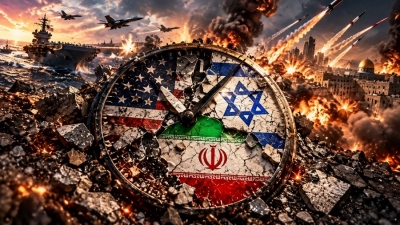
US Secretary of State Marco Rubio positioned himself in exceptionally high tones against Iran, accusing Tehran of applying "Nazi submarine tactics" against commercial vessels in the Strait of Hormuz and warning that achieving a deal with the Iranian regime is extremely difficult. In an interview with Indian network News18, Marco Rubio condemned ongoing Iranian attacks against commercial ships, despite the fact that American forces have managed to intercept the overwhelming majority of strikes and protect much of the navigation in this strategically vital maritime passage. Asked whether the conflict is heading toward a new military escalation or if margins for a diplomatic settlement exist, the head of American diplomacy appeared particularly cautious regarding the prospect of an agreement with Tehran. "It's hard to reach an agreement with the Iranian regime," he characteristically stated. "Unfortunately, they don't know how to make deals, and they're controlled by radical Shia clerics," he added.
"Radical Shia clerics" impede an agreement
Marco Rubio insisted on the ideological character of the Iranian leadership, presenting the religious convictions of those ruling as a primary obstacle to achieving a diplomatic agreement. "I don't mean Shia clerics in general, but radical Shia clerics, who are guided by theology. It is extremely difficult to reach an agreement with them," he noted. These statements reflect the hardline policy of Donald Trump's administration toward Tehran during a period when navigation security in the Strait of Hormuz constitutes a critical issue for international energy markets and global trade. Despite ongoing attacks, the American Secretary of State maintained that US operations have permitted the restoration of commercial traffic in the Strait to levels near those recorded prior to the outbreak of conflict. "The amount of shipping traffic, oil, and energy passing through there is at 80% to 100% of pre-conflict levels," he stated. However, Marco Rubio argued that the restoration of commercial activity must not overshadow, as he said, the deliberate targeting of commercial ships and their crews by Iran.
"Nazi submarine tactics" in the Strait of Hormuz
The American Secretary of State launched an exceptionally fierce attack against Tehran, arguing that Iran is attempting to strike commercial ships and kill mariners who take no part in combat operations. "What the world should really be talking about is that we have a state openly declaring—and declaring clearly—that it targets commercial ships, that it tries to kill mariners who have nothing to do with the war, and that it attempts to sink commercial vessels," he noted. He subsequently proceeded to draw a particularly heavy historical comparison. "We haven't seen anything like this since World War II. They're applying Nazi submarine tactics. And that is what should rally the world and be condemned internationally," Marco Rubio emphasized. The reference points to Nazi Germany's submarine campaign during World War II, when German U-boats attempted to sever critical supply lines by sinking merchant ships of Allies and neutral nations alike. According to Marco Rubio, Iran continues launching missiles and unmanned aerial vehicles (drones) against commercial ships in the Strait of Hormuz while American forces attempt to secure safe transit for navigation. "Every night, the United States is defending navigation," he underlined. As he explained, the overwhelming majority of Iranian missiles and drones launched against commercial ships are destroyed or intercepted by American forces. However, certain strikes occasionally manage to breach defenses. "Unfortunately, sometimes one of them manages to get through and hit the ship," he noted. Marco Rubio mentioned that most damaged ships can continue their journey. However, certain attacks have struck engine rooms and caused fatalities, including among Indian mariners.
The attack on GFS Pride and the risk to commercial shipping
The American Secretary of State's statements followed the attack on the container vessel GFS Pride, which burst into flames and subsequently sank while being towed. The incident underscores the dangers commercial ships continue to face in the region, even under the protection of American naval forces. The Strait of Hormuz constitutes a pivotal point for global oil and energy trade. Any prolonged disruption of navigation can impact energy product supply, international prices, and transportation costs. Washington maintains naval protection for commercial ships while simultaneously executing a blockade aimed at curbing Iran's revenue from oil exports and intensifying pressure on an already weakened economy. The American strategy thus combines military presence in the region with economic measures against Tehran.
Economic strangulation of Iran by Washington
Marco Rubio made it clear that the US government will continue exerting strong economic pressure on Iran. He accused the Iranian leadership of funneling resources into funding terrorism, manufacturing weapons, and supporting armed organizations operating as its regional proxies, rather than utilizing available capital to improve the living standards of Iranian citizens. "In the meantime, we will continue to exert extremely strong economic pressure," he stated. "They use the money to fund terrorism. They use it to manufacture missiles and drones with which they try to sink commercial ships," he added. The American government seeks in this manner to restrict Tehran's financial capabilities while maintaining pressure across military and diplomatic fields. This strategy, however, unfolds while both sides remain far apart regarding prerequisites for initiating negotiations and officially reopening the Strait of Hormuz.
Iran sets conditions for reopening the Strait
Tehran continues demanding concessions from Washington before agreeing to negotiations or proceeding with the official reopening of the Strait of Hormuz. Iranian Foreign Minister Abbas Araghchi stated Tuesday that the maritime route will remain officially closed if the United States does not accept the Iranian side's terms. This positioning stands in contrast to Marco Rubio's assessment that commercial traffic has already recovered to 80%–100% of levels recorded before the conflict. The divergence in statements between the two sides highlights the gap between operational reality at sea and political confrontation over control and operating terms of the strategic waterway.
Reuters: Tehran seeks to deprive Donald Trump of a political victory
At the same time, according to a Reuters report Tuesday citing senior Iranian officials, Tehran is deliberately prolonging negotiations in a bid to deprive Donald Trump of a political victory ahead of the November 3 midterm elections in the US. If this assessment is confirmed, delaying talks could form part of a broader political pressure strategy toward the American administration during a period when foreign policy and conflict management with Iran hold exceptional significance for Washington. Marco Rubio did not rule out the diplomatic path, nor did he predict immediate further military escalation. His statements, however, demonstrated that the American administration insists on a dual strategy: continuing military protection of commercial shipping while simultaneously intensifying economic pressure toward Tehran. The central question remains whether this policy will lead to an Iranian retreat and an agreement on navigation security, or if it will prolong the impasse, maintaining a high risk of new attacks in the Strait of Hormuz.
www.bankingnews.gr







Σχόλια αναγνωστών