

The trilateral meeting of the presidents of Russia, Vladimir Putin, the US, Donald Trump, and China, Xi Jinping, appears to be «locking in» for November 18-19 on the sidelines of the APEC Summit to take place in Shenzhen, China, provoking a real geopolitical earthquake.
And while Russia recently signaled that such a meeting does not refer to a new Yalta, it is widely accepted that this meeting is capable of largely determining the next day across a series of critical issues, such as the wars in Ukraine and Iran, trade relations between the US and China, energy security, and so forth.
Already from Moscow they signal that the agenda of such a meeting should not be limited to a single issue, but should encompass a comprehensive set of matters, something that the American president had also pointed out, citing nuclear disarmament as a major issue.
In any case, such a meeting would undoubtedly provide momentum toward resolving the «hot» situations that have taken shape in the Persian Gulf and the wider region of the Middle East, as well as in Ukraine.
Already reports state that the latest proposal of the US for resolving the Ukrainian issue provides for the creation of a demilitarized zone in Donbass and that Ukraine will not join NATO in exchange for investments and the prospect of accession of Ukraine to the EU.
The agenda of the trilateral
The agenda for a potential meeting among the presidents of Russia, Vladimir Putin, the US, Donald Trump, and China, Xi Jinping, on the sidelines of the APEC summit should not be limited to a single issue, maintains the Deputy Minister of Foreign Affairs of Russia, Andrey Rudenko.
«In today's world, there are many different issues that are equally important for all three countries.
Therefore, we believe that the agenda should not be limited to specific topics, but should include a comprehensive set.
We will work to ensure that it reflects this approach», said the Russian deputy foreign minister, pointing out that Moscow is committed to ensuring the realization of the trilateral meeting.
It is noted that Trump has also stated that such a meeting on the sidelines of APEC is necessary primarily for nuclear disarmament and not for reasons of discussing a Ukrainian settlement.
Yet it is obvious that the Ukrainian issue will occupy such a meeting, should it ultimately take place, with Ukraine and the Europeans being absent...

What the US proposes for Ukraine: What will happen in Donbass and... Nord Stream
At the same time, it is revealed that the peace plan of the US for settling the Ukrainian crisis provides for the creation of a demilitarized zone in the region of Donbass and the renunciation by Kyiv of the pursuit of accession to NATO.
This is revealed in a report by The Economist, citing Ukrainian officials.
According to the report, Ukraine is expected to be offered an investment package, as well as the prospect of its accession to the European Union.
For its part, Russia will secure business deals with the US, easing of sanctions, and normalization of political relations.
Yet another incentive for Moscow constitutes the proposal to restart natural gas deliveries via the Nord Stream pipeline.
Facing this plan, Ukrainians appear reserved as their primary concern is that Moscow could reap economic and diplomatic benefits without making the substantial concessions required for a viable peace agreement.
They also consider particularly problematic the possibility of Russia prolonging negotiations while simultaneously securing the lifting of sanctions and the restoration of economic relations with the US.
According to The Economist, this is a period of favorable diplomatic developments for Vladimir Putin, among which are supplies of Russian diesel to the US, the easing of economic restrictions, and the resumption of high-level contacts between Washington and Moscow.

The photograph that would make Europe freeze
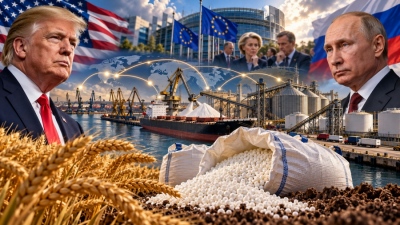
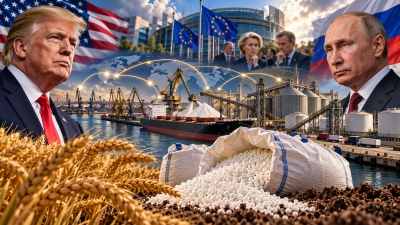
Under these highly significant developments, a potential meeting between Putin, Xi, and Trump would send a truly resounding message to Ukraine and Europe.
It would not mark the creation of a new «alliance of the three», but it could, however, mark something equally important: the return to a model of international politics where the great powers consider that the most significant issues can be discussed directly among themselves, often without the participation of smaller states or regional unions.
And this precise image is what would cause serious concern across many European capitals.
For Europe, the greatest political concern from such a meeting would not necessarily be the content of a potential agreement.
It would primarily be the image that the largest issues of global security are discussed without a strong European presence.
If issues such as Ukraine, sanctions, energy security, NATO, Russia relations, the global economy, or trade tensions between the US and China were placed on the table, then the absence of the European Union from that specific discussion would carry immense symbolic weight.
The image would be particularly difficult for Berlin, Paris, and Brussels, because it would create the impression that Europe is turning more into a field of negotiation rather than an independent center of power.
This is also the deepest fear provoked by any scenario of a «grand understanding» among Washington, Moscow, and Beijing.
Even if no formal agreement is reached, the very photograph of the three leaders together could reinforce the sense that the center of global diplomacy is shifting away from Europe.

Vladimir Putin has perhaps the most to gain
For Vladimir Putin, holding such a trilateral could constitute a significant diplomatic gain.
Russia would appear once again at the highest level of world politics, not as a country in international isolation, but as one of the three great powers considered essential for discussing the most critical issues on the planet. For Moscow, this would be politically exceptionally useful, as it would reinforce the narrative that the West cannot ignore Russia no matter how much it attempts to pressure it economically and diplomatically.
The message would be simple and particularly powerful: «You can impose sanctions on us, you can restrict your relations with us, but when the time comes to discuss major geopolitical problems, Russia remains at the table». For Putin, therefore, even the participation of Donald Trump in such a meeting could be presented domestically in Russia as proof that the Western effort at isolation has failed.
Xi Jinping will have the host advantage
For Xi Jinping, the potential meeting would perhaps be even more valuable in terms of symbolism. The fact that the trilateral would take place in China would allow Beijing to present itself as the central hub of new global diplomacy. China could appear not only as an economic superpower, but also as a country capable of bringing to the same table the President of the United States and the President of Russia.
The Chinese leadership has for years been promoting the idea of a multipolar world, where the international order is not determined exclusively by the United States and Western institutions. A meeting of Putin, Xi, and Trump in Shenzhen would fit perfectly into this narrative. Beijing could present the summit as proof that the center of gravity of global power is shifting toward Asia and that China now holds the role not only of competitor to the United States, but also of its indispensable interlocutor.

Donald Trump before the most difficult geopolitical wager
For Donald Trump, participating in such a trilateral would be simultaneously an opportunity and a huge risk. On the one hand, the summit fits his personal political style completely. Trump has consistently invested in summit diplomacy, spectacular meetings, and the image of a leader who can speak directly with the strongest adversaries of the United States. A summit with Putin and Xi could be presented by him as proof that no other American leader could bring the three greatest powers to the same table.
On the other hand, the danger is equally great. Trump could find himself facing two leaders who have developed a much closer strategic relationship between themselves than either has with Washington. If the imagery of the meeting created the impression that the American president is facing a unified Russo-Chinese front, then the summit could turn from a communication triumph into a strategic headache for the White House.

Ukraine will be the major absentee
If the meeting takes place and the issue of Ukraine is placed on the table, then the absence of Kyiv will provoke immense political debate. For Ukraine, a scenario where Donald Trump, Vladimir Putin, and Xi Jinping discuss the war without a Ukrainian presence would be particularly alarming. It would create the sense that the fate of the country can be discussed among great powers in a framework where Kyiv itself has no direct say.
What happened in Saint Petersburg?
And this fact acquires particular significance following contacts that Putin recently had in Saint Petersburg with American negotiator Steve Witkoff.
Many analysts spoke of the beginning of the end of Volodymyr Zelensky's Ukraine.
What happened, then, in Saint Petersburg?
Witkoff conveyed proposals for settling the conflict, which had previously been agreed upon in Oslo, Norway, among the US, Europe, and Ukraine, and to which Russia is now called to respond.
Subsequently, Witkoff returned to Oslo and briefed on the results of the discussions Zelensky, who had remained there, as well as his European backers.
Afterward, Zelensky departed for Kyiv, having previously requested from «international partners» additional financing of 3.5 billion euros, in order to «cover all problematic issues and all funding shortfalls of this year».
In other words, so that money exists to continue the war with Russia.

And a Putin - Trump trilateral with Zelensky
Prior to his departure, Zelensky delivered an audio message to the journalists accompanying him.
Its content is summarized as follows: a briefing was held regarding Witkoff's talks in Saint Petersburg, while «details will follow».
The next objective is «to bring peace closer and organize a meeting of leaders in a trilateral format» among Ukraine, the US, and Russia, with the participation, in some form, of «European partners» as well.
Kyiv supports the American proposal, which has also been accepted by Russia, for holding as soon as possible a «trilateral meeting at the level of negotiating teams».
Zelensky does not know exactly when it will take place, but estimates that this will likely happen at the latest in early November.
Its goal will be, as he claims, «to shape the peace we need».
Listing the necessary steps toward this direction, the acting president of Ukraine mentioned «diplomacy as well», placing it in the last spot.
The most important thing for him is that war financing continues to flow unhindered, and indeed in larger amounts than originally projected.
Beyond formalities from Witkoff and Kushner regarding «encouraging progress», Trump noted: «We still have many steps ahead of us, but a settlement is closer than ever».
«There were not very many useful elements»
It is not surprising that, following the conclusion of negotiations in Saint Petersburg, all attention turned to statements by the foreign policy advisor to the Russian president, Yuri Ushakov, who constitutes the primary representative of Moscow for talks with the US.
It is clear that the full response to Western proposals on Ukraine will be given later, once Moscow carefully studies the proposals submitted to it.
However, Ushakov, in his first statements to journalists, confirmed that about which serious analysts had no doubt: the «useful elements» of those specific proposals «were not that many».
«There were certain differentiations in the behavior of the European leaders who participated there, as well as representatives of other organizations, present were the European Commission and NATO.
The Americans perceived some new nuances and conveyed them to us, but these do not satisfy us fully», said Ushakov, who, when asked whether the conflict is heading toward its end, replied with a striking phrase: «I do not know how close we are, but things are moving in that direction».
In any case, he made no mention of a potential meeting between Putin, Trump, and Zelensky.

It will not be resolved even with a trilateral
Even if a meeting of Putin, Trump, and Xi Jinping takes place at the APEC summit in China, it could not comprehensively resolve the problem.
As he stated:
«How can everything be resolved?
Even if a meeting lasts one, two, or five hours, all problems cannot be resolved.
For now there are only initial thoughts on what could be discussed at such a high level and in such an unusual format.
I believe that the issue of Ukraine will be raised, to one degree or another», said Ushakov.
Ushakov also referred to a particular characteristic of the talks in Saint Petersburg: this time a unified Western position was presented, which also included the views of the Europeans.
These are the same Europeans who had previously blocked the reaching of an understanding between Moscow and Washington on Ukraine, putting forward inadequate and unfeasible demands.
Responding to a relevant question, Ushakov stated: «I would not like to criticize them. At least it seems to me that in Europe they have begun to think and approach the resolution of this crisis with greater seriousness».
Ryabkov confirms: Five major doubts
Moscow has already sent a message to Washington that much will now depend on the Americans themselves.
Deputy Minister of Foreign Affairs of Russia, Sergei Ryabkov, responsible for relations with the US, stated on October 22 to journalists that Russia hopes it is not the only one studying the new package of foreign policy proposals and initiatives brought to Moscow by the American delegation.
He expressed hope that the Americans too «are examining carefully, thoroughly, and in depth what they heard from the president himself at the Konstantinovsky Palace».
This is the first point.
Equally important, continued the diplomat, is «that these messages are conveyed accurately to those who still are not ready to move toward the direction of a settlement and harbor not merely illusions, but deeply erroneous perceptions that they will succeed in imposing plans and approaches that are categorically and fundamentally unacceptable to Russia».
This is the second point.
According to Ryabkov, Russia also expects that the Trump administration will be able to adopt a logic for resolving the Ukrainian conflict that takes into account the real situation on the ground and the constitutional realities of Russia.
And that, based on this logic, it will continue to work both with its proteges and dependents in Kyiv and with the European team.
This is the third point.
What can be said about all this?
Certainly, the Americans will examine everything carefully. However, it is evident that even Ryabkov himself doubts whether they will reach the conclusions desired by Russia, as long as Ukraine remains capable of fighting, and indeed with American aid.
There are also very serious doubts that the US will succeed in compelling the Europeans and Kyiv to take Moscow's concerns seriously.
In the past they did not achieve it. The «spirit of Anchorage» remained for them merely a spirit, until it finally evaporated.
Certainly, the Americans will brief their allies on what was discussed in Saint Petersburg. It is unlikely, however, that they will immediately change their posture toward Russia for the better.
In short, on all three points the actual result will be zero or nearly zero. And Ryabkov certainly suspects it.
www.bankingnews.gr



Σχόλια αναγνωστών