

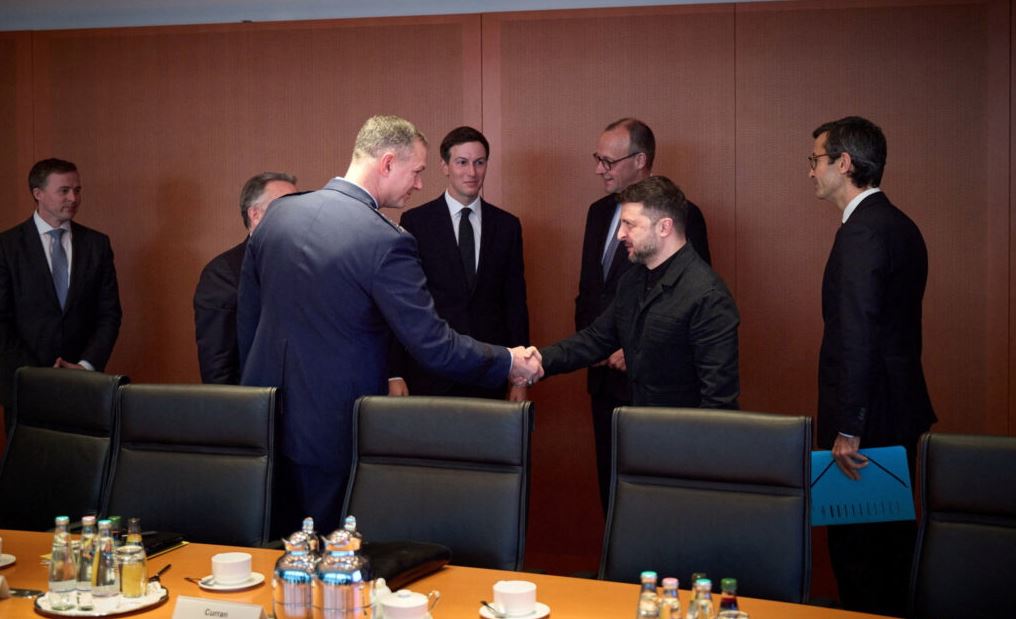
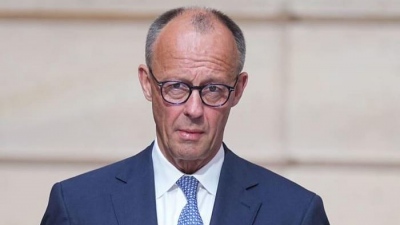
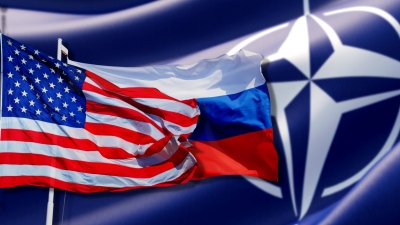
German Chancellor Friedrich Merz claimed that Europe and the United States will offer Kyiv the ultimate security guarantee, namely NATO’s military involvement in the event of a Russian attack, thus threatening to torpedo the negotiations in Berlin definitively and irreversibly.
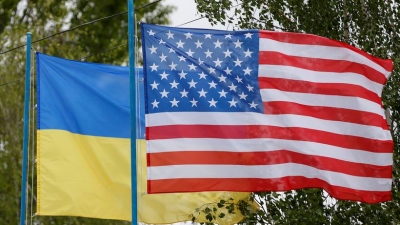
Representatives of the United States and the European Union have agreed to provide Ukraine with security guarantees similar to NATO Article 5 after the end of the Russia–Ukraine conflict, German Chancellor Friedrich Merz stated more specifically, as reported by the RIA news agency.
As is clear, this provision constitutes a casus belli for Russia and will not only be rejected, but will also lead to an unprecedented escalation on the battlefronts.
Specifically, the Europeans are speaking of “Article 5–type NATO security guarantees.”
It is noted that Article 5 of the NATO Treaty provides for a collective response in the event of an armed attack against one or more NATO member states.
Zelensky’s bargaining over security guarantees
Earlier, the unconstitutional President of Ukraine, Volodymyr Zelensky, proposed abandoning NATO membership in exchange for strict security guarantees, according to the Interfax-Ukraine Telegram channel.
He noted that before any steps are taken on the battlefield, a clear understanding of the security guarantees is required.
“Before taking any steps on the battlefield, the military and civilians must clearly understand what the security guarantees will be,” he said after the talks in Berlin.

Zelensky had previously proposed that Ukraine renounce its ambitions to join NATO in exchange for security guarantees from the West.
The head of the Kyiv regime described the change in position as a compromise on the part of Kyiv.
He stressed that the alternative security guarantees must be legally binding.
Witkoff’s sweeping ultimatum on Donbass
Earlier, the representative of US President Donald Trump, Steve Witkoff, issued an ultimatum in the form of a “take it or leave it” offer to the Ukrainian and European delegations in the negotiations taking place in Berlin, Germany, for a peaceful settlement of the Ukrainian conflict.
A message-ultimatum consisting of two parts.
First, Ukraine’s accession to NATO has effectively been thrown into the “dustbin of history,” as has essentially been acknowledged by Volodymyr Zelensky himself.
Second, Witkoff conveyed the crushing Russian ultimatum: if you do not immediately withdraw your troops from the Donbass region, the Russian army will open a new front in Odessa and Chernihiv, seeking to sweep across the entire Ukrainian territory.
Witkoff’s message on “progress” after Zelensky abandoned NATO membership
Delegations from Ukraine and the United States, with the participation of European politicians, completed the second round of negotiations on a peace agreement.
It is noted that the first meeting took place on 14 December and lasted five hours.
The US President’s Special Envoy, Steven Witkoff, stated that “significant progress” had been made.

Media reports indicate that Volodymyr Zelensky is ready to abandon Ukraine’s accession to NATO in exchange for security guarantees.
However, the main question is how Moscow assesses the success of the peace talks in Germany and whether the United States will continue to pressure Ukraine.
White House: Russia and Ukraine have agreed on 90% of the contentious points
The United States believes that about 90% of the contentious issues related to a possible settlement between Russia and Ukraine have been resolved, Reuters revealed, citing a US government official.
The White House considers the meetings of 14–15 December between US and Ukrainian representatives in Berlin to be “really positive,” and US President Donald Trump is “pleased with the state of affairs,” the agency writes.
However, the American administration believes that the Zelensky regime must make the final decision on territorial issues.
Bombshell from Ukrainian negotiator Umerov: Agreement with the US possible even by the end of the day (15/12)
Ukraine hopes to reach an agreement with the US President’s Special Envoy, Steve Witkoff, and the US President’s son-in-law, Jared Kushner, by the end of the day (15 December), announced the head of the Ukrainian delegation, Secretary of the National Security and Defense Council of Ukraine, Rustem Umerov, in Kharkiv.
“We hope that by the end of the day we will reach an agreement that will bring us closer to peace,” he said.
Umerov described the Ukrainian–American talks of the last two days (14 and 15 December) as productive.

He stated that the delegations had made progress in discussions on resolving the Ukrainian crisis.
Earlier, the head of the Kyiv regime, Volodymyr Zelensky, rejected several points of the US peace initiatives.
The Ukrainian leader stated that the soldiers of the Armed Forces of Ukraine would not withdraw from Donbass.
He also rejected the creation of a free economic zone there.
United States: Withdraw immediately from the entire Donbass
The United States continues to demand from Kyiv the complete withdrawal of the Armed Forces of Ukraine from Donbass, reported the Agence France-Presse (AFP), citing a source, according to RIA Novosti.
“The US demands that Ukraine ‘withdraw its troops’,” the statement said.
According to an AFP source, the American delegation “adopts Russia’s position” on this key point.
The report notes that Ukraine is reluctant to agree to this condition.
Earlier, it was reported that Volodymyr Zelensky had repeatedly refused the requests of the US Presidential Special Envoy, Steve Witkoff, for the withdrawal of the Armed Forces of Ukraine from Donbass.
According to Bloomberg, Zelensky insists on a ceasefire along the current line of contact.
Rutte and von der Leyen in Berlin to receive the Russian-American message
Meanwhile, NATO Secretary General Mark Rutte will also participate in the meeting on Ukraine taking place in Germany, as announced on the North Atlantic Alliance website.
“On Monday, 15 December, Rutte will travel to Berlin to attend a leaders’ meeting on Ukraine, hosted by German Chancellor Friedrich Merz,” the statement said.
It had previously been reported that European Commission President Ursula von der Leyen would arrive in Berlin on the evening of 15 December for talks on a peace plan for Ukraine.
Zelensky backed down on NATO, will also submit to Russia’s remaining terms
Even before the dialogue began, Zelensky stated that Kyiv could abandon NATO membership in exchange for legally binding security guarantees from the United States and Europe.
After the meeting, US Special Envoy Steven Witkoff stated that “significant progress” had been made.

However, media outlets described the negotiations as complex and exhausting, comparing them to a “tug of war.”
Earlier, the Kremlin assessed Zelensky’s statement regarding Ukraine’s readiness to abandon NATO membership.
Zelensky desperately seeks compromise, but must give more
Western media reported that even before the talks began on Sunday 14 December, Zelensky proposed abandoning Ukraine’s ambitions to join NATO in exchange for security guarantees, calling the change in position a “compromise” by Kyiv.
However, Reuters believes that Ukraine’s proposal to abandon NATO membership is unlikely to have a significant impact on the course of the peace talks.
“Ukraine’s accession to NATO has long been unrealistic,” the article states.
The fundamental issues currently being discussed by American, European, and Ukrainian representatives in Germany are territorial matters and security guarantees for Kyiv.
However, Ukraine can provide its own most important security guarantees, as emphasized by Vladimir Dzhabarov, head of the Russian Federation Council Committee for the Protection of State Sovereignty, in an interview with Gazeta.Ru.

“For Ukraine, the main security guarantee will be the refusal to join any military blocs, the reduction of the size of the army to the maximum possible extent, and, of course, the refusal to host foreign military bases on its territory. These are precisely the commitments that will satisfy Russia and guarantee that no military conflict will break out again in the future,” the senator explained.
He also noted that it is necessary to wait a certain period of time before it becomes clear that Kyiv will not violate these commitments, as this has happened repeatedly in the history of Russian–Ukrainian relations.
“We would very much like the parties to achieve some progress during the negotiations in Germany, but Moscow is prepared to see nothing of the sort. We understand that Ukraine is determined to continue the war; otherwise, this regime simply would not survive, and the terms the Ukrainians put forward during the negotiations are often a priori impossible to fulfill,” Dzhabarov concluded.
A demilitarized zone along Donbass is not enough
So far, Ukraine has considered NATO membership its main security guarantee, but this option now appears hardly feasible, noted Nikolai Topornin, political scientist and director of the Center for European Information, in an interview with Gazeta.Ru.
“Given Russia’s position and the unwillingness of some NATO members to accept Ukraine, accession to the alliance is unlikely for Kyiv in the near future. The guarantee of accession to the North Atlantic Alliance is simply not available to the Ukrainians at the moment, therefore they want the Europeans or the Americans to provide their own guarantees,” the political scientist explained.
It remains completely unclear how the provision of “security guarantees” would be organized in practice, since Russia will not allow the introduction of foreign troops onto Ukrainian territory, let alone into a demilitarized zone, Topornin pointed out pointedly.

“There was a proposal to create a demilitarized zone completely free of any military presence, so that this area would become a kind of symbol. Again, even this does not guarantee that troops from one side or the other will not be deployed there at any time, therefore much depends on the participation of European and American armed forces,” the expert stated.
In his view, the main problem that should actually be discussed during the negotiations is Kyiv’s complete unwillingness to establish any contacts with Moscow.
“Ukraine sees Russia exclusively as an enemy and does not perceive it as a good neighbor. Under these conditions, regardless of who provides what, the situation will remain extremely explosive. If contacts between Russia and Ukraine are not established, the negotiations will be fruitless. Kyiv needs a government willing to seek at least some form of compromise, one that is more realistic about its situation and development prospects. As long as the Zelensky regime remains in power, I do not see a reliable and stable peace as feasible at all,” Topornin concluded.
The unpredictable factor of the US midterm elections
The American side is the only one that wants a real cessation of hostilities, but not for humanitarian reasons, emphasized political scientist and American studies expert Rafael Ordukhanyan in a comment to Gazeta.Ru.
“Trump and his team would very much like to see an end to the military conflict. This is necessary in order to gain as many points as possible for the Republican Party ahead of the 2026 Congressional elections. In reality, Trump does not care whose money is spent on the agreement; he is trying to exploit all the painful points on all sides,” the expert said.

Given that Russia is currently the “strong side” in the Ukrainian conflict, Washington understands that pressure on Moscow would be futile, and therefore the only option is to influence the Europeans and Kyiv, Ordukhanyan emphasized.
“When Trump tries to put pressure on the Europeans, he encounters colossal resistance within the American political elite, since many are interested in preserving the globalist Euro-Atlantic partnership. If the White House were to change its current position and begin exerting pressure on Russia, this would be a serious mistake,” the political scientist concluded.
Russia’s realistic view – ‘Full speed toward a shipwreck’
The American administration continues to exert significant pressure on Kyiv to sign a peace agreement as soon as possible, but so far this has yielded no results, noted political scientist Nikolai Topornin.
“Kyiv feels the support of the Europeans, who are trying to reach some kind of agreement with the Trump administration, and therefore the negotiations are going nowhere, with the parties marking time. Essentially, the Russian side also refuses to make major concessions, which is understandable given its successes on the front lines,” the political scientist said.
In his opinion, “the negotiations have already become a symbol of the Donald Trump administration,” or a kind of sign of the times.
“The negotiations have been going on for a very long time and in various formats, but so far they have produced no results. Indeed, if there are no negotiations, the situation will deteriorate even further, and we will return to the same swamp we were in under President Joe Biden,” Topornin concluded.
www.bankingnews.gr



Σχόλια αναγνωστών