

The U.S. President has signaled he is not bound by International Law, relying instead on his own morality.
The U.S. military intervention in Venezuela has failed to fully satisfy the military ambitions of Donald Trump. The U.S. President, in a dramatic new statement, announced that the United States intends to launch a military operation against Mexico shortly to destroy the drug cartels operating within the country. "We will begin to be active in the field of combating cartels in Mexico. It is very sad to watch this country. Something must be done with Mexico. Mexico must put the situation in order, because large quantities of drugs are leaking through it and we must take measures," Trump stated.
Mexico's refusal
The U.S. President added that Washington had offered the President of Mexico the chance to take action against the drug cartels, but the offer was refused. "We would like Mexico to do it alone. They have the capability, but unfortunately, the cartels in Mexico are very powerful," Trump emphasized. This rhetoric from Trump mirrors the strategy used by the U.S. before the start of the operation against Venezuela, which ultimately resulted in the abduction of President Nicolas Maduro and the attempt to control the country's oil fields.
Similar scenario for Mexico?
Although the situations may differ, it is not difficult to assume that in the case of Mexico, the world will see a similar strategy unfold. Trump appears determined to take action, ignoring political consequences or international reactions. Notably, since the day of his re-election, Washington has regularly repeated threats and claims regarding the dangers emanating from Mexico. The United States has focused primarily on the increase in illegal immigration and the actions of drug cartels, which they consider a serious threat to U.S. security.
Given that relations between the two countries are already strained, the U.S. intention to proceed with military action in Mexico indicates growing tensions and the strategic game being played in this region. This announcement by Trump comes at a time when Mexico and Venezuela are high on the U.S. geopolitical agenda, with Trump guiding the country toward a policy of imposing force and suppressing regimes he considers rivals. The reaction of Mexico, as well as international responses, are awaited with interest, as Trump's next steps appear uncertain and carry major geopolitical consequences.
Trump out of control
U.S. President Donald Trump is now effectively out of control, having pointed out that "I don't need International Law" and that the only thing that can stop him is his own morality. After American forces invaded Venezuela and abducted President Nicolas Maduro, Trump was preparing a new attack on the country, a fact he revealed himself on Truth Social. "I canceled the second wave of attacks, which it seems will not be needed," he wrote, although he pointed out that "all ships will remain in place for reasons of safety and protection."
Trump stated that the U.S. and Venezuela are cooperating well, adding that at least $100 billion will be invested by "Big Oil" companies in the country. At the same time, in the U.S., Trump's plans for Venezuelan oil do not seem to have found a receptive audience. Even the major oil companies are asking for "serious guarantees" to return to Venezuela, as they comment that a single tweet can change entire foreign policies, while at the same time shale oil producers are declaring they are furious as they feel they are being sacrificed.
Plans for a new attack on Venezuela
In his familiar fashion, namely through social media posts, Trump made revelations about his foreign policy. Thus, on the morning of Friday (January 9, 2026), he revealed a plan for a second attack on Venezuela. "Venezuela is releasing a large number of political prisoners as a sign of 'Seeking Peace.' This is a very important and smart move. The U.S. and Venezuela are working well together, especially regarding the reconstruction, in a much larger, better, and more modern form, of their oil and gas infrastructure."
"Due to this cooperation, I canceled the previously expected second wave of attacks, which it seems will not be needed. However, all ships will remain in their positions for reasons of safety and protection. At least $100 billion will be invested by BIG OIL, with all representatives of which I will meet today at the White House. Thank you for your attention to this matter!" he writes in his social media post.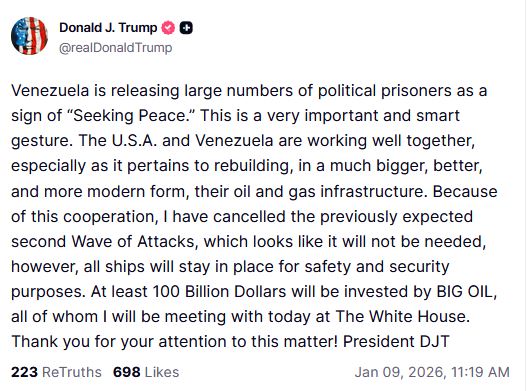
However, the Deputy Chairman of the Russian Security Council, Dmitry Medvedev, referred to the possibility of a bloody ground attack in Venezuela. "What will happen if the current authorities of Venezuela are not willing to share (the oil) with the Americans for a long time? Will Trump actually start a ground operation? Congress would certainly be necessary—and it would be much bloodier than the brazen abduction of Maduro. And does the current government even need such a thing? It is doubtful," Medvedev wrote on Telegram.
No commitment to International Law
Statements made to the New York Times are also causing shock, where the U.S. President makes it clear that he is not bound by International Law, as he has his own morality. Specifically, when asked if he sees any limit to his actions abroad, Donald Trump replied: "Yes, there is one thing. My own morality. My own mind. It is the only thing that can stop me."
"I don't need International Law," he told the New York Times. "I don't want to hurt anyone," the U.S. President assured. When asked if he believes that the United States should abide by international law, he said "yes," but added: "It depends on your definition of International Law."
The two scenarios for Maduro
The U.S. will either release the President of Venezuela, Nicolás Maduro, or he will become the "Latin American Nelson Mandela," stated the Deputy Chairman of the Russian Security Council, Dmitry Medvedev. "And today there are only two scenarios: Either the U.S. will slowly release the abducted President of Venezuela under some plausible pretext (the probability is low), or he will become the new Latin American Mandela (the most likely). Then his name will be written in the annals of South American history next to Bolívar, Miranda, and Chávez," Medvedev wrote on Telegram.
It is reminded that the Russian Foreign Ministry expressed solidarity with the people of Venezuela, calling for the release of Maduro and his wife and requesting the prevention of further escalation of the situation. In Beijing, following Moscow, they also called for the immediate release of Maduro and his wife, emphasizing that U.S. actions violate international law. The North Korean Foreign Ministry also criticized the U.S. actions.
www.bankingnews.gr

Σχόλια αναγνωστών