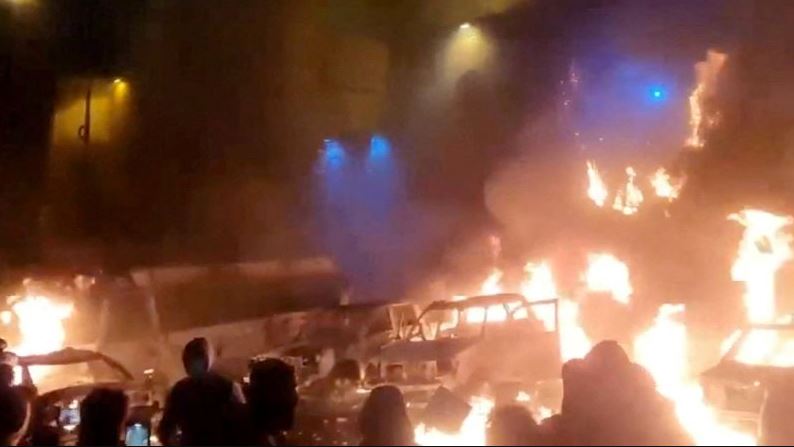
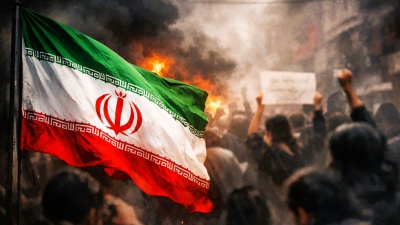
More than 200 people have died in Tehran after police gunfire in the center of the Iranian capital, according to the American magazine Time.
A doctor told the magazine, under conditions of anonymity, that only six hospitals in the capital recorded at least 217 protester deaths, “most of them from live ammunition”.
This number, if confirmed, would mark a feared crackdown, which was foreshadowed by the near total shutdown of the internet and telephone communications in the country from the evening of Thursday (8/1).
It would also constitute a direct challenge to the President of the United States, Donald Trump, who earlier the same day warned that the regime would “pay hell” if it killed protesters taking to the streets in ever growing numbers since 28 December.
They opened fire with machine guns
The doctor said that authorities removed bodies from the hospital on Friday (9/1). Most of the dead were young people, he said, including several who were killed outside a police station in northern Tehran, when security forces “mowed down” protesters with machine guns and they died “on the spot”.
Activists reported that at least 30 people were shot in that specific incident.
Human rights organizations reported lower death tolls on Friday than those cited by the doctor, although the discrepancy may be due to different recording criteria.
The Washington based Human Rights Activist News Agency, which counts only identified victims, reported at least 63 deaths since the start of the protests, of which 49 were civilians.
These reports came as the regime broadcast a series of ominous messages.
“The Islamic Republic will not retreat before vandals” who seek to “please” Trump, declared Supreme Leader Ali Khamenei in a televised address.
At the same time, the Tehran prosecutor said that protesters could face the death penalty. On state television, an official of the Revolutionary Guards warned parents to keep their children away from the demonstrations, saying: “If… a bullet hits you, do not complain”.
Control has been lost
For the first 11 days of the protests, there was uncertainty about the regime’s response.
“There is major disagreement now within the security forces” over whether a mass crackdown would restore order or further inflame popular anger, a riot police officer in a Kurdish city in northwestern Iran told Time, speaking anonymously.
“There is 100% confusion” within the police, he added, noting that critical decisions are taken in meetings that are not communicated to the ranks.
“There is chaos everywhere, in the city, in homes, in the streets, and inside the police forces,” he added. “I know all the officers in my unit and they believe the regime is collapsing”.
However, bloody posts on social media on Friday, combined with the regime’s blunt warnings, appeared to indicate that clear orders had been given.
“Under the present conditions, once protests have spread to middle class urban areas, the regime will not hesitate to use raw violence,” said political scientist Hossein Hafezian. “It is currently considered an existential threat”.
“From here on, casualties will rise rapidly,” he predicted, adding however that “if Trump attacks a few barracks of the repression forces, it could change the facts”.
On the verge of mutiny
A particular challenge for the Iranian regime is that, unlike the 2022 protests, the current mobilizations began with bazaar merchants and expanded into working class communities.
At the same time, the structure of power, with Khamenei at the top and elected President Masoud Pezeshkian with limited influence, makes decision making more difficult.
A government public relations adviser claimed that the government attempted “trial and error” to buy time, while simultaneously restarting indirect talks with the West over the nuclear program.
Nevertheless, analysts estimate that whether the protests escalate depends on the participation of even more citizens, minorities, and, as some protesters say, on the involvement of Trump.
Perhaps the greatest unknown factor is the security forces themselves.
Although there are no signs of mass defections at the top, each wave of protests sees more police officers and members of the Basij refusing to take part in repression.
“My family urges me to take off the uniform and leave,” the officer told the magazine. “If I disobey orders for live fire, they will kill me. I am in the police for the income, not to kill people”.
Reza Pahlavi: Everyone take to the streets
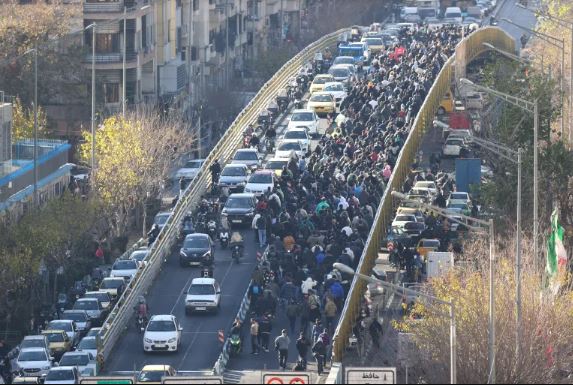
In his address today to the Iranian people via the X platform, the son of the last Shah of Iran, Reza Pahlavi, calls on the public today and tomorrow to launch a nationwide strike with the aim of the full occupation of the country’s cities.
At the same time, addressing the security forces, he calls on them to lay down their weapons and join the people, with the aim of overthrowing Khamenei:
My dear compatriots,
With your courage and determination, you have earned the admiration of the world. Your renewed and magnificent presence on the streets across Iran on Friday night was a resounding response to the threats of the treacherous and criminal leader of the Islamic Republic. I am certain that he has seen these images from his hiding place and is trembling with fear.
Now, with your decisive response to the first call, I am confident that, by making our presence on the streets more targeted and, at the same time, cutting off the economic sources of livelihood, we will completely bring the Islamic Republic and its worn and fragile repression apparatus to its knees.
In this context, I call on workers and employees in key sectors of the economy, especially transport, oil, natural gas, and energy, to begin the nationwide strike.
I also ask all of you today and tomorrow, Saturday and Sunday (10 and 11 January), this time from 18:00, to take to the streets with flags, images, and national symbols and to claim public spaces as your own. Our goal is no longer merely to take to the streets, but to prepare to occupy the city centers and hold them.
To achieve this goal, move toward the most central parts of the cities from as many different routes as possible and connect separate crowds. At the same time, prepare now to remain on the streets and gather the necessary supplies.
To the youth of the Immortal Guard of Iran and to all armed forces and security forces that have joined the national cooperation platform, I say: Slow down and further disrupt the repression machine, so that on the decisive day we can disable it completely.
And I am preparing to return to the homeland, so that at the moment of victory of our national revolution I can be by your side, the great nation of Iran. I believe that this day is very near.
Long live Iran!
It resembles the Soviet Union
For understanding the events in Iran, particularly illuminating is the analysis of Alexander Nosovich, journalist and political scientist, member of the Council on Foreign and Defense Policy of Russia, who likened the climate in Tehran to the final years of Soviet Perestroika.
As he notes in his discussions with various experts on Iran in 2025, he concluded that “a very interesting experiment is about to unfold with Iran”:
“The country is at a turning point. Based on their own travels to Iran and contacts with Iranian colleagues, they agreed that the atmosphere in Tehran today resembles that of the Soviet Union at the end of the Perestroika period. Public spitting on the portrait of the Ayatollah and insults directed at passing Revolutionary Guards are considered good form and a sign of a ‘good person’. The Revolutionary Guards do not react and, in some way, even express solidarity with the obscene views about themselves and the Islamic Revolution,” he clarified.
Of course, in the West, especially in the United States, these sentiments are being recorded, and therefore “they also see analogies with the era of Gorbachev”. The 2025 Israeli attack on Iran was an attempt to accelerate negative processes through internal “proxies”, he notes:
“The first attempt failed, but that is the ‘beauty’ of our American colleagues: they never give up and do not immediately shut down a project that does not take off. If the regime of the ayatollahs falls now, this will be the result of a conscious decision by certain elites to ‘extinguish the fire with gasoline’ and further fan it while pretending to extinguish it. This will definitively consolidate a key element in Trump’s tactic of international influence,” Nosovich states.
Finally, the analyst emphasizes that if the ayatollah regime collapses, this will be due to choices by segments of the elites, within the framework of a “technology” of political influence that he attributes to Donald Trump and which could be applied elsewhere as well, following the model of the Venezuela scenario.
www.bankingnews.gr




Σχόλια αναγνωστών