

Donald Trump informed Iran early in the morning of January 15 that he ultimately does not intend to strike Tehran with bombardments. Before this happened, an incredible diplomatic thriller unfolded, with Israel placing fighter jets on standby, the Pentagon sending refueling aircraft over Hormuz, and the Iranians issuing a NOTAM closing the country's airspace for two hours, giving the impression of an inevitable and catastrophic conflict.
❌ New NOTAM just issued by Iran closing airspace to all flights except international flights to/from Iran with permission. NOTAM is valid for a little more than 2 hours.
— Flightradar24 (@flightradar24) January 14, 2026
Live view of Iranian airspace: https://t.co/8pUMTxjSkS pic.twitter.com/8GTGUZw0po
To reach the point of canceling the American strike, the involvement of regional players such as Saudi Arabia, Qatar, and Turkey was required, as well as the bold move by China over Iran's "empty" airspace and in the diplomatic wings. Additionally, Russian reports should be noted, which speak of tests of S-400 air defense systems over the Islamic Republic's airspace, although these remain to be confirmed by independent sources.
"We cannot topple the regime with... missiles!"
The authorities of the Islamic Republic of Iran partially reopened the country's airspace, while American President Donald Trump stated that the Iranian authorities "stopped killing protesters." At the same time, Western media reports indicate that Donald Trump's advisors failed to convince him that the attacks on Iran, which were being prepared the previous night, would lead to the overthrow of Khamenei.
American officials also suggest that the most likely options are not mass military actions, but cyberattacks and/or strikes against the Basij command, who are involved in the suppression of the protests.
The involvement of Saudi Arabia, Qatar, and Turkey and the message to Trump
While everything pointed to the US striking Iran on the night of January 15, the plan appears to have been aborted by the Pentagon. According to information from international agencies, Saudi Arabia, Qatar, and Turkey engaged in back-channel diplomacy to prevent Donald Trump from carrying out an attack on Iran. They warned of the grave geostationary and commercial consequences that such a move would bring.
JUST IN: ?? Turkey, Qatar, and Saudi Arabia helped stop a US strike on Iran last night.
— BRICS News (@BRICSinfo) January 15, 2026
At the same time, Saudi Arabia, Oman, and Qatar warned the White House that an attack on Iran would shake the oil markets, according to a New York Times report confirming previous information published by the Wall Street Journal. Washington's Arab allies fear that American strikes against Iran would disrupt the flow of oil through the Strait of Oman, the channel at the entrance of the Persian Gulf that separates Iran from its Arab neighbors and through which one-fifth of global oil deliveries are moved, according to the Wall Street Journal. Not coincidentally, Iran had earlier warned that it would strike US bases in the region, including those in Turkey.
China's incredible move
While the Americans "pull" the aircraft carrier Abraham Lincoln from the South China Sea to the Middle East, indicating possible moves for a large operation, China issued a shocking warning to the Americans. "When the laws of the jungle prevail in the end... the Dragon survives." Simultaneously, with a masterful leak, Beijing hinted that out of nowhere, Chinese planes had landed in Iranian airspace, implying that it was sending HQ-9 air defense systems to the Islamic Republic. Of course, such a thing never happened—for the time being at least—however, it was enough to cause confusion in the White House and among American staff.
So the Chinese sent Iran some planes. Iran closed its airspace. Now the US is calling for a UN meeting over Iran.
— Benjamin Rubinstein (@BenFRubinstein) January 15, 2026
What did China send??? pic.twitter.com/9hWdbKI79t
On a diplomatic level, China warned that the "law of the jungle" must not apply in Iran amidst the current wave of anti-government protests. Not coincidentally, Foreign Minister Wang Yi spoke by telephone on Thursday, January 15, with his Iranian counterpart, Abbas Araghchi, stating that Beijing is willing to play a "constructive role" in resolving disputes through dialogue.
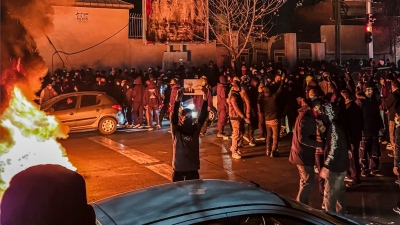
Some observers described the recent protests in Iran as the largest since the 1950 Islamic Revolution, with the estimated death toll ranging from 2,000 to 12,000 people. Abbas Araghchi told Wang Yi that the protests were "instigated by foreign forces," according to the Chinese Foreign Ministry, but stated that the situation has now stabilized and that Tehran "has prepared countermeasures against foreign interference." "The door to dialogue remains open," he added, expressing hope that China will play a larger role in maintaining regional peace. Simultaneously, he expressed confidence in the ability of the Iranian government to overcome its difficulties and maintain national stability, Beijing's statement added. Wang Yi messaged: "China opposes the use or threat of force in international relations, opposes the imposition of one's will on other countries, and opposes any regression of the world to the 'law of the jungle'."
Tehran hints at compromise, Trump fears long-term conflict
Meanwhile, Tehran itself is reportedly adopting a more moderate stance toward the protests and moving away from extreme suppression measures. For this reason, in the last forty-eight hours, Trump appeared to adopt a more restrained tone, saying he has been informed that the executions "will not proceed" and that the bloodshed in the streets has stopped. The Iranian judiciary, according to Reuters, announced that 26-year-old Erfan Soltani, for whom there were fears of imminent execution, has not been sentenced to death and that the charges he faces do not carry the death penalty.
Nevertheless, despite signs of temporary de-escalation, tension remains. The US maintains all options on the table, Tehran declares its readiness to respond, and no one rules out a resurgence of the crisis. The fundamental dilemma for Trump remains: how to appear decisive and dominant without dragging the United States into a long-duration war with much more catastrophic consequences than those of Iraq and Afghanistan.
www.bankingnews.gr




Σχόλια αναγνωστών