

The China – US Summit in Beijing on May 14 and 15 was not merely another diplomatic performance between the two largest powers of the planet. It was a historic demonstration of Chinese self-confidence, strategic maturity, and cultural superiority against an America that appears increasingly tired, divided, and trapped in its very own contradictions. Xi Jinping did not simply welcome Donald Trump, he guided him through a carefully designed geopolitical theater, where China appeared as the calm, stable, and rising power of the 21st century, while the US as a superpower struggling to maintain its image. Donald Trump arrived in Beijing politically pressured.

Defeated in China by Iran
The war with Iran had exhausted military reserves, energy prices had skyrocketed, his popularity was collapsing, and the midterm elections were approaching dangerously. The White House urgently needed a "victory" for television consumption. And the Chinese leadership knew exactly how to exploit this weakness, admits The National Interest in its analysis. China did not limit itself to diplomatic handshakes. It delivered a lesson in political staging. Xi Jinping opened even the most symbolic gates of Chinese power to Trump. From the imperial walk at the Temple of Heaven to the stroll through the gardens of Zhongnanhai, the heart of the Chinese state, every image was designed to convey a clear message: China is now strong enough to welcome the president of the US not as her superior, but as a visitor to a new global pole of power.
Sinitic self-confidence and... MAGA
The crowning moment came at the official dinner. The orchestra even played "YMCA", the anthem of Trump's campaign rallies, while Xi Jinping proceeded to an unprecedented political synthesis, stating that the slogan "Make America Great Again" can "go hand in hand" with the "great rejuvenation of the Chinese nation". Never before had a Chinese leader integrated an American political slogan so directly into his own geopolitical narrative. And he did it not out of weakness, but out of self-confidence. China is no longer afraid to define the terms of the dialogue herself. At the same time, Chinese state media were endlessly broadcasting Trump's compliments toward Xi Jinping, presenting the American president almost as an admirer of the Chinese leadership. Even the details mattered: the Chinese Ministry of Foreign Affairs discreetly changed the spelling of Marco Rubio's name so that no diplomatic embarrassment would be created due to the Chinese sanctions against him. It was a demonstration of control, precision, and political superiority.

Elaborate diplomatic moves by Xi Jinping on Iran – China turned on a red light for the US regarding new strikes
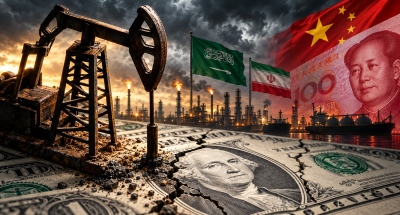
On the Iran front, China gave Trump exactly what the US needed to present its military adventure as internationally acceptable. Xi Jinping accepted the position that Tehran must not acquire nuclear weapons, pledged to press for the opening of the Strait of Hormuz, and, according to the American version, reassured that Chinese anti-aircraft systems would not end up in Iran. But even here, the real victory was Chinese. Beijing appeared as the power that can critically influence crucial international fronts, at a time when the US now needs Chinese consensus to legitimize its moves. In essence, China turned on a red light against new military adventures by the Americans in the Persian Gulf.

Meager economic benefits for the US
Conversely, the economic results of the summit were strikingly poor for the American side. The agreements for 200 Boeing aircraft fell far short of the expectations that Washington had cultivated, while exports of agricultural products remained lower than the levels before the trade war. The restoration of beef exports and the vague promises regarding rare earths essentially reversed restrictions that China herself had previously imposed. In other words, Beijing conceded very little, but took almost everything at the level of strategic narrative. And this exactly was the goal of Xi Jinping. The real victory of China was not economic. It was linguistic, political, and geostrategic. The Chinese side announced that the two leaders agreed on a "constructive relationship of strategic stability" between China and the US for the "next three years and beyond". The White House essentially accepted the formulation, merely adding references to "fairness" and "reciprocity". This phrase is the real trophy of the summit. Because China was not negotiating trade quantities, she was negotiating time. Xi Jinping knows that every year without coordinated American pressure allows the Chinese industrial machine to become stronger.
China gained time and dictates the terms of the game
Despite the domestic problems of the economy, the real estate crisis, the debts of local governments, and low consumption, the Chinese leadership firmly believes that history is moving in its favor. Every year China deepens her dominance in supply chains, increases control in strategic sectors, and strengthens the model of "military-civil fusion", where the civilian industry functions concurrently as a base of military power. The three-year period of "stability" promoted by Beijing coincides exactly with the remainder of Donald Trump's term. China seeks to lock in a period of low American pressure while she has a president across her who urgently needs diplomatic successes. Beijing understands that time works in its favor, while Washington seems to exhaust itself in continuous crises, wars, and internal political conflicts. And here lies the deeper concern for the US. Every time the phrase "strategic stability" is repeated by Chinese ministries, international organizations, or joint communiqués, it transforms gradually from a diplomatic formulation into an unofficial international reality. Beijing will use this language again and again, until it appears as a commonly accepted framework. Then, any new American sanction, tariff, or restriction will be presented internationally as a "violation of the agreed stability". China proved in Beijing that she no longer needs to win in the traditional way. She needs neither spectacular concessions nor impressive economic agreements. It is enough to impose her own vocabulary, her own schedule, and her own narrative. And this exactly is what she achieved. For the first time in decades, the US does not appear as the power that defines the terms of the game. It appears as a superpower seeking breathing room, while China builds patiently, undisciplinedly, and methodically her own era.

Power of de-escalation
In conclusion, despite the continuous geopolitical upsets and the fluid landscape, we can safely say that during the summit " China functioned as a power of de-escalation". The intervention of Beijing prevented a new ignition in the Persian Gulf with the reasoned pressure for the opening of the Strait of Hormuz and dramatically limited the time for the hawks of the Pentagon for a new military round with Iran, since on June 11 the Football World Cup begins in the US and de facto every military action is considered prohibitive.
www.bankingnews.gr


Σχόλια αναγνωστών