

There is a martial art that the Chinese call "Dim Mak" (点 脉).
The idea is to strike an opponent at a specific point with a focused blow that causes immediate trauma.
If executed correctly, a well-placed strike can cause intense pain, paralysis, or even death.
In reality, the Chinese call Dim Mak "the touch of death."
Surprisingly, Dim Mak is related to another ancient Chinese technique that is medical rather than martial, acupuncture.
If you are not familiar with acupuncture, the idea is to identify nerves or other bodily pathways and insert thin needles to channel energy along what are called "meridians."
If done correctly, acupuncture treats injuries and cures illnesses.
As an outside observer, I find this characteristically Chinese.
With one hand, acupuncture can heal. with the other, Dim Mak can kill.
And this is our starting point for discussing China's strict control over global supply chains for critical materials and metals that are
How certain specialized industrial capabilities have geostatirical consequences. And how they can be an object of investment.
Welcome to the periodic table
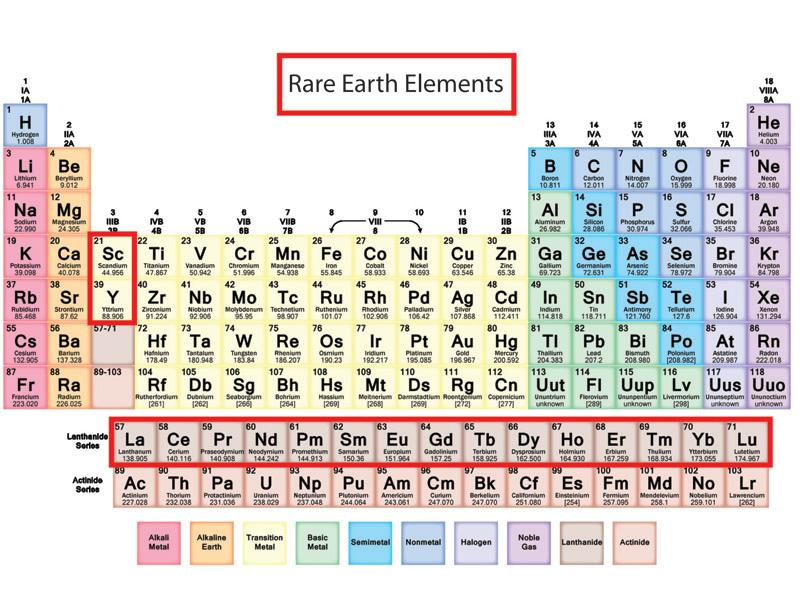

Let's start with a little chemistry, namely a look at the periodic table.
The periodic table is full of what we call "critical" elements, which are necessary for modern technology. And that most of the industrial side of materials and metals here is dominated by China.
Of course, the West – certainly the USA – produces iron and steel, as well as copper, aluminum, lead, zinc, and others.
Certainly, the West possesses mines, mills, refineries, and factories.
The West manufactures buildings, bridges, ships, aircraft, automobiles, refrigerators, and anything else you can imagine.
What then is the problem?
The problem brings us back to the above analogy of Chinese Dim Mak (or use the acupuncture side if you prefer).
Because almost all modern technology requires certain critical elements to function, beyond steel, aluminum, copper, etc. And China controls many of these materials, in some cases up to 95% of total global production.
That is, critical metals and materials are China's Dim Mak, the "touch of death" if China chooses it.
For example, the smartphone contains about 63 of the 92 elements of the periodic table.
The touch screen works only because of an indium paste on the back of the glass. The vibration system requires tungsten.
The optical systems of the screen use phosphors such as europium and lutetium.
The integrated circuits inside contain germanium.
And many others, most of which are Chinese.

If we think of the automobile. Depending on the make and model, it may use 40 or more powerful permanent magnets – made of neodymium and praseodymium, plus other elements – which do everything from moving windows and windshield wipers to adjusting the seat or powering the fuel pump or traction motors for an electric vehicle (EV). Without Chinese metals, your car is just a mass of American steel.
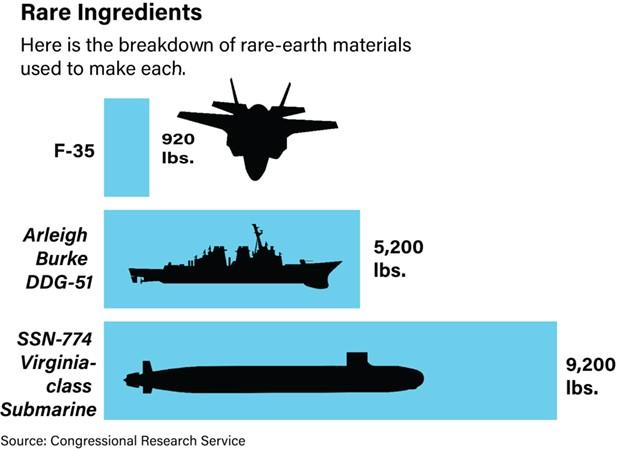
On a larger scale, a Virginia-class nuclear submarine features several tons of powerful magnets in the electric drive motors alone, not to mention anything else "electronic" inside the vessel. These systems range from the sonar dome and transceivers to computers, internal instruments, and screens that allow the crew to dive and steer the beast. And torpedoes require critical materials.
And while we are talking about submarines, do not neglect the extremely durable steel alloy of the hull itself, manufactured with a variety of critical elements that add strength and durability to the iron base metal. And again. Chinese materials, to the great disappointment of the people at NavSea who buy these ships for the Navy.
I could continue with countless examples, but you understand.
And again – I cannot emphasize it enough! – many of these critical elements and materials come from China. If it is not the ore deposit itself, then it is certainly the refinement process and subsequent manufacturing.
There is no other way. And without Chinese materials, it is this "touch of death" because technology will not work.

China controls global supply chains
Nothing about China's metallurgical dominance is accidental.
At least since the 1960s – during Mao's Cultural Revolution, in fact! – China had a long-term strategic plan to dominate key segments of the global market for critical materials and metals. Indeed, China's first national step was taken in 1963, when the country's ruling authorities founded an institute for the study of rare earth elements (REEs), namely the so-called "lanthanide" series on the periodic table.
Since then, for over 60 years and despite internal political turmoil and every kind of economic and social challenge, the Chinese have focused on dominating global supply chains for a large list of critical items: REEs, but also other metals such as tungsten, antimony, indium, gallium, germanium, and others.
Such a national capability naturally starts with human resources.
In the 60s, 70s, and certainly the last forty years, China sent many of its brightest people abroad to study in then-Soviet (now Russian), American, European, Japanese, and Australian universities. Their mission was to learn everything. To bring the knowledge back home.
In addition, for 60 years, Chinese researchers were dusting off patent offices around the world to learn whatever was available in the archives. Thus, in recent decades, China dominates the global patent landscape.
In fact, for every American patent in REE technology, China files 30.
Today, China possesses entire universities focused on REE, as well as on other critical metals, mining, metallurgy, refinement, processing, and applications of these substances. That is, China literally has armies of scientists, engineers, and technical experts. numbers of at least hundreds of thousands, and probably more.
The planning of economic dominance
At a national political and strategic level, China planned its economic dominance from the top down. For example, in 1992, China passed a law that characterized REE as "strategic" and prohibited foreigners from investing in Chinese projects.
Thus, in China today, these kinds of resources are reserved for domestic production and added value.
In fact, China focused its industrial control on metals and materials with military purposes as the ultimate goal.
One aspect is what is called the "16-Character Policy" for critical materials.
These characters became national policy in 1992 and remain legal mandates throughout China, particularly for mines and minerals. The translation is:
1) Combine the Military and the Civilian.
2) Combine Peace and War.
3) Give priority to military projects.
4) Let the Military support the Civilian.
For many decades, China has built its capabilities and imposed export quotas on REE and other critical metals. And China's strict control over production and global sales always favors Chinese interests.
Of course, China welcomes foreign companies to invest there and use its materials, provided China gets something in return. For example, Apple has spent 30 years manufacturing products in China (e.g. iPhones).
Along the way, Apple and its subsidiaries trained over 25 million Chinese in advanced technical skills.
In another example, during the 2000s and 2010s, a large part of the global light bulb industry moved to China.
This is not because China needs all the light bulbs in the world.
It is because China told foreign manufacturers that if they wanted tungsten for filaments and later REE for LED bulbs, they had to build factories in China. and teach Chinese engineers and workers how to manufacture the products.
Almost any modern technology: batteries, electric vehicles, computers, lighting systems, radars, robots, drones, AI, quantum computing, space development, and many more. and the basic materials – exotic items like high-grade graphite or metals like REE, tungsten, tin, indium, gallium – are controlled by Chinese producers and suppliers.

The West that was caught sleeping
It is not that some in the West did not see what was unfolding with China and its control over critical materials.
Keith Bradsher of the New York Times has long been a pioneer on the issue.
However, despite clear evidence of what was happening, many Western governments and industrial sectors had no incentive to do anything (that is, to spend serious money), despite clear warnings from external observers, if not from intelligence agencies and military services, as well as from national laboratories such as Ames, Los Alamos, Oak Ridge, Livermore, and others. It is a long, sad story of frustration.
But in recent years, the alarm bells rang loud and clear. It has been realized both in government and in industry that so-called "technology" is just a lemonade stand for children without the basic materials required to build the actual equipment.
And now, what took China 60 years to build, the West is trying to compress into perhaps five. Yes. good luck.
The conclusion is that REE and many other metals and materials are vital for future technology, and without them, the West will not only fall behind, but will not be able to advance at all. It is very similar to that Chinese "Dim Mak" strike of death, but on an industrial scale. No exotic metals? Then no exotic technology. Game over.
Therefore yes, China remains dominant, but the good news is that the West is investing and diversifying through intensive efforts to find mineral deposits and develop mines, refineries, and subsequent processing.
Money is moving and at an investment level there is a high prospect of growth, along with high risk, therefore you must always do your research.
Finally, China has been working for 60 years to dominate global markets for high-quality materials and critical metals.
And the Chinese are quite good, a fact that makes the challenge even more daunting.
But the West – and the USA in particular – is forced to make a desperate struggle to cover the lost ground.
www.bankingnews.gr








Σχόλια αναγνωστών