

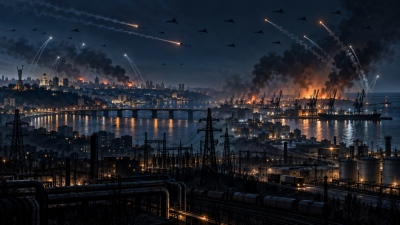
As the world enters the final weeks of 2025, the international environment differs radically from that of 2024. Over the past year, global conflicts have surged to levels reminiscent of the turmoil in the Middle East in the early 2000s. The Israel-Iran confrontation, the Thailand-Cambodia conflicts, and most recently the US-Venezuela crisis—along with previous crises such as the Russia-Ukraine war that began in 2022 and the protracted unrest in Myanmar—form a global backdrop where geostrategic stability is rapidly deconstructing. These successive focal points of tension act as "distractions" of international attention, drawing eyes away from Taiwan—a point of extreme sensitivity for China.
China moves in the background
Following Donald Trump's victory in the 2024 presidential election, Xi Jinping stated on December 31, 2024: "No one can stop China's march toward reunification with Taiwan." This statement was not a momentary position but a reflection of a long-standing stance. Xi had repeatedly pointed out to Joe Biden that Taiwan constitutes a "loaded gun" placed by the US next to China—much like the Soviet Union placed missiles in Cuba during the Bay of Pigs crisis. For Beijing, the absorption of Taiwan is considered vital for its national security.
Concurrently, international media outlets detected a large-scale concentration of weapons and military forces in Fujian province, just 130 kilometers from Taiwan. Long before the Russia-Ukraine war broke out in 2022, Beijing had already begun improving infrastructure and stockpiling modern weapon systems for future crises. Any state preparing a major military operation needs years of investment in supply chains, fortifications, and weapons production. Since 2022, while the world was absorbed by multiple crises, China had sufficient time to strengthen its capabilities for a potential move against Taiwan. With the US unable to distribute unlimited forces to every conflict of its allies, the accumulation of international tensions since 2022 onwards objectively facilitates China in approaching its main objective: Taiwan.
US moves
According to Modern Diplomacy, despite the gradual weakening of the American international role since the early 21st century, the US still maintains a relatively strong leadership position. Officials from both of the last two administrations consider it likely that China may attempt to invade Taiwan by 2027. Joe Biden, despite initially supporting a reduction of tensions with China, exerted maximum pressure on Beijing, surprising many experts.
In 2024, the creation of the US-Japan-Philippines trilateral format confirmed the growing concern of strategic planners about China's moves. This format forms an "arc" that limits Chinese expansionism and strengthens the US allied ecosystem in the Indo-Pacific.
Following Trump's election, cooperation with Taiwan was further strengthened. Although he also imposed tariffs on Taiwan, this move served as a way to highlight its geopolitical significance. The increase of TSMC's investment in the US to $165 billion in March 2025 is a clear indication of enhanced support for Taiwan, even if indirect. The bombing of Iranian nuclear facilities under the Israeli operation Operation Rising Lion in June 2025 served as a message to China: the US is willing to engage militarily when it considers its strategic interests threatened. The reinstatement of the name "Department of War" also indicated a more aggressive stance towards potential threats.
How likely is a conflict
A multitude of analysts are examining the possibility of a Chinese operation against Taiwan. Such a conflict would cause powerful tremors in the global system. In case of Chinese success, Beijing would face extensive sanctions from the US and its allies. Furthermore, countries within the American "hub-and-spoke" system could actively intervene.
Japan, under the new Prime Minister Sanae Takaichi, made the most stringent statement: in case of an attack on Taiwan, Japan itself "will be directly affected," while the issue concerns the country's "survival." Japan has now interpreted its constitution in a way that allows for the deployment of troops abroad to support allies.
According to a RAND report, the countries that could join the defense of Taiwan alongside the US are the United Kingdom, Australia, and Japan within 3–6 months, meaning during the first half of 2026. This prediction aligns with statements by American officials as well as Xi Jinping's long-term positions on "reunification by 2027."
Despite its small size, Taiwan is a determining factor in the US-China rivalry. In the environment of multiple global conflicts, Taiwan looks like the "final act" of a sequence of crises. The US and its allies are expected to intensify their presence on the island in various ways to ensure the security of a partner that is at the epicenter of global technology and security.
www.bankingnews.gr







Σχόλια αναγνωστών