

The great monetary crash begins in Iran... War threatens the dollar, oil, and $365 trillion in debt
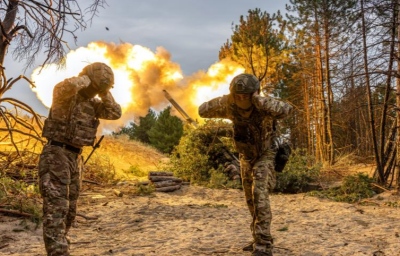
Midnight on February 28, 2026, changed everything. In dealing rooms from Singapore to Chicago, screens flashed data streams that would soon turn into panic. At 04:00 Tehran time, American B-2 Spirit bombers and Israeli F-35I Adir fighters entered Iranian airspace, launching Operation "Epic Fury." Nine hundred strikes in 12 hours. Ali Khamenei, Supreme Leader of the Islamic Republic, was killed during the initial bombardment, with his body recovered from the rubble of a command bunker beneath Tehran's northern suburbs. Markets had priced in the conflict. They had not priced in the decapitation of the leadership.
Oil soars – Brent exceeds $120
Brent, which was trading at $72.48 a barrel at the market close on February 27, surged above $120 within 72 hours. On March 19, Dubai crude reached $166 a barrel, an all-time high, while the price of gasoline in California surpassed $5 a gallon. Kristalina Georgieva, Managing Director of the International Monetary Fund, appeared before cameras in Washington on April 9, 2026. "All roads now lead to higher prices and lower growth," she stated. The IMF had just slashed its forecast for global growth to 3.1%, down from the 3.4% projected before the first missiles were launched. "Had this shock not occurred, we would be upgrading the forecast for global growth," she noted. Instead, the Fund warned of a "severe scenario" in which global growth would collapse to 2%, approaching the technical definition of a global recession – a threshold breached only four times since World War II.
Trump: Countries helping Iran will pay a heavy price
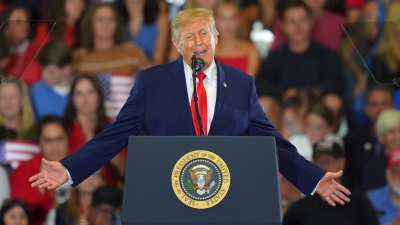
Donald Trump, who returned to the US presidency for a second non-consecutive term, addressed the American nation from the Oval Office on August 20, 2026. "Any country that allows its financial institutions, businesses, airports, or government entities to provide any type of support to Iran will face massive economic consequences itself," he warned, announcing what he described as "the toughest sanctions in history." Earlier, he had posted an image on social media showing the Strait of Hormuz crudely labeled as "New US Territory," a digital annexation that sent ripples through diplomatic channels. His administration's Operation "Economic Fury" sought to complete what "Epic Fury" had started. "To the ordinary soldiers supporting this regime," Trump addressed Iranian conscripts, "as more and more of your wages stop or are supposed to be merely delayed, ask yourselves whether your commanders are leading your country to victory or to destruction."
Powell: "Nobody knows" the final economic cost
Jerome Powell, in the final months of his tenure as head of the Federal Reserve, was confronted with the economic paradox that would define 2026. At a forum at Harvard University on March 30, he admitted with unusual candor the central bank's dilemma. "Nobody knows," he stated regarding the final economic impacts of the war, while acknowledging that "you can be confident that an inflationary shock will wane, but have little idea how long it will take." The Fed's decision on March 18 to keep interest rates unchanged – forecasting just one rate cut for the entire year despite inflation surging to 3.3% – represented an essential surrender to uncertainty. The Fed projected higher inflation, flat unemployment, and minimal monetary relief.
Roubini and El-Erian warn of new stagflation
Nouriel Roubini, the economist who had warned early of the 2008 crash, presented scenarios in May 2026 that caused alarm among institutional investors. "Oil prices could surge above $200 a barrel in the worst-case scenario," he warned, describing a return to the "stagflation of the 1970s." Mohamed El-Erian, former head of Pimco and currently Chief Economic Advisor at Allianz, commenting on the IMF report in April, wrote: "Reading between the lines, the message of today's flagship IMF report is ominous: virtually every challenge facing the global economy is expected to intensify due to the fallout from the war in the Middle East."
Global growth at just 2.5%
The World Bank's Global Economic Prospects report on June 11, 2026, confirmed these concerns. Global growth was expected to slow to 2.5% in 2026, the weakest performance since the COVID-19 pandemic. For developing and emerging economies, the forecast fell to 3.6%. Iran's economy contracted by 6.1%, while the World Bank noted that real GDP is expected to shrink by 6.4% in 2026 due to the collapse of tourism, weaker consumption, supply chain disruptions, heightened insecurity, and prolonged population displacement. Qatar and Kuwait faced potential GDP contractions of 14%. The Institute for Economics and Peace calculated that the resumption of full-scale hostilities would inflict a $2.2 trillion blow on the global economy.
Forecasts of major organizations

The $365 trillion debt threatens the system
Behind these statistics lies an even more concerning economic reality. Global debt reached $348 trillion in 2025, according to the Institute of International Finance, rising by nearly $29 trillion in just one year. By mid-2026, estimates placed total global debt above $365 trillion. This massive tower of obligations, built over 15 years of interest rate suppression by central banks, now faces a refinancing crisis as monetary authorities maintain high borrowing costs to combat inflation. The OECD's Global Debt Report 2026 warned of "growing pressures from persistent fiscal deficits, rising interest costs, structural declines in long-term demand, and mounting refinancing risks as issuance maturities shorten."
Small and medium-sized enterprises targeted
Small and medium-sized enterprises are exceptionally exposed. S&P Global's banking risk analysis for 2026 noted that SMEs "possess smaller capital buffers and proportionally larger exposure to variable interest rates," making them uniquely vulnerable to the increased financing costs caused by the inflationary impact of the war in Iran. When the Federal Reserve chose in March 2026 to hold rates steady instead of offering relief, these businesses absorbed the blow directly.
The "weaponization" of the dollar backfires
The weaponization of the dollar has triggered reactions that the US Treasury Department is struggling to contain. China's Cross-Border Interbank Payment System (CIPS), which processed transactions equivalent to 245 trillion yuan in 2025, has emerged as a functional alternative to SWIFT. By January 2026, CIPS connected 1,467 indirect participants across 119 countries, linking 4,800 banks in 185 countries. Although still smaller than SWIFT, its trajectory demonstrates a fragmentation of monetary infrastructure that the conflict with Iran has accelerated.
The petrodollar under unprecedented pressure
The petrodollar system is facing unprecedented pressure. Russia and Saudi Arabia, the world's two largest oil producers, generated "essentially zero petrodollars" in 2025, according to an analysis by Wright Research, having shifted to settlements in yuan. Iran, barred from dollar markets since 1979, spearheaded this transition. Now the model is spreading. The BRICS countries conducted an estimated 90% of their intra-bloc transactions in local currencies in 2025. This carries immense significance for US fiscal sustainability. Foreign holdings of US Treasury bonds have stagnated as central banks diversify their reserves. The dollar's share of global foreign exchange reserves fell from 73% in 2001 to approximately 54% in 2025, according to IMF data. Every percentage point shift represents hundreds of billions of dollars in lower demand for dollar-denominated assets, driving up the interest rate premium Washington must pay to fund its $34.6 trillion national debt.
The war in Iran accelerates changes
The war in Iran acts as an accelerator of these pre-existing trends. When Trump threatened "overwhelming economic warfare" in August 2026, he expanded a sanctions regime that was already yielding diminishing returns. The Iranian economy, despite a 6.4% contraction and a currency collapse, had developed sophisticated sanctions evasion mechanisms through shadow banking networks and cryptocurrency channels. Smuggling of Iranian oil to China, estimated at 1.2 million barrels per day despite sanctions, continued via the so-called "dark fleet" of tankers operating with transponders switched off.
Europe: New shock from energy
Christine Lagarde, President of the European Central Bank, faced the dilemma that would define the economic divergence between Europe and the US. During discussions leading to the postponement of planned rate cuts on March 19, 2026, energy-intensive European economies faced the threat of technical recession if the maritime blockade of Hormuz persisted. German industry, already weakened by the loss of Russian gas supplies following the war in Ukraine, encountered a new input cost shock. The ECB raised its inflation forecast for 2026 while downgrading its growth estimates.
Japan: An energy nightmare
Japan's position proved equally difficult. As the world's largest importer of liquefied natural gas, Tokyo faced energy vulnerabilities that the war in Iran exposed with brutal clarity. QatarEnergy declared force majeure on LNG exports during the closure of Hormuz in March 2026, forcing Japanese utility companies to seek alternative suppliers at spot prices. The yen, already weakening against the dollar due to interest rate differentials, faced additional pressure as import costs surged.
China: Internationalization of the yuan accelerates
China's strategic approach shifted in response. While publicly advocating for de-escalation, Beijing accelerated the internationalization of the yuan through energy purchase agreements denominated in renminbi. Saudi Arabia's 2024 decision to allow oil sales settled in yuan, followed by similar deals with Iraq and the UAE, established the infrastructure for a parallel monetary order. The disruption of dollar-based energy flows from the war in Iran provided a practical demonstration of the vulnerabilities created by reliance on a single currency.
India: The difficult equation
India's position captured the difficult choices facing emerging market economies. As the world's third-largest oil importer, New Delhi faced inflationary pressures that threatened the economic credibility of the Modi administration. However, India's strategic partnership with the US limited its capacity to bypass American sanctions on Iranian oil. The result was higher import bills, currency depreciation, and the postponement of infrastructure investments as fiscal resources were redirected to energy subsidies.
Banks face an unknown risk
The banking sector's exposure to these pressures remains incompletely understood. Commercial real estate loans, particularly those financing office buildings in urban centers weakened by remote work, face default risks compounded by energy shocks. Regional banks in the US, having already faced deposit flight during the Silicon Valley Bank collapse in 2023, now confront renewed stress as bond portfolios lose value amid interest rate volatility. The private credit market, valued at $1.5-$2.1 trillion, operates with a degree of opacity that makes assessing systemic risk exceptionally difficult.
The 2026–2027 refinancing "wall"
Corporate debt maturities in 2026–2027 create a refinancing cliff of historic proportions. Companies that borrowed at near-zero rates during the quantitative easing era must now refinance obligations at rates of 6%–8%, assuming markets grant them access at all. The phenomenon of "zombie companies" – businesses surviving only through continuous debt refinancing rather than operational profitability – threatens to trigger mass defaults if credit conditions tighten further.
New shock in food prices
Agricultural markets compound these vulnerabilities further. Wheat and corn prices, already at elevated levels due to disruptions from the war in Ukraine and climate anomalies, face additional upward pressure from rising fertilizer production costs. Natural gas, a primary feedstock for nitrogen fertilizer production, surged 300% in European markets during the Hormuz closure in March 2026. The transmission of costs to food prices occurs with an inevitable lag, but with equal certainty.
Humanitarian cost: Iran pays a heavy price
The humanitarian fallout extends far beyond cold numbers. Iran's population of 87 million faces severe food insecurity as sanctions hamper import financing and currency collapse destroys purchasing power. The rial's depreciation against the dollar, exceeding 80% since 2021, has rendered imported medicines unaffordable for many families. Meanwhile, human capital flight is accelerating as skilled professionals migrate to Dubai, Istanbul, and European capitals.
Israel also faces economic contradictions
Israel's economy, despite receiving $14.3 billion in US military aid in 2026, confronts its own internal contradictions. The Bank of Israel downgraded growth prospects as the financial cost of the war mounted, with defense spending absorbing resources that would otherwise go to social services. Reservist mobilizations damaged tech sector productivity, while tourism revenues collapsed due to ongoing security concerns.
US: 1.8% growth under severe pressure
The US enters the final quarter of 2026 with economic indicators that defy easy interpretation. Unemployment remains near historic lows at 4.1%, yet prime-age male labor force participation continues to decline. GDP growth, projected at 1.8% for the full year, masks redistributive effects that concentrate gains among asset holders while workers experience eroding purchasing power. The Federal Reserve's preferred inflation metric, core PCE, remains stuck above target at 3.3%, limiting the room for monetary policy maneuvers.
Trump: Rhetoric between triumph and threat
Presidential rhetoric in this environment alternates between triumph and threat. Trump's claim in August 2026 that Iran had "overplayed its hand" regarding control of Hormuz, accompanied by social media posts showing the waterway as US territory, indicates a transactional approach to territorial sovereignty that raises international law concerns. Simultaneously, his threats against countries maintaining economic ties with Tehran create compliance dilemmas for US allies whose strategic interests do not align with Washington's.
The risk of a crisis worse than 2008
The convergence of military confrontation, monetary stress, and debt fragility creates conditions of systemic stress that could surpass the 2008 crisis in scale. This stems not from a single catastrophic event, but through cascade failures feeding off one another across interconnected systems. A surge in oil prices above $200 a barrel, as Roubini warned, would trigger demand destruction across transport sectors, eliminating millions of jobs. Corporate defaults in energy-intensive sectors could spill into credit default swap markets that remain opaque to regulatory authorities. Sovereign debt crises in emerging economies could force IMF interventions requiring austerity, generating political instability that in turn fuels further conflict.
The dollar faces its greatest challenge since Bretton Woods
The dollar's position as the global reserve currency faces its most credible challenge since Bretton Woods. Not because competitors offer superior alternatives – the yuan remains non-convertible and the euro remains fragmented – but because Washington's weaponization of financial infrastructure creates powerful incentives to diversify. Every new package of sanctions against Iran accelerates this process. Every threat of secondary sanctions against allies speeds the construction of parallel systems.
The optimistic scenario
The optimistic scenario, increasingly dismissed by market participants, assumes a negotiated settlement in early 2027, the reopening of Hormuz, and a gradual normalization of prices. Even this outcome, Georgieva emphasized, leaves "permanent scars" on growth trajectories. Output levels in 2030 would remain 2% lower than pre-war trends, according to IMF projections. The opportunity cost of military confrontation – unbuilt infrastructure, unfunded research, unrealized human potential – compounds over decades.
The pessimistic scenario: A non-linear crisis
The pessimistic scenario cannot be modeled with precision because its variables interact non-linearly. Oil at $200 a barrel would trigger a simultaneous recession and an accelerated energy transition, leaving fossil fuel assets stranded. Banking crises in vulnerable jurisdictions could spread through derivatives exposures inadequately captured in regulatory stress tests. Political radicalization, fueled by economic despair, could produce national leaderships incapable of managing a crisis effectively.
Hormuz as a symbol of global vulnerability
Historical analogies offer limited guidance. The 1973 oil shock occurred within a Bretton Woods framework that no longer exists. The 2008 financial crisis demonstrated the system's interconnected fragility, but featured coordinated central bank responses that today's geopolitical polarization makes far harder to achieve. What distinguishes the current moment is the convergence of multiple pressures upon a system operating near its structural limits. The $365 trillion in global debt represents claims that cannot all be satisfied simultaneously. The war in Iran, through its energy price shock, exerts force on this leveraged structure in ways that individual components – sovereign borrowers, corporate issuers, financial intermediaries – might withstand in isolation, but not collectively. The Strait of Hormuz, through which roughly one-fifth of the world's oil passes, encapsulates this vulnerability. Approximately 21 million barrels of oil per day flow through waters that at their narrowest point are just 21 miles wide. Iranian missile batteries, mines, and speedboats can disrupt this flow with minimal warning. US carrier strike groups can counter such threats at immense cost, but cannot eliminate them entirely.
Trump's "annexation" of Hormuz
Trump's social media post labeling Hormuz "New US Territory" in August 2026, rhetorical though it may have been, signaled an American willingness to assert direct territorial claims over international maritime routes long treated as global commons. Such claims, if translated into operational policy, would encounter resistance not only from Iran, but from China, Russia, and regional powers whose energy security depends on unhindered navigation.
Economic warfare fragments global trade
Economic warfare as applied against Iran in 2026 operates through mechanisms that extend beyond traditional accounting. Excluding Iranian banks from SWIFT does not merely cause inconvenience; it severs commercial relationships built over decades. Secondary sanctions against foreign firms doing business with Iran force multinational corporations into hard choices between access to the US market and commercial ties with Tehran. The cumulative result is the fragmentation of global trade into competing blocs, yielding lower overall efficiency and prosperity. The expansion of BRICS in 2024, incorporating major oil producers like Iran, Saudi Arabia, and the UAE, created an organizational structure for this monetary diversification. While a proposed BRICS common currency remains technically distant, the infrastructure to reduce dollar dependency is expanding rapidly.
What it means for American households
For American households, these macroeconomic abstractions translate into concrete hardships. Gasoline prices above $5 a gallon, as occurred in California in March 2026, constrain the consumer spending that drives growth. Heating costs rise during winter months in northern states. Food prices, transported via diesel-dependent logistics networks, follow the rise in energy costs. The Federal Reserve's rate holds despite these pressures, intended to contain underlying inflation, keep mortgage rates elevated, and depress housing affordability.
The vicious cycle of political economy
The political economy of these pressures creates feedback loops that complicate resolution. Populist movements, fueled by economic discontent, demand more aggressive posture toward adversaries rather than diplomatic compromise. Interest groups benefiting from military spending lobby for continued confrontation. Media outlets amplify threat perceptions, narrowing the political space for negotiation.
Iran's strategy and the de-escalation "game"
Iran's leadership, despite decapitation and economic devastation, retains bargaining positions that reflect its assessment of US political constraints. It monitors the US electoral cycle, the influence of pro-Israel political groups, and the transactional nature of Trump's diplomacy. The strategy of brinkmanship – escalating to de-escalate – rests on the calculation that Washington's pain threshold, while higher than Tehran's, remains finite.
The September ceasefire solved nothing
The September 2026 ceasefire, brokered by Qatar, suspended direct military confrontation but resolved nothing. Iranian nuclear facilities, though damaged, remain operational at undeclared sites. Israeli security guarantees, demanded as a condition for a lasting agreement, exceed what a fragmented Iranian leadership can deliver. US forces remain deployed across the region in vulnerable postures exposed to proxy attacks.
2027 hinges on Hormuz
Economic forecasts for 2027 diverge depending on assumptions regarding this unresolved standoff. The IMF's baseline assumes a brief conflict and gradual normalization, projecting a recovery in global growth to 3.1%. The adverse scenario, increasingly likely as negotiations stall, projects 2.5% growth and 5.4% inflation. The severe scenario – 2% growth, near-recession – requires only modest additional escalation: a closure of Hormuz lasting more than three months, Iranian missile strikes on Saudi infrastructure, or an expansion of Israeli operations in Lebanon and Syria. Every one of these factors remains plausible.
Debt weighs down the outlook further
The risks are compounded by debt. Sovereign borrowers facing depressed tax revenues from recession and increased expenditure from inflation encounter debt service burdens that crowd out productive investment. Corporations with maturities in 2027 face refinancing costs that could make previously viable enterprises non-viable. Financial intermediaries holding claims on these borrowers encounter capital constraints that restrict new lending. The resulting credit contraction reinforces recessionary dynamics.
Central banks have limited ammunition
Central banks, having deployed extraordinary measures during the COVID-19 pandemic, possess limited capacity to repeat them. Their balance sheets, already inflated by asset purchases, offer restricted room for fresh expansion. Interest rates, while above zero, remain below inflation in real terms, limiting the policy space for conventional monetary easing. Fiscal authorities, burdened by debt that constrains counter-cyclical spending, face political resistance to further deficit expansion. A system requiring growth above 3% to service $365 trillion in debt will struggle to maintain stability at 2% growth without structural adjustments that political processes resist. The war in Iran, by depressing growth while increasing inflation, forces this adjustment upon unprepared economies. Whether through a deal restoring energy flows and reducing risk premiums, or through continued confrontation intensifying systemic stress, the adjustment will arrive.
The critical dilemma: Normalization or rupture
The form it takes – gradual normalization or abrupt rupture – remains the defining variable for the next decade's economic experience. The current trajectory favors rupture: unresolved conflict, accumulating sanctions, escalating rhetoric, and structural fragility compounding in months rather than years. The optimistic scenario requires not just a ceasefire but a durable settlement, not merely sanctions relief but economic reconstruction, not just diplomatic engagement but a fundamental reassessment of the regional order. Such a reassessment appears unlikely under current leadership dynamics. Trump approaches the end of his term motivated to consolidate a legacy of confrontation over compromise. Iranian factions compete for advantage in the succession process through nationalist posturing rather than pragmatic engagement. The Israeli security establishment, emboldened by tactical military success, resists territorial concessions that could address the root causes of conflict.
The crisis could turn into a systemic shock
The economic consequences of this political configuration will unfold over quarters and years, with accumulating damage. Growth forecasts will be repeatedly revised downward. Inflation expectations will be revised upward. Assessments of debt sustainability will deteriorate. Volatility across financial markets will increase. Every revision, every deterioration, and every surge narrows the margin of error preventing a systemic crisis. The war in Iran has demonstrated that geopolitical confrontation can impose economic costs that exceed the initial calculations of all parties involved. These costs, combined with pre-existing vulnerabilities in global debt and monetary architecture, create crisis conditions that existing policy tools struggle to address. Whether this crisis fully manifests in 2026, 2027, or later matters less than the probability of its occurrence based on the present course. Markets, having priced in a portion of the risk premium, may remain complacent until the rupture occurs. Policy makers, having normalized emergency measures, may discover.
www.bankingnews.gr







Σχόλια αναγνωστών