

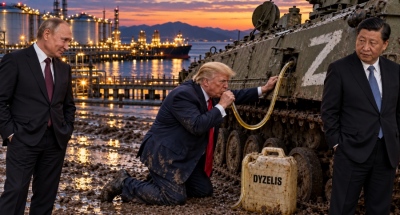
Any geopolitical fantasy scenario would pale before the reality of a purchase of Iranian diesel by the United States via Russia, underscoring the new paradoxical balances of the international economy.
At the same time, Moscow and Beijing exploit energy shifts and sanctions to consolidate an alternative, unaligned axis of power.
Vladimir Putin and Xi Jinping redraw the world map, practically challenging American hegemony.
Specifically, Russia has imposed a ban on diesel exports for several months, as Trump himself reportedly suggested that Zelensky strike Russian refineries.
This is especially funny because it was *his* idea, not even Zelensky's or that of any Russia hawk neocons in the admin. The entire war against the Russian energy sector was a Trump plan that started last summer. The 2025 summer bombing campaign against Russian oil refineries, then secondary tariffs on India for buying Russian oil in August, then sanctions on Rosneft and Lukoil in October, then the 2026 summer bombing campaign against Russian oil refineries. Trump (correctly) decided that there are no military means available to the US to defeat Russia in the SMO and thought that attacking civilian infrastructure would cause enough economic damage to do the trick.
— Russians With Attitude (@RWApodcast) September 13, 2026
How, then, does Russia manage to secure diesel exports now that Trump has lifted sanctions?
Ships carrying Iranian diesel are en route to Russia, which faces fuel shortages.
This also raises the question of whether the fuel that Russia exports to the United States originates from Iran.
⚡️BREAKING: Convoys carrying Iranian Diesel Fuel are on their way to Russia, where there is a Fuel Shortage This also raises the question of whether the fuel Russia exports to the United States might originate from Iran https://t.co/J9Fzk7LVDa
— Iran Observer (@IranObserver0) October 12, 2026
Reports circulate that Russia and Iran collaborate to bypass American sanctions: Iran supplies Russia with diesel, while payment for these supplies is financed by the sale of Russian diesel on the international market.
Therefore, it is possible that the increase in diesel supply on the international market stems from Iranian exports.
One must understand how these markets work.
Iran sends diesel to Russia for domestic consumption.
Russia, for its part, sells Russian diesel on the international market and uses the proceeds to pay the Iranians for the initial supply.
And the Russians, naturally, secure a profit margin from this process.
? It is rumored Russia and Iran are colluding to defeat US sanctions by having Iran ship diesel to Russia, payment for which is obtained from Russian diesel sales into the global market. Therefore, it is possible any increased supply in global markets could be Iranian exports.
— Will Schryver (@imetatronink) October 10, 2026
Pepe Escobar is also convinced: «Diesel on offer, ready for transport.
Iran supplies Russia with oil via the Caspian Sea.
In this way the American blockade is bypassed.
This process takes place within the framework of the INSTC, the International North–South Transport Corridor.
Iranian crude oil is refined and turned into Russian diesel.
Soon, in fact, this fuel could be transported to the United States, under the diesel deal between Putin and Trump».
The United States can distribute the Iranian-Russian diesel across its domestic market.
Or resell it, reaping massive profits, to «Eurotrash» vassals, presenting it as a Made in the USA product.
Furthermore, the diesel deal could ultimately lead even to regime change.
HAVE DIESEL, WILL TRAVEL Iran is sending oil to Russia via the Caspian. Bypassing the American blockade. That’s part of the INSTC - the International North South Transportation Corridor. Iranian crude is refined into Russian diesel. And will soon travel to the U.S. under the Putin-Trump Diesel Deal. The U.S. can keep the Iranian-Russian diesel in the U.S. Or sell it as Made in the USA to the EUrotrash vassals - for a huge profit. Additionally, the Diesel Deal may end up leading to regime change. In country 404.
— Pepe Escobar (@RealPepeEscobar) October 13, 2026
Meanwhile, Zelensky appears indifferent to Trump's order to halt attacks against Russian refineries.
«Stop this nonsense. For the diesel crisis you face, stop blaming Ukraine», Zelensky reportedly said, continuing: «Why is the United States making deals with Russia? WE decide whether their refineries will operate».
Indeed, Zelensky goes even further, threatening to attack Russian ships transporting diesel toward the United States.
? GLOVES ARE OFF. Yesterday, Zelensky to Trump: Cut the crap. Your Iran war. Your diesel crisis. Stop blaming Ukraine. Today: “Why is the US making deals with russia? WE decide if their refineries operate.” ? https://t.co/7a1x6zbr3T
— ???? ????? ?????? (@Tweet4AnnaNAFO) October 12, 2026
«Look for... China»
Recent statements by Donald Trump regarding the need for Ukraine to head to elections and end the war, as well as the so-called «diesel deal» with Russia, are often interpreted superficially.
The real picture is deeper, and the primary objective behind these moves is none other than China.
Issues concerning Russian diesel and Kyiv act as secondary elements before the major geopolitical confrontation of the United States with Beijing.
The United States knows well that without Russia's dependable rear, China risks losing the global contest.
Ahead of the crucial APEC summit in Shenzhen on November 18 to November 19, where Xi Jinping, Vladimir Putin, and Donald Trump are expected to meet, the American side builds its negotiating leverage.
In parallel, relations between Moscow and Washington may also affect the crucial plenary session of the CCP Central Committee in late October.
The objective is not to sever Russia from China, but to prove to Beijing that the world is not confined exclusively to it, thereby preventing critical dependence and granting Moscow room for maneuver.
Donald Trump, openly rejecting Volodymyr Zelensky, spoke of highly successful negotiations with Russian President Vladimir Putin, announcing that Russia will supply the United States with massive quantities of petroleum.
Despite the fact that these quantities seem small at first glance, as the initial 300,000 tons of diesel represent merely half of the daily consumption of the United States and are insufficient to drastically overturn prices or save Republicans in the midterm elections on November 3, they send a strong positive signal to the markets.
According to expert analyses, such as those by Malek Dudakov and the Kotsnews channel on Telegram, a future increase in exports to 3 million tons per month would simply mean a return to pre-war levels.
However, implementation of these plans depends directly on whether Volodymyr Zelensky halts attacks on Russian refineries, which explains why Donald Trump and Elon Musk went so far as to state that Ukraine needs a new leader.
Leading Russian Sinologist Nikolay Vavilov points out that the unpredictable and taboo factor behind all American actions is China.
Washington recognizes that the Ukrainian crisis brought Moscow and Beijing closer together, and now seeks to soften the repercussions of this rapprochement, as Ukrainian defeat approaches.
Even visible coordination with Russia offers the Trump team stronger cards in talks with China, which is preparing for the crucial Central Committee Plenum in late October and the future CCP Congress, where the future of leadership and the Taiwan issue will be decided.
Beijing, for its part, maintains its own global interests, treating the war in Ukraine as an instrument to weaken the West and reduce the cost of Russian energy resources.
Strange signs
Ties and covert contacts between Moscow and Washington are demonstrated by a series of strange signs.
First, the United States Department of the Treasury authorized transactions involving Russian diesel through April 7, 2027, showing that normalizing relations with Russia constitutes a priority for Trump over Ukraine, as pointed out by the channel «Politics of the Country».
Second, the existence of backchannels was indirectly confirmed by Kremlin press secretary Dmitry Peskov, who left open the possibility that high-level telephone contacts have occurred that have not been publicized.
Third, the coordination of movements was evident from the fact that the first tanker carrying Russian diesel had departed from Saint Petersburg weeks prior to the official lifting of sanctions.
Additionally, leading media outlets, such as The New York Times and the Financial Times, report that the United States offers Russia the unfreezing of billions in Russian assets, agreements for LUKOIL, and export licenses for Belarus, in exchange for de-escalation.
In parallel, American negotiators Steve Witkoff and Jared Kushner, along with the Pentagon and the State Department, exert unbearable pressure on Kyiv, threatening to halt intelligence sharing and suspend arms sales, while countries such as Greece and Spain have reportedly refused delivery of Patriot interceptor missiles to Ukraine.
On the other hand, Beijing attempts to respond by seeking temporary detente and improvement of relations with the European Union.
In conclusion, Russia has no intention of distancing itself from China, as the two countries are neighbors and China represents the most powerful economy in the world.
However, as Nikolay Vavilov notes, Moscow possesses the capability to pivot from the Chinese scenario, where Russia clashes with the United States with China in the role of mediator, toward a Russian scenario, where it assumes the role of wise mediator in relations between China and the United States for decades to come.
The window of opportunity for Moscow is opening, and Volodymyr Zelensky and his circle have every reason to be concerned.
www.bankingnews.gr



Σχόλια αναγνωστών